
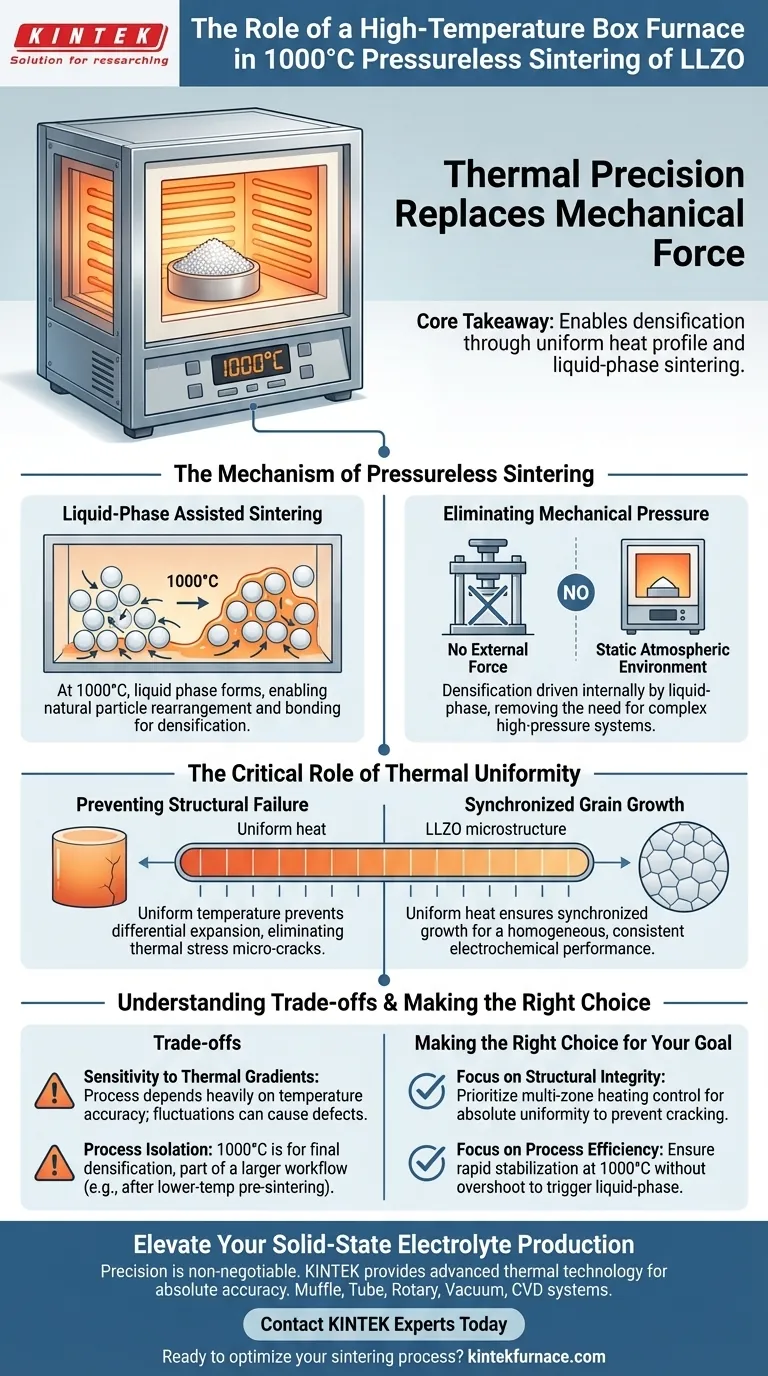
A high-temperature box furnace acts as a precise thermal chamber effectively enabling the densification of Lithium Lanthanum Zirconium Oxide (LLZO) without the need for external mechanical pressure. By maintaining a stable environment at 1000°C, the furnace facilitates liquid-phase assisted sintering, allowing the solid electrolyte to achieve the necessary density and structural integrity through thermal dynamics alone.
Core Takeaway: The furnace's primary function is to replace mechanical force with thermal precision. It creates a uniform heat profile that triggers liquid-phase sintering, ensuring the material densifies evenly while preventing the thermal stress cracks that compromise electrolyte performance.

The Mechanism of Pressureless Sintering
To understand the role of the box furnace, one must look beyond simple heating. It provides the specific conditions required for the material to bond chemically and physically on its own.
Liquid-Phase Assisted Sintering
At the specific setpoint of 1000°C, the LLZO material enters a critical phase. The box furnace maintains this temperature to induce liquid-phase assisted sintering.
In this state, a portion of the material forms a liquid phase which facilitates the rearrangement and bonding of solid particles. This process allows the material to densify naturally, closing pores and increasing the solid volume without the "squeezing" force used in hot-pressing methods.
Eliminating Mechanical Pressure
The distinction of this process is that it is pressureless.
The box furnace provides a static, atmospheric environment. Because the liquid-phase mechanism drives the densification internally, the complex hydraulic systems required for high-pressure hot re-pressing are rendered unnecessary for this specific stage of synthesis.
The Critical Role of Thermal Uniformity
The success of sintering LLZO relies heavily on how evenly heat is applied. The high-temperature box furnace is engineered to minimize thermal gradients across the chamber.
Preventing Structural Failure
LLZO is a ceramic material susceptible to thermal shock. If one part of the sample heats or cools faster than another, differential expansion occurs.
The box furnace ensures temperature uniformity, which is the primary defense against thermal stress. By keeping the thermal environment consistent, the furnace prevents the formation of micro-cracks that would otherwise destroy the electrolyte or severely hamper its ionic conductivity.
Synchronized Grain Growth
For an electrolyte to function correctly, its microscopic grain structure must be consistent.
The uniform heat provided by the furnace ensures that grain growth is synchronized across the entire sample. This results in a homogeneous microstructure, which is essential for consistent electrochemical performance throughout the material.
Understanding the Trade-offs
While the high-temperature box furnace is effective for pressureless sintering, relying solely on thermal parameters introduces specific challenges.
Sensitivity to Thermal Gradients
Because there is no external pressure to force particles together, the process is entirely dependent on temperature accuracy. Any fluctuation or "cold spot" in the furnace chamber can lead to incomplete sintering or localized defects.
Process Isolation
It is important to note that this 1000°C step is often part of a larger workflow. As noted in broader material processing contexts, this stage may follow a lower-temperature pre-sintering step (e.g., at 800°C) used to establish preliminary bonding. The box furnace at 1000°C is specifically targeting final densification, not initial forming.
Making the Right Choice for Your Goal
When configuring your sintering process for LLZO, your equipment settings should align with your specific material requirements.
- If your primary focus is Structural Integrity: Prioritize a furnace with verified multi-zone heating control to guarantee absolute temperature uniformity and prevent cracking.
- If your primary focus is Process Efficiency: Ensure your furnace can reach and stabilize at 1000°C rapidly without overshooting, as this specific temperature triggers the essential liquid-phase mechanism.
The high-temperature box furnace is the enabler of internal chemical bonding, substituting mechanical force with precise thermal control to create a dense, conductive solid electrolyte.
Summary Table:
| Feature | Function in LLZO Sintering (1000°C) |
|---|---|
| Mechanism | Facilitates liquid-phase assisted sintering without mechanical pressure |
| Thermal Profile | Ensures uniformity to prevent thermal stress cracks and micro-defects |
| Grain Control | Synchronizes grain growth for a homogeneous microstructure |
| Atmospheric State | Provides a static environment for natural densification and bonding |
Elevate Your Solid-State Electrolyte Production
Precision is non-negotiable when sintering LLZO at 1000°C. KINTEK provides the advanced thermal technology required to replace mechanical force with absolute thermal accuracy.
Backed by expert R&D and manufacturing, KINTEK offers Muffle, Tube, Rotary, Vacuum, and CVD systems, along with customizable lab high-temperature furnaces designed for your unique material needs. Ensure synchronized grain growth and eliminate structural failure in your ceramics today.
Ready to optimize your sintering process? Contact our experts today to find the perfect thermal solution for your lab.
Visual Guide
References
- Seung Hoon Chun, Sangbaek Park. Synergistic Engineering of Template‐Guided Densification and Dopant‐Induced Pore Filling for Pressureless Sintering of Li<sub>7</sub>La<sub>3</sub>Zr<sub>2</sub>O<sub>12</sub> Solid Electrolyte at 1000 °C. DOI: 10.1002/sstr.202500297
This article is also based on technical information from Kintek Furnace Knowledge Base .
Related Products
- High Temperature Muffle Oven Furnace for Laboratory Debinding and Pre Sintering
- Vacuum Heat Treat Sintering Furnace Molybdenum Wire Vacuum Sintering Furnace
- Molybdenum Vacuum Heat Treat Furnace
- 2200 ℃ Tungsten Vacuum Heat Treat and Sintering Furnace
- 1700℃ High Temperature Laboratory Tube Furnace with Alumina Tube
People Also Ask
- What thermal phenomena occur during polymer binder burnout in ceramic green bodies? Lab Furnace Guide
- Why is controlled heat treatment in a muffle furnace necessary for calcined clay? Achieve Optimal Pozzolanic Activity
- What role does a high-temperature muffle furnace play in STFO synthesis? Achieve Pure Perovskite Results
- How does a high-temperature muffle furnace facilitate the formation of LaNbxAl1−xO3+δ perovskite structures? Key Roles
- What role does a high-temperature muffle furnace play in the multi-stage synthesis of Li0.5MnFe1.5O4? Key to Pure Spinel



















