
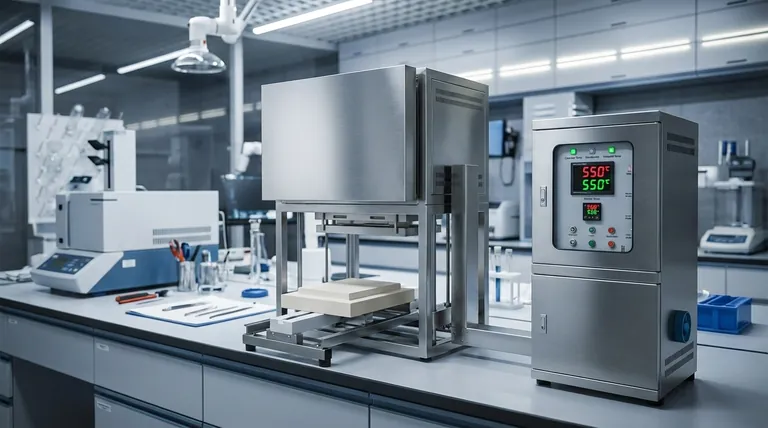
At a glance, the controls simultaneously display the current chamber temperature and the setpoint temperature. This means you can see the real-time temperature inside the unit right next to the target temperature you have programmed.
The simultaneous display of actual (chamber) and target (setpoint) temperatures is a fundamental design choice for effective process control. It provides an immediate, at-a-glance comparison that is crucial for monitoring performance and ensuring operational stability.
The Two Core Temperature Metrics Explained
To effectively operate the equipment, it's essential to understand what each of these values represents and why seeing them together is so important.
The Setpoint Temperature: Your Target
The setpoint is the target temperature you program into the controls. It is the desired state you want the chamber to achieve and maintain.
Think of it as setting the thermostat in your home. You are telling the system what temperature to aim for.
The Chamber Temperature: Your Reality
The chamber temperature is the actual, real-time temperature inside the unit as measured by an internal sensor. This value reflects the current physical conditions of your process.
This is the "ground truth" of your system, telling you what is happening at this very moment.
Why This Dual Display is the Standard
Displaying both values together allows you to instantly see the difference, or "delta," between the target and the reality.
This visual feedback is the most critical piece of information for an operator. It immediately answers key questions: Is the unit heating up correctly? Has it reached temperature? Is it stable?
Interpreting the Display for Operational Insight
The relationship between the chamber and setpoint temperatures provides a live diagnostic of the system's performance and health.
Monitoring System Performance
During a heat-up or cool-down cycle, you should see the chamber temperature progressively moving toward the setpoint.
A large, persistent gap between the two values once the system should have stabilized can indicate a problem, such as a faulty heating element, a compromised door seal, or an overloaded chamber.
Verifying Process Stability
Once the setpoint is reached, the chamber temperature should hover very closely around that value. Minor fluctuations are normal as the controller makes small adjustments.
This simultaneous view allows you to confirm that your process is running under stable, controlled conditions, which is often critical for scientific and manufacturing outcomes.
Aiding in Troubleshooting
When a fault occurs, the display is your first diagnostic tool.
If the chamber temperature fails to rise at all, it points to a heating system failure. If it wildly overshoots the setpoint, it may suggest a controller tuning issue or a faulty sensor.
Making the Right Choice for Your Goal
Use this dual display as more than just a readout; use it as a tool to actively manage your process.
- If your primary focus is starting a new process: Watch the rate at which the chamber temperature approaches the setpoint to understand your system's warm-up time.
- If your primary focus is monitoring an ongoing run: Ensure the chamber temperature remains tightly aligned with the setpoint to verify process stability.
- If your primary focus is troubleshooting a fault: A chamber temperature that is static or moving away from the setpoint is your key indicator that a hardware or control failure has occurred.
By understanding the relationship between these two values, you transform the display from a simple readout into a powerful diagnostic instrument.
Summary Table:
| Temperature Type | Description | Key Insight |
|---|---|---|
| Setpoint | The target temperature programmed by the user | Desired state for the chamber to achieve and maintain |
| Chamber | The real-time temperature inside the unit | Reflects current process conditions for immediate monitoring |
Optimize your lab's thermal processes with KINTEK's advanced furnace solutions! Leveraging exceptional R&D and in-house manufacturing, we provide diverse laboratories with precise high-temperature equipment like Muffle, Tube, Rotary, Vacuum & Atmosphere Furnaces, and CVD/PECVD Systems. Our strong deep customization capability ensures we meet your unique experimental needs for superior control and efficiency. Contact us today to discuss how we can enhance your operations!
Visual Guide

Related Products
- 1400℃ High Temperature Laboratory Tube Furnace with Alumina Tube
- 1800℃ High Temperature Muffle Oven Furnace for Laboratory
- 1700℃ High Temperature Laboratory Tube Furnace with Alumina Tube
- 1700℃ High Temperature Muffle Oven Furnace for Laboratory
- 1700℃ Controlled Inert Nitrogen Atmosphere Furnace
People Also Ask
- How are high-temperature laboratory tube furnaces applied in long-term vacuum homogenization heat treatments for intermetallic samples?
- How do high-temperature laboratory tube furnaces ensure environmental stability? Precision Thermal Reduction Tips
- How are high-temperature tube furnaces applied in testing ceramic-supported alloy membranes? Insights
- What is the mechanism of a high-temperature furnace in Bi-2223 sintering? Achieve Precision Phase Transformation
- What is the function of a furnace in CuAlMn alloy treatment? Achieve Perfect Microstructural Homogenization



















