
For thermal cycling experiments on volcanic rocks, a tube furnace provides two essential environmental conditions: a spatially uniform thermal field and a temporally precise rate of temperature change. Specifically, it creates a sufficient constant temperature zone (e.g., 80 mm) to fully encompass the sample, minimizing longitudinal gradients, while allowing for slow, programmable heating and cooling rates (such as 1°C per minute) to maintain thermal equilibrium and accurately induce micro-cracking.
The core advantage of a tube furnace is the decoupling of thermal stress from thermal shock. By guaranteeing that the entire rock sample experiences the exact same temperature at the exact same time, researchers can attribute physical changes—such as micro-cracking—solely to the intrinsic properties of the rock rather than external heating irregularities.
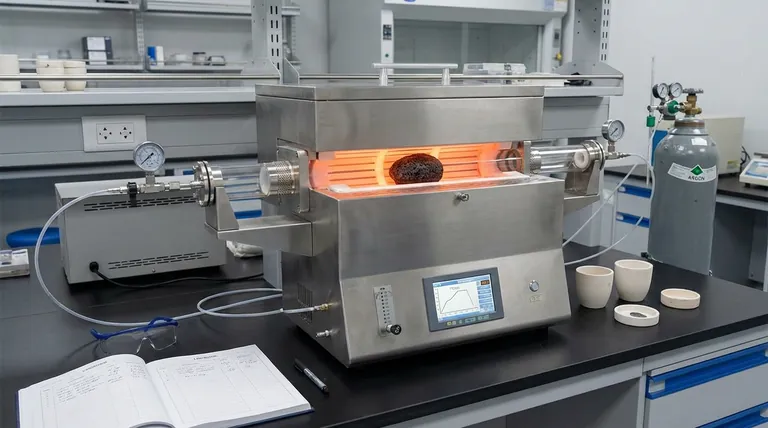
Creating a Homogeneous Thermal Environment
The Constant Temperature Zone
The most critical feature for rock mechanics is the furnace's ability to maintain a constant temperature zone.
In the context of volcanic rock experiments, this zone must be sufficiently long (approximately 80 mm) to completely cover the rock specimen.
Minimizing Longitudinal Gradients
If a rock sample extends outside this uniform zone, different parts of the specimen will experience different temperatures simultaneously.
This creates longitudinal temperature gradients, which introduce artificial stress and skew experimental data regarding thermal expansion and cracking.
Precision Control of Thermal Kinetics
Programmable Rate Control
Tube furnaces are equipped with sophisticated control systems that manage the rate of heating and cooling with high precision.
For volcanic rocks, a slow rate, such as 1°C per minute, is often required to ensure the heat penetrates the low-conductivity rock evenly.
Maintaining Thermal Equilibrium
Rapid heating causes the surface of a rock to expand faster than its core, leading to immediate fracture (thermal shock).
By utilizing the furnace’s precise rate control, researchers maintain thermal equilibrium, ensuring the temperature is uniform throughout the sample's volume at every step of the cycle.
Inducing Micro-Cracks Accurately
The ultimate goal of many volcanic rock experiments is to study weathering via thermal fatigue.
Precise control allows researchers to induce thermal micro-cracks gradually, mimicking natural diurnal or seasonal cycles rather than catastrophic failure events.
Atmospheric Control Capabilities
Exclusion of Oxygen
While the primary focus for rock cycling is thermal control, tube furnaces also offer the ability to strictly control the chemical atmosphere.
Supplementary data indicates that these furnaces can maintain inert atmospheres (using Argon or Nitrogen) to create an oxygen-free environment.
Preventing Mineral Alteration
At high temperatures (e.g., 500°C to 1400°C), certain minerals within volcanic rocks may oxidize if exposed to air.
Using the sealed atmosphere system of a tube furnace prevents these chemical changes, ensuring that observed structural changes are due to thermal stress and not chemical weathering or phase transformation.
Understanding the Trade-offs
Sample Geometry Restrictions
The physical geometry of a tube furnace inherently limits the diameter of the rock sample.
You must ensure your sample is small enough to fit within the tube while still being large enough to be representative of the bulk rock formation.
Time Intensity
Achieving the high precision required for thermal equilibrium comes at the cost of time.
Running cycles at 1°C per minute means a single heating and cooling loop can take many hours, significantly limiting the throughput of the experiment compared to less precise methods.
Making the Right Choice for Your Goal
To maximize the utility of a tube furnace for volcanic rock studies, align the settings with your specific experimental objectives.
- If your primary focus is mechanical weathering mechanics: Prioritize the length of the constant temperature zone to ensure zero longitudinal gradients across the sample.
- If your primary focus is mineralogical purity: Utilize the furnace's gas flow capabilities to maintain an inert atmosphere, preventing oxidation of iron-rich minerals at high temperatures.
Precision in the furnace environment allows you to isolate the variables that truly drive geological change.
Summary Table:
| Feature | Critical Requirement | Impact on Experiment |
|---|---|---|
| Thermal Field | Constant Temperature Zone (≥80mm) | Minimizes longitudinal gradients; ensures sample uniformity. |
| Kinetics Control | Slow Programmable Rates (e.g., 1°C/min) | Maintains thermal equilibrium; avoids artificial thermal shock. |
| Atmosphere | Inert Gas Purging (Argon/Nitrogen) | Prevents mineral oxidation and unwanted chemical alterations. |
| Precision Control | Micro-crack Induction | Mimics natural geological weathering via controlled thermal fatigue. |
Elevate Your Geological Research with KINTEK Precision
Precise thermal cycling is critical for accurate rock mechanics data. Backed by expert R&D and world-class manufacturing, KINTEK offers high-performance Tube, Muffle, Rotary, Vacuum, and CVD systems designed to meet the rigorous demands of laboratory research.
Our furnaces provide the uniform thermal zones and programmable kinetics required to isolate variables and prevent experimental error. Whether you need an oxygen-free environment for mineral stability or a custom tube diameter for specific rock geometries, our systems are fully customizable for your unique needs.
Ready to optimize your thermal experiments? Contact our technical team today to find the perfect furnace solution for your lab.
References
- Luke Griffiths, H. Albert Gilg. Thermal Stressing of Volcanic Rock: Microcracking and Crack Closure Monitored Through Acoustic Emission, Ultrasonic Velocity, and Thermal Expansion. DOI: 10.1029/2023jb027766
This article is also based on technical information from Kintek Furnace Knowledge Base .
Related Products
- Laboratory Quartz Tube Furnace RTP Heating Tubular Furnace
- Vertical Laboratory Quartz Tube Furnace Tubular Furnace
- 1700℃ High Temperature Laboratory Tube Furnace with Alumina Tube
- Split Multi Heating Zone Rotary Tube Furnace Rotating Tube Furnace
- Slide PECVD Tube Furnace with Liquid Gasifier PECVD Machine
People Also Ask
- What physical conditions does a laboratory Tube Furnace provide for SOEC? Precision Heat for Solid Oxide Characterization
- What are the main features and functions of a laboratory tube furnace? Unlock Precise High-Temp Control for Your Lab
- What role does a laboratory tube furnace play in geological and mineralogical research? Unlock Earth's Secrets with Precision
- What conditions do tube furnaces provide for Au-Seeded TiO2 nanowires? Master Precision Thermal Synthesis
- What parameters must be controlled when calcining freeze-dried oxide precursors in a laboratory tube furnace? A Guide



















