
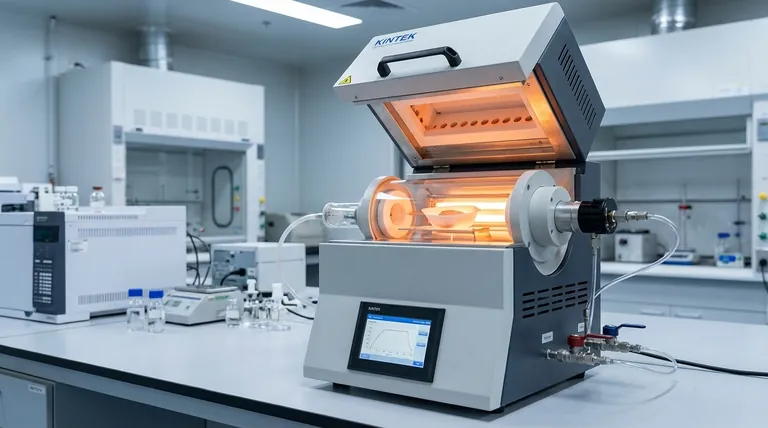
At its core, a quartz tube furnace offers a unique combination of three critical capabilities for high-temperature material processing: precise temperature control, a chemically non-reactive environment, and the ability to directly observe your sample during the process. This blend of control, purity, and visibility makes it an indispensable tool in research and specialized manufacturing.
The true value of a quartz tube furnace isn't just its ability to get hot. It's the power it gives you to create a highly controlled, repeatable, and observable environment, turning a "black box" heating process into a transparent and manageable science.
The Core Advantage: Unmatched Process Control
A furnace is fundamentally a tool for controlling a process. A quartz tube furnace excels by giving you precise command over the two most critical variables: temperature and atmosphere.
Precision Temperature Management
The furnace's heating elements are governed by a PID (Proportional-Integral-Derivative) controller. This system constantly monitors the temperature and makes tiny adjustments to the power output, ensuring the setpoint is held with remarkable stability.
This precision is vital for processes like annealing or crystal growth, where even minor temperature deviations can ruin the final product.
While the ends of the tube are naturally cooler, the central "hot zone" provides a highly uniform temperature environment. This predictable thermal profile is essential for achieving consistent and repeatable results.
Controlled Atmosphere Integrity
The sealed quartz tube allows you to completely control the gaseous environment surrounding your sample. You can evacuate the tube to create a vacuum or fill it with a specific gas.
This is critical for preventing oxidation of sensitive materials by flowing an inert gas like argon or nitrogen. It also enables processes that require a reactive atmosphere, such as chemical vapor deposition (CVD).
The Power of Direct Observation
The transparency of the quartz tube is a simple feature with profound implications. It is arguably the single greatest advantage over opaque ceramic or metallic furnaces.
Being able to see your sample allows you to witness phase transitions, color changes, melting, or sintering in real time. This direct feedback is invaluable for process development, troubleshooting, and fundamental research, saving time and preventing failed runs.
The Practical Benefits of Quartz and Design
The choice of quartz as the tube material and the overall simplicity of the furnace design deliver tangible benefits for daily lab work.
High Purity and Chemical Inertness
Quartz is essentially high-purity fused silica (SiO₂). It is extremely non-reactive and will not contaminate or interact with the vast majority of materials, even at temperatures exceeding 1000°C.
This inertness ensures that the results of your experiment are due to your process variables, not due to unexpected reactions with the furnace chamber itself.
High-Temperature Resilience
Standard quartz tubes are designed for continuous operation at temperatures up to 1100-1200°C (around 2000-2200°F). This capability covers a massive range of common lab applications, including calcination, diffusion, sublimation, and synthesis.
Simplicity and Versatility
Tube furnaces have a simple, robust structure, making them easy to operate and maintain. Their configurable nature allows for different tube diameters and lengths to accommodate various sample sizes and batch requirements.
Their relatively compact, horizontal design also makes them space-efficient compared to many other types of high-temperature equipment.
Understanding the Trade-offs and Limitations
To use a quartz tube furnace effectively, you must also understand its limitations. Objectivity requires acknowledging where this tool may fall short.
Thermal Shock Sensitivity
Quartz is a glass, and like any glass, it is vulnerable to thermal shock. Heating or cooling the tube too quickly will create internal stress and cause it to crack.
You must always adhere to controlled ramp rates for both heating and cooling to ensure the longevity of the tube. This limitation means processes requiring rapid quenching are not suitable for this equipment.
Limited Reaction Compatibility
While highly inert, quartz can be attacked by a few specific substances at high temperatures. Strong alkali materials (like sodium hydroxide), hydrofluoric acid, and phosphoric acid will etch and damage the tube. Always verify the chemical compatibility of your sample with silica.
The Central Hot Zone
The most uniform temperature exists only in the central portion of the tube. Placing samples too close to the ends will result in them being at a lower, less predictable temperature. Accurate and repeatable processing depends on consistent sample placement within this optimal hot zone.
Making the Right Choice for Your Application
Selecting the right equipment hinges on your primary objective. A quartz tube furnace is not just a heater; it is a sophisticated process environment.
- If your primary focus is material synthesis or crystal growth: The combination of direct observation and precise atmospheric control allows you to monitor and fine-tune your process in real time.
- If your primary focus is sample purity and avoiding contamination: The chemical inertness of the high-purity quartz tube is the key benefit that protects your sample from unwanted reactions.
- If your primary focus is process development and optimization: The ability to see your sample react to heat and atmosphere provides invaluable data that dramatically accelerates your learning and troubleshooting cycles.
Understanding these core principles allows you to leverage the quartz tube furnace from a simple heating element to a powerful tool for discovery and innovation.
Summary Table:
| Benefit | Description |
|---|---|
| Precise Temperature Control | PID controllers ensure stable, uniform heating for consistent results in processes like annealing and crystal growth. |
| Controlled Atmosphere | Sealed quartz tube allows vacuum or specific gas environments to prevent oxidation or enable reactive processes like CVD. |
| Direct Observation | Transparent tube enables real-time monitoring of phase changes, melting, and sintering for better process development. |
| High Purity and Inertness | Quartz material is non-reactive, preventing contamination and ensuring sample integrity at high temperatures. |
| High-Temperature Resilience | Operates continuously up to 1200°C, suitable for calcination, diffusion, and synthesis applications. |
| Simplicity and Versatility | Easy to operate and maintain with configurable tube sizes for various sample needs and space efficiency. |
Unlock the full potential of your laboratory with KINTEK's advanced high-temperature furnace solutions! Leveraging exceptional R&D and in-house manufacturing, we provide diverse labs with tailored equipment like Quartz Tube Furnaces, Muffle Furnaces, Vacuum & Atmosphere Furnaces, and CVD/PECVD Systems. Our strong deep customization capability ensures we precisely meet your unique experimental requirements, delivering unmatched control, purity, and efficiency. Don't let process limitations hold you back—contact us today to discuss how our solutions can elevate your research and manufacturing outcomes!
Visual Guide

Related Products
- Laboratory Quartz Tube Furnace RTP Heating Tubular Furnace
- 1200℃ Split Tube Furnace Laboratory Quartz Tube Furnace with Quartz Tube
- Vertical Laboratory Quartz Tube Furnace Tubular Furnace
- Multi Zone Laboratory Quartz Tube Furnace Tubular Furnace
- High Pressure Laboratory Vacuum Tube Furnace
People Also Ask
- What physical conditions does a laboratory Tube Furnace provide for SOEC? Precision Heat for Solid Oxide Characterization
- What are the main features and functions of a laboratory tube furnace? Unlock Precise High-Temp Control for Your Lab
- What role does a laboratory tube furnace play in geological and mineralogical research? Unlock Earth's Secrets with Precision
- What parameters must be controlled when calcining freeze-dried oxide precursors in a laboratory tube furnace? A Guide
- Why is control of heating rate and gas flow in a lab tube furnace critical for EM wave absorption materials?



















