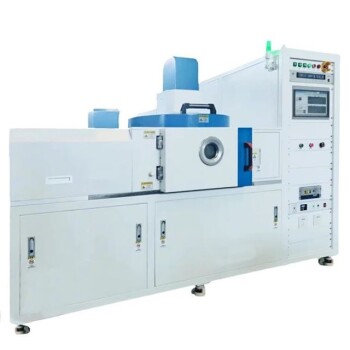
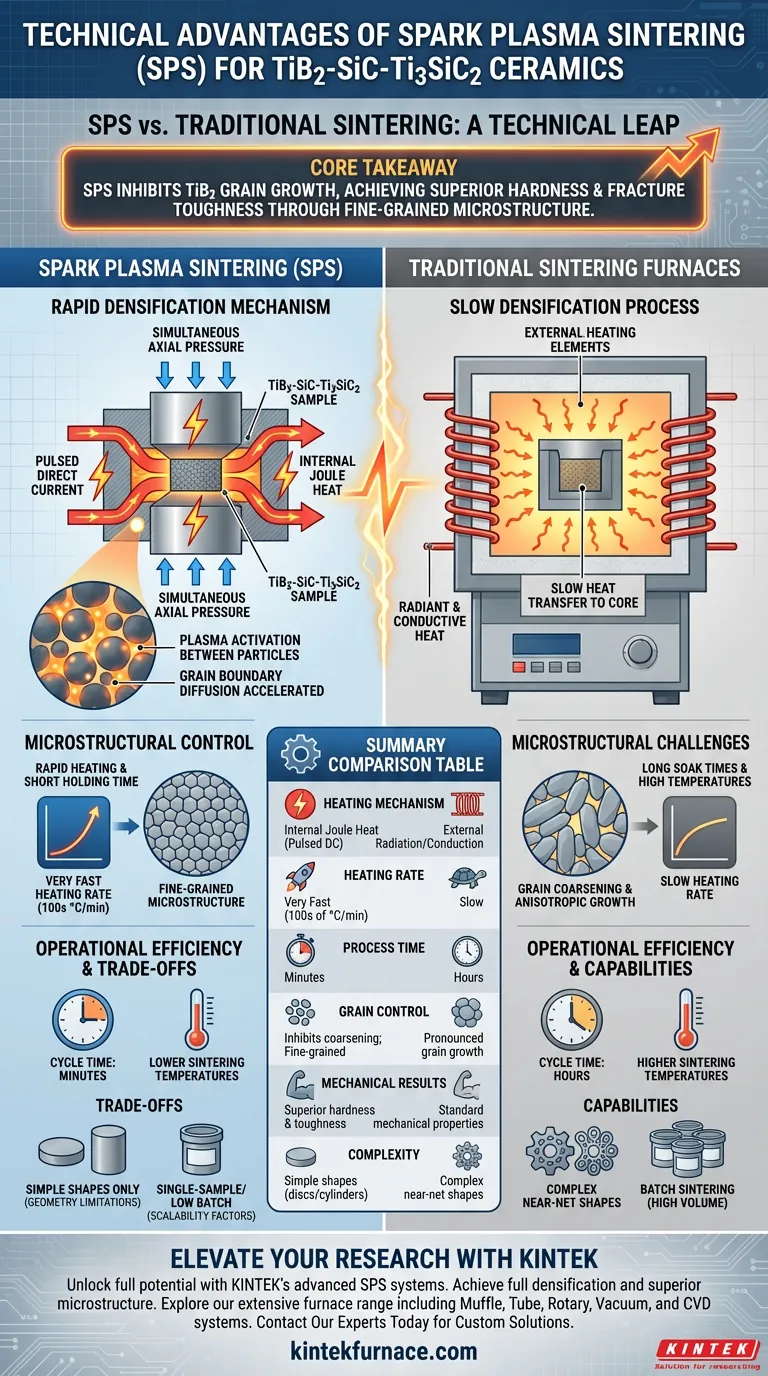
Spark Plasma Sintering (SPS) offers a distinct technical advantage over traditional furnaces by utilizing high-current pulses to generate internal Joule heat combined with simultaneous axial pressure. Unlike conventional methods that rely on external heating elements and long soak times, SPS enables rapid heating rates that densify TiB2-SiC-Ti3SiC2 ceramics before grain coarsening can occur.
Core Takeaway The primary value of SPS for this specific composite lies in its ability to inhibit the anisotropic growth of TiB2 grains. By achieving full densification at lower temperatures with significantly shorter holding times, SPS preserves a fine-grained microstructure, which is the direct driver for superior hardness and fracture toughness.
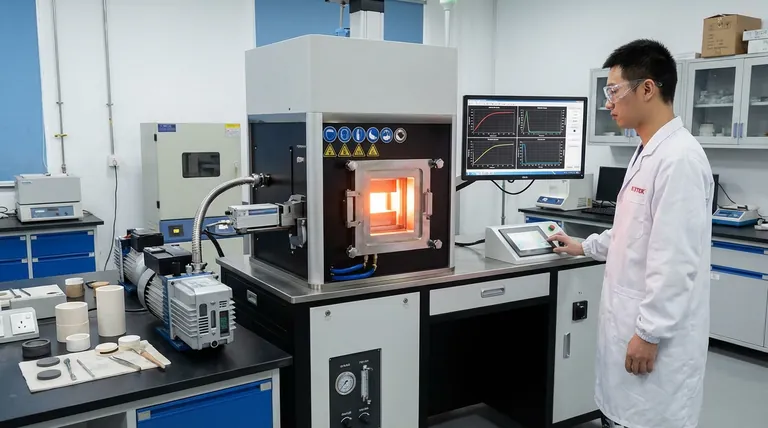
The Mechanism of Rapid Densification
To understand the advantage, you must look at how the heat is delivered to the material.
Direct Volumetric Heating
Traditional sintering furnaces (such as muffle or tube furnaces) use external heating elements. Heat must radiate to the surface of the mold and slowly conduct to the core of the sample.
In contrast, SPS passes pulsed direct current directly through the mold and the sample itself. This generates Joule heat internally. Because the heat is generated from within, the system can achieve heating rates of several hundred degrees per minute.
Simultaneous Pressure Application
SPS is not just about heat; it is a pressure-assisted process. The system applies axial pressure synchronously with the current.
This pressure physically aids in particle rearrangement and densification. It allows the material to reach high relative densities without requiring the extreme temperatures necessary in pressureless sintering.
Plasma Activation
The pulsed current does more than just heat; it creates a "plasma activation effect" between particles. This mechanism significantly promotes grain boundary diffusion, accelerating the sintering process far beyond the capabilities of resistance heating.
Microstructural Control and Performance
For TiB2-SiC-Ti3SiC2 ceramics, the microstructure dictates performance. The technical superiority of SPS is most visible here.
Inhibiting Anisotropic Growth
Titanium Diboride (TiB2) grains have a natural tendency toward anisotropic growth (growing at different rates in different directions) at high temperatures.
In traditional furnaces, the long dwell times required for densification allow TiB2 grains to coarsen and grow effectively unchecked. SPS drastically reduces the time the material spends at these critical grain-growth temperatures.
Preserving Fine-Grained Structure
Because the heating is rapid and the holding time is short, the "window" for grain growth is minimized. The result is a ceramic with a fine-grained microstructure.
Enhanced Mechanical Properties
The relationship between grain size and strength is linear. By locking in a fine grain structure, SPS produces ceramics with significantly higher hardness and fracture toughness. The material effectively bypasses the intermediate temperature zones where structural degradation typically begins.
Operational Efficiency
Beyond material performance, the SPS system offers clear process engineering advantages.
Lower Sintering Temperatures
Because of the combination of internal heating, plasma activation, and applied pressure, full densification occurs at lower overall temperatures compared to traditional hot pressing or pressureless sintering.
Production Throughput
The total cycle time in an SPS system is a fraction of that in a traditional furnace. The ability to heat and cool rapidly significantly improves production efficiency, allowing for faster iteration and higher throughput.
Understanding the Trade-offs
While SPS is technically superior for material properties, it is essential to recognize the constraints of the technology to ensure it fits your application.
Geometry Limitations
Because SPS relies on uniaxial pressure applied through a die (typically graphite), it is generally limited to simple shapes like discs or cylinders. Producing complex, near-net-shape components is far more difficult than with traditional pressureless sintering.
Scalability Factors
Traditional furnaces can often batch sinter hundreds of parts simultaneously. SPS is typically a single-sample or low-batch process. While the cycle time is much faster, the total volume per batch is generally lower, which may impact cost calculations for mass production.
Making the Right Choice for Your Goal
When deciding between SPS and traditional sintering for TiB2-SiC-Ti3SiC2 ceramics, weigh your specific requirements:
- If your primary focus is Maximum Mechanical Performance: Choose SPS. The inhibition of TiB2 grain growth and the resulting high fracture toughness are unmatched by traditional methods.
- If your primary focus is Rapid Prototyping: Choose SPS. The fast cycle times allow you to test multiple variations of temperature and pressure in a single day.
- If your primary focus is Complex Part Geometry: Traditional sintering may be required, as SPS is constrained by the geometry of the pressure die.
SPS is the definitive choice when the structural integrity and mechanical limits of the ceramic are the priority.
Summary Table:
| Feature | Spark Plasma Sintering (SPS) | Traditional Sintering Furnaces |
|---|---|---|
| Heating Mechanism | Internal Joule Heat (Pulsed DC) | External Radiation/Conduction |
| Heating Rate | Very Fast (100s of °C/min) | Slow |
| Process Time | Minutes | Hours |
| Grain Control | Inhibits coarsening; Fine-grained | Pronounced grain growth |
| Mechanical Results | Superior hardness & toughness | Standard mechanical properties |
| Complexity | Simple shapes (discs/cylinders) | Complex near-net shapes |
Elevate Your Material Research with KINTEK
Unlock the full potential of your high-performance ceramics with KINTEK’s advanced Spark Plasma Sintering (SPS) systems. Backed by expert R&D and precision manufacturing, we provide the cutting-edge technology needed to achieve full densification and superior microstructural control for TiB2-SiC-Ti3SiC2 composites and beyond.
Our extensive lab furnace range includes Muffle, Tube, Rotary, Vacuum, and CVD systems, all fully customizable to meet your unique research and production needs. Don't settle for grain coarsening and long cycle times—experience the KINTEK advantage today.
Contact Our Experts Today to Find Your Custom Solution
Visual Guide
References
- I O Poenaru, V Puţan. Research Regarding Advanced Degassing of Steels for Manufacturing Automotive Components. DOI: 10.1088/1742-6596/3153/1/012016
This article is also based on technical information from Kintek Furnace Knowledge Base .
Related Products
- Spark Plasma Sintering SPS Furnace
- Chairside Dental Porcelain Zirconia Sintering Furnace with Transformer for Ceramic Restorations
- 600T Vacuum Induction Hot Press Vacuum Heat Treat and Sintering Furnace
- 9MPa Air Pressure Vacuum Heat Treat and Sintering Furnace
- Dental Porcelain Zirconia Sintering Ceramic Vacuum Press Furnace
People Also Ask
- How does the heating mechanism of Spark Plasma Sintering (SPS) function? Enhance TiC/SiC Composite Fabrication
- Why is it necessary to maintain a high vacuum environment during the SPS of SiC? Key to High-Density Ceramics
- What are the technical advantages of using an SPS sintering furnace? Elevate Al2O3-TiC Material Performance
- What are the steps in the discharge plasma sintering process? Master Fast, High-Density Material Consolidation
- What are the advantages of spark plasma sintering (SPS) over traditional forging? Precision Microstructural Control