
Vacuum pressure control is the fundamental mechanism that enables high-density cemented carbide in Spark Plasma Sintering (SPS) by removing physical and chemical barriers. By maintaining a high vacuum environment (typically around $10^{-2}$ Pa), the process strips away residual gases and surface oxides. This "cleaning" effect is what allows the liquid cobalt binder to flow freely into microscopic gaps, driving densification even without the need for excessive mechanical pressure.
Core Takeaway Achieving full densification in cemented carbide is less about force and more about surface purity. A high vacuum environment prepares the particle surfaces, allowing capillary forces and viscous flow to naturally pull the material into a solid, pore-free state while optimizing elemental distribution.
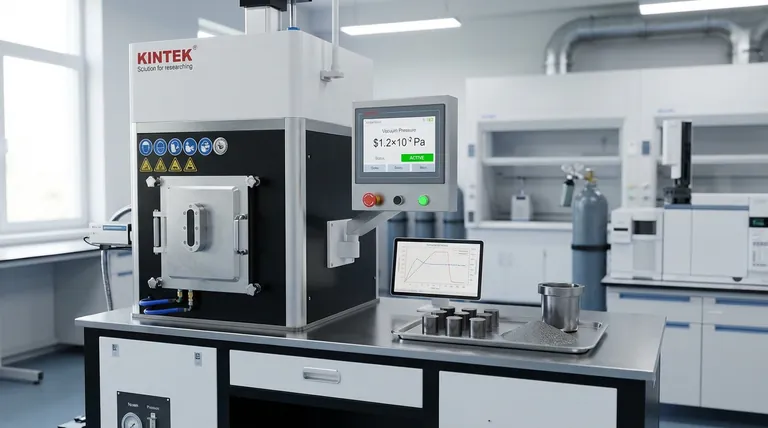
The Mechanics of Vacuum-Assisted Densification
Eliminating Residual Gases
The most immediate physical barrier to densification is trapped air. In a standard atmosphere, gas pockets get caught between powder particles, creating voids that mechanical pressure alone cannot resolve.
Vacuum pressure control removes these residual gases before the sintering temperature creates a sealed structure. This evacuation prevents the formation of porosity, ensuring the final component is solid rather than sponge-like.
Preventing Oxidation
At the high temperatures required for sintering, metallic components are highly susceptible to oxidation. Oxygen reacts with the powder surfaces to form oxide layers.
These oxide layers act as a barrier, preventing particles from bonding. The high vacuum environment prevents this reaction, keeping the particle surfaces "clean" and metallic, which is a prerequisite for strong atomic bonding.
Enhancing Liquid Phase Flow
Triggering Capillary Action
Once the surfaces are cleaned by the vacuum, the liquid binder (typically Cobalt) can interact directly with the Tungsten Carbide (WC) particles.
Because there are no oxides or gases in the way, the liquid cobalt can wet the carbide surfaces effectively. This enables strong capillary action, where the liquid is naturally drawn into the tiny interstices between solid particles.
Facilitating Viscous Flow
The vacuum environment significantly aids viscous flow. This is the mechanism by which the material rearranges itself under heat.
With the liquid phase free to move, it fills particle gaps rapidly. This efficient filling is what allows SPS to achieve high density even if the external sintering pressure is kept relatively low.
Optimizing Microstructural Formation
Promoting Element Migration
Beyond simple densification, vacuum pressure control influences the chemical behavior of the alloy. It specifically promotes the migration of inhibiting elements like Vanadium (V) and Chromium (Cr).
Forming Segregation Layers
Under high vacuum, these elements migrate effectively toward the Tungsten Carbide grain boundaries.
This migration creates segregation layers that are critical for the material's performance. These layers help control grain growth and reinforce the boundaries, leading to a microstructure that is not only dense but also mechanically superior.
Operational Considerations
The Necessity of High Vacuum
It is not enough to simply have "some" vacuum; the specific level matters.
The primary requirement is maintaining a pressure level near $10^{-2}$ Pa. If the vacuum is insufficient, adsorbed gases and volatile impurities remain on the powder surface, compromising the integrity of the grain boundaries.
Balancing Pressure and Temperature
While vacuum aids the process, it must work in concert with temperature.
The environment relies on the vacuum to prevent oxidation, but it still requires temperatures sufficient to melt the cobalt phase. The advantage of SPS is that the vacuum allows these mechanisms to work efficiently without requiring extreme external mechanical pressures to force the particles together.
Strategies for Process Optimization
To get the most out of your SPS process, align your vacuum settings with your specific material goals:
- If your primary focus is Maximum Density: Ensure your vacuum system can reliably hold $10^{-2}$ Pa to fully activate capillary action and viscous flow for gap filling.
- If your primary focus is Microstructural Stability: Utilize the high vacuum environment to facilitate the migration of Vanadium and Chromium to grain boundaries, which enhances the material's toughness.
Ultimately, vacuum pressure is not just a protective measure; it is an active processing tool that replaces mechanical force with chemical cleanliness to achieve superior material density.
Summary Table:
| Mechanism | Impact on Densification | Material Benefit |
|---|---|---|
| Gas Removal | Eliminates trapped air pockets | Prevents porosity and voids |
| Oxide Prevention | Maintains clean metallic surfaces | Ensures strong atomic bonding |
| Capillary Action | Enhances liquid cobalt wetting | Enables natural pore filling |
| Element Migration | Promotes V and Cr segregation | Controls grain growth and toughness |
| Vacuum Level | High vacuum ($10^{-2}$ Pa) | Optimizes viscous flow and purity |
Maximize Your Material Density with KINTEK
Unlock the full potential of your Spark Plasma Sintering (SPS) processes with precision-engineered equipment. Backed by expert R&D and manufacturing, KINTEK offers high-performance Muffle, Tube, Rotary, Vacuum, and CVD systems, as well as other lab high-temperature furnaces—all fully customizable to meet your unique sintering requirements.
Whether you are refining cemented carbides or developing advanced ceramics, our systems provide the vacuum stability and temperature control necessary for peak performance. Contact us today to find your custom solution.
References
- Hao Jiang, Zhiwei Zhao. Effect of Metal Elements on Microstructure and Mechanical Properties of Ultrafine Cemented Carbide Prepared by SPS. DOI: 10.3390/molecules29071678
This article is also based on technical information from Kintek Furnace Knowledge Base .
Related Products
- Spark Plasma Sintering SPS Furnace
- 9MPa Air Pressure Vacuum Heat Treat and Sintering Furnace
- Vacuum Heat Treat Sintering Furnace with Pressure for Vacuum Sintering
- 600T Vacuum Induction Hot Press Vacuum Heat Treat and Sintering Furnace
- Small Vacuum Heat Treat and Tungsten Wire Sintering Furnace
People Also Ask
- How does the heating mechanism of Spark Plasma Sintering (SPS) function? Enhance TiC/SiC Composite Fabrication
- Why is it necessary to maintain a high vacuum environment during the SPS of SiC? Key to High-Density Ceramics
- What are the technical advantages of using an SPS sintering furnace? Elevate Al2O3-TiC Material Performance
- What are the steps in the discharge plasma sintering process? Master Fast, High-Density Material Consolidation
- What are the advantages of spark plasma sintering (SPS) over traditional forging? Precision Microstructural Control



















