
The primary advantages of a downdraft fixed-bed reactor for biomass and plastic co-gasification are its inherent ability to produce clean syngas, its operational simplicity, and its cost-effectiveness. The specific "downdraft" configuration forces gases through a high-temperature zone, effectively solving the issue of tar contamination that plagues many other gasification methods.
Core Takeaway: The downdraft fixed-bed reactor is the superior choice when syngas purity is the priority. Its internal architecture utilizes a hot charcoal bed to naturally crack tars before they exit the system, delivering a cleaner product with significantly lower operating complexity than alternative designs.
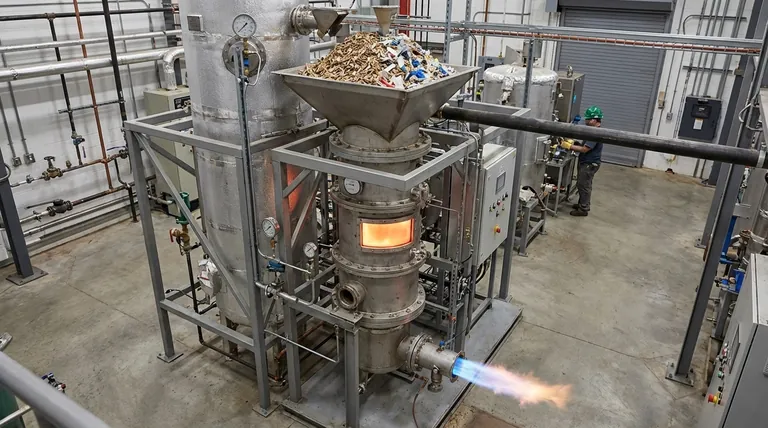
Solving the Tar Challenge: The Quality Advantage
The most critical technical advantage of the downdraft reactor is its ability to minimize impurities in the final gas output.
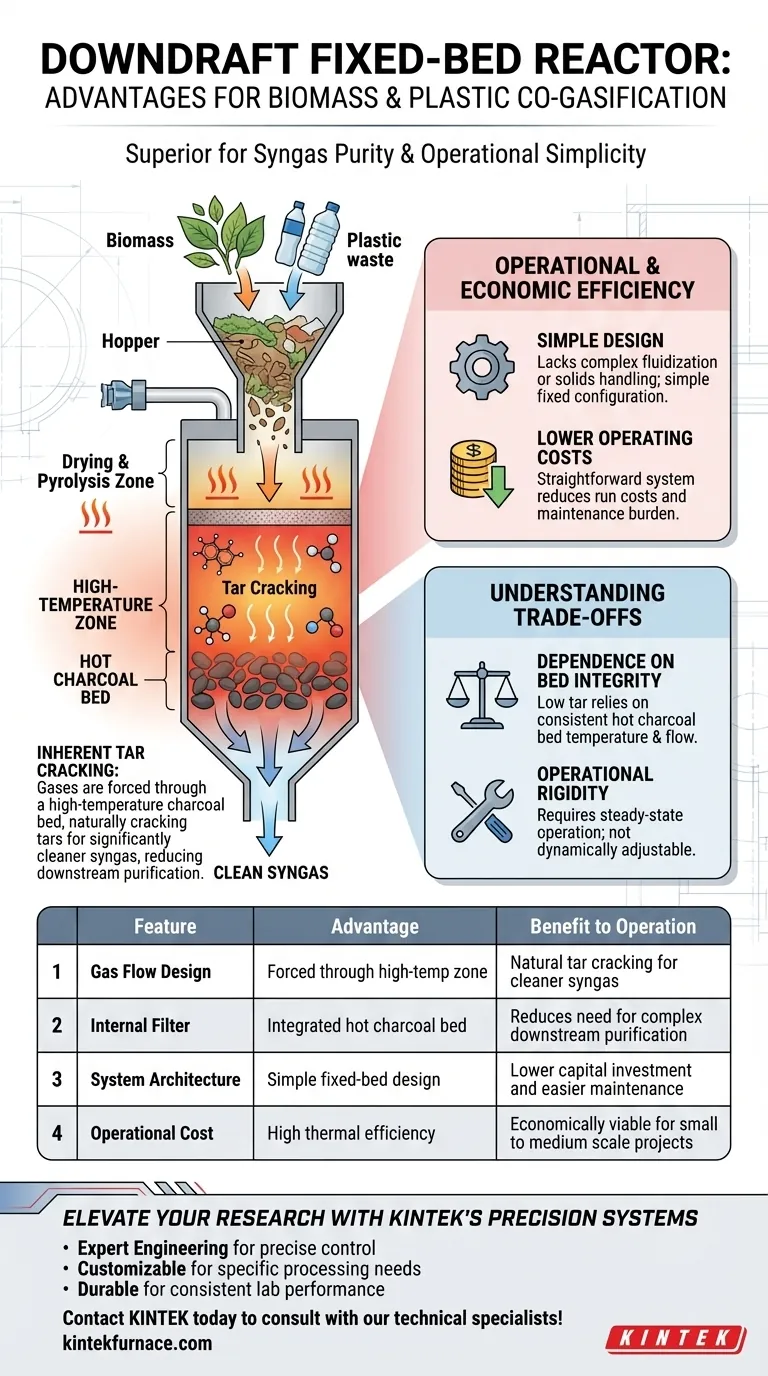
The Mechanism of Tar Cracking
In a downdraft configuration, the produced gases are not allowed to exit immediately. Instead, they are forced to pass downward through a high-temperature zone.
The Role of the Hot Charcoal Bed
This high-temperature zone consists of a hot charcoal bed. As the gas moves through this bed, the charcoal acts as both a thermal and chemical agent.
Significantly Cleaner Syngas
The heat and contact with the charcoal promote the cracking of tars. This breaks down heavy, problematic contaminants into useful combustible gases, resulting in a significantly cleaner syngas that requires less downstream purification.
Operational and Economic Efficiency
Beyond the chemistry, the physical design of the reactor offers distinct project management benefits.
Design Simplicity
The downdraft fixed-bed reactor is preferred for its simple design. It lacks the complex fluidization machinery or intricate solids handling systems required by fluidized bed or entrained flow reactors.
Lower Operating Costs
Because the design is straightforward, the system is generally less expensive to run. The low operating costs make it an attractive option for projects where budget constraints or ease of maintenance are key factors.
Understanding the Trade-offs
While the downdraft reactor excels in purity and simplicity, it is important to recognize the operational constraints inherent in its design.
Dependence on Bed Integrity
The system's primary advantage—low tar—is entirely dependent on the hot charcoal bed. If the bed temperature fluctuates or the flow through the bed becomes uneven, the tar-cracking efficiency will drop immediately.
Operational Rigidity
The "simple design" implies a fixed configuration. Unlike more complex reactors that can be dynamically adjusted, a fixed-bed system relies on consistent feed and steady-state operation to maintain the charcoal bed's effectiveness.
Making the Right Choice for Your Goal
When evaluating reactor types for co-gasification, align the reactor's strengths with your specific project constraints.
- If your primary focus is Syngas Quality: Select the downdraft reactor to leverage the hot charcoal bed for maximum tar reduction and cleaner output.
- If your primary focus is Budget and Maintenance: Choose this reactor for its simple design and low operating costs, which reduce the burden on technical staff and capital expenditure.
By prioritizing the downdraft configuration, you effectively use the process's own byproducts (charcoal) to purify the result, creating a highly efficient loop for co-gasification.
Summary Table:
| Feature | Advantage | Benefit to Operation |
|---|---|---|
| Gas Flow Design | Forced through high-temp zone | Natural tar cracking for cleaner syngas |
| Internal Filter | Integrated hot charcoal bed | Reduces need for complex downstream purification |
| System Architecture | Simple fixed-bed design | Lower capital investment and easier maintenance |
| Operational Cost | High thermal efficiency | Economically viable for small to medium scale projects |
Elevate Your Research with KINTEK’s Precision Systems
Are you looking to optimize your co-gasification process or material synthesis? KINTEK provides industry-leading lab equipment tailored for high-performance thermal applications. Backed by expert R&D and manufacturing, we offer high-temperature Muffle, Tube, Rotary, Vacuum, and CVD systems—all fully customizable to meet your unique research specifications.
Our value to you:
- Expert Engineering: Systems designed for uniform heating and precise control.
- Customization: Flexible configurations for specific biomass and plastic processing needs.
- Durability: Robust construction for consistent, long-term laboratory performance.
Contact KINTEK today to consult with our technical specialists and find the perfect high-temperature solution for your lab!
Visual Guide
References
- Mariana Busto, Carlos R. Vera. Catalytic and Non-Catalytic Co-Gasification of Biomass and Plastic Wastes for Energy Production. DOI: 10.3390/catal15090844
This article is also based on technical information from Kintek Furnace Knowledge Base .
Related Products
- Electric Rotary Kiln Small Rotary Furnace Biomass Pyrolysis Plant Rotating Furnace
- Slide PECVD Tube Furnace with Liquid Gasifier PECVD Machine
- Custom Made Versatile CVD Tube Furnace Chemical Vapor Deposition CVD Equipment Machine
- Laboratory Quartz Tube Furnace RTP Heating Tubular Furnace
- Inclined Rotary Plasma Enhanced Chemical Deposition PECVD Tube Furnace Machine
People Also Ask
- What are the main applications of a rotary kiln electric furnace? Achieve Uniform Heat Treatment for Powders
- What are the key components of a rotary kiln electric furnace? Unlock Efficient Thermal Processing
- What is the significance of the refractory lining in a rotary kiln electric furnace? Unlock Efficiency and Longevity
- What is the benefit of adjustable speed control in rotary kilns? Optimize Efficiency and Quality
- What are the main advantages of using rotary kilns for bulk solids processing? Achieve High-Volume, Uniform Thermal Processing






