
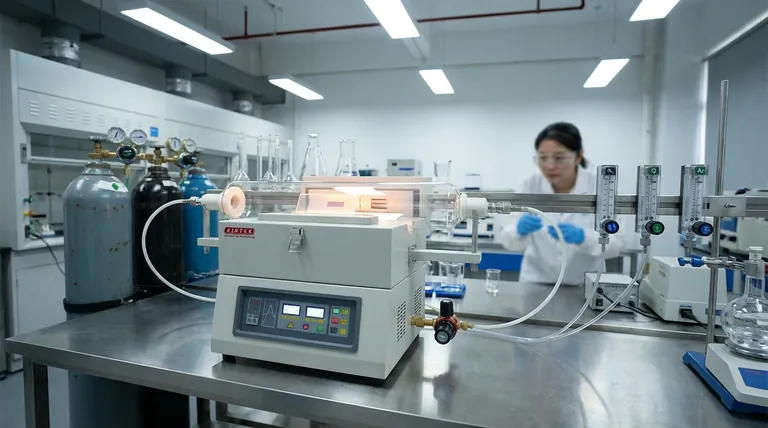
The primary advantage of using an atmosphere-controlled tube furnace for annealing FTO (Fluorine-doped Tin Oxide) thin films is the ability to precisely regulate the gas environment during the thermal treatment. By strictly controlling the oxygen partial pressure within the chamber, researchers can fine-tune the material's non-stoichiometric ratio, which is the critical factor defining its performance as a transparent conductive oxide.
Core Takeaway The performance of FTO thin films relies on a delicate balance between electrical conductivity and optical transparency. An atmosphere-controlled tube furnace enables the specific modulation of oxygen vacancies, allowing you to optimize this balance far more effectively than standard air annealing.
Optimizing Optoelectronic Performance
Precise Regulation of Oxygen Vacancies
The conductivity of FTO films is largely dependent on the concentration of oxygen vacancies within the lattice. An atmosphere-controlled tube furnace allows you to introduce specific gases—such as inert gases, oxygen, or reducing mixtures—to dictate the oxygen partial pressure.
This control enables the creation of a specific non-stoichiometric ratio in the film. By manipulating this ratio, you effectively tune the carrier transport characteristics of the semiconductor without relying solely on the initial doping concentration.
Balancing Conductivity and Transmittance
There is often a trade-off in transparent conductors: increasing conductivity can inadvertently decrease light transmission. The tube furnace provides the environmental stability needed to decouple these properties to a certain extent.
By optimizing the annealing atmosphere, you can achieve high electrical conductivity while maintaining high light transmittance. This results in a higher-performance electrode suitable for photovoltaics and other optoelectronic applications.
Enhancing Structural Integrity
Promoting Crystallization and Grain Growth
While atmosphere control is the differentiator, the tube furnace also provides the thermal activation energy required to transition the film from a quasi-crystalline to a high-quality polycrystalline state.
The stable thermal field within the tube facilitates atomic diffusion. This promotes grain growth and reduces the density of grain boundaries, which are often sites for electron scattering that degrade performance.
Facilitating Lattice Substitution
Effective FTO performance requires fluorine atoms to successfully replace oxygen atoms within the tin oxide lattice. The controlled thermal environment of the tube furnace supports this substitution process.
Simultaneously, the annealing process helps repair lattice distortions and eliminates internal stresses generated during the initial deposition (such as sputtering). This leads to significantly improved crystallinity and lower electrical resistivity.
Understanding the Trade-offs
Sample Geometry Limitations
While tube furnaces offer superior atmosphere control, the cylindrical geometry of the processing tube limits the size and shape of the FTO substrates you can treat. Unlike box furnaces, which can accommodate larger or oddly shaped batches, tube furnaces are generally restricted to smaller samples that fit within the tube's diameter.
Throughput vs. Precision
Tube furnaces are optimized for precision rather than volume. If your primary goal is mass production of large-area glass panels, the limited hot zone and batch size of a standard laboratory tube furnace may be a bottleneck compared to continuous belt furnaces or large-chamber box furnaces.
Making the Right Choice for Your Goal
To maximize the utility of an atmosphere-controlled tube furnace for your FTO films, consider your specific performance targets:
- If your primary focus is maximizing conductivity: Utilize a reducing or inert atmosphere to increase oxygen vacancies, which acts as an n-type dopant source.
- If your primary focus is maximizing optical transparency: precise control of oxygen partial pressure is required to prevent "darkening" of the film caused by excessive metallic tin reduction while ensuring the film remains stoichiometric enough to be clear.
The tube furnace is not just a heating element; it is a chemical reaction chamber that defines the final electronic structure of your material.
Summary Table:
| Feature | Advantage for FTO Thin Films | Impact on Performance |
|---|---|---|
| Atmosphere Control | Precise regulation of oxygen partial pressure | Fine-tunes carrier density and non-stoichiometry |
| Thermal Stability | Uniform heating and atomic diffusion | Promotes crystallization and reduces grain boundaries |
| Lattice Substitution | Facilitates fluorine-to-oxygen replacement | Lowers electrical resistivity and repairs distortions |
| Controlled Environment | Decouples conductivity from transmittance | Optimizes balance between transparency and resistance |
Elevate Your Material Research with KINTEK
Precision is non-negotiable when engineering next-generation FTO thin films. At KINTEK, we empower researchers with advanced Atmosphere-Controlled Tube Furnaces designed to deliver the rigorous environmental stability required for high-performance transparent conductive oxides.
Backed by expert R&D and manufacturing, KINTEK offers Tube, Muffle, Rotary, Vacuum, and CVD systems, all fully customizable to meet your unique laboratory needs. Whether you are optimizing photovoltaics or scaling optoelectronic prototypes, our high-temperature solutions provide the control you need to succeed.
Ready to optimize your annealing process? Contact KINTEK today to discuss your custom furnace requirements!
References
- Paweł Lejwoda, Maciej Thomas. Recovery of Cerium Salts from Sewage Sludge Resulting from the Coagulation of Brewery Wastewater with Recycled Cerium Coagulant. DOI: 10.3390/ma17040938
This article is also based on technical information from Kintek Furnace Knowledge Base .
Related Products
- Controlled Inert Nitrogen Hydrogen Atmosphere Furnace
- 1200℃ Controlled Inert Nitrogen Atmosphere Furnace
- 1400℃ Controlled Inert Nitrogen Atmosphere Furnace
- Mesh Belt Controlled Atmosphere Furnace Inert Nitrogen Atmosphere Furnace
- 1700℃ Controlled Inert Nitrogen Atmosphere Furnace
People Also Ask
- How does hydrogen furnace annealing assist in preparing mechanically alloyed powders for compaction?
- How does atmospheric annealing in a controlled hydrogen furnace affect the cold compaction behavior of metal powders?
- What are the characteristics and uses of hydrogen atmospheres in furnaces? Unlock Clean Metal Processing
- What are the characteristics and uses of hydrogen atmosphere in furnaces? Achieve Superior Surface Purity and Bonding
- What controlled-atmosphere furnace conditions are required for sintering powder metallurgy copper alloy compacts? Ideal Setup



















