Vacuum Spark Plasma Sintering (SPS) fundamentally outperforms traditional methods through direct volumetric heating. By utilizing pulsed electric current to heat the sample from the inside out, SPS achieves exceptionally high heating rates and full densification in minutes rather than hours. This rapid processing suppresses abnormal grain growth, resulting in TiB2-SiC composites with superior hardness and fracture toughness.
The decisive advantage of SPS lies in its ability to decouple densification from grain growth. By achieving full density through rapid heating before grains can coarsen, it produces a fine-grained microstructure that significantly enhances mechanical performance compared to traditional high-temperature furnaces.
The Mechanics of Rapid Densification
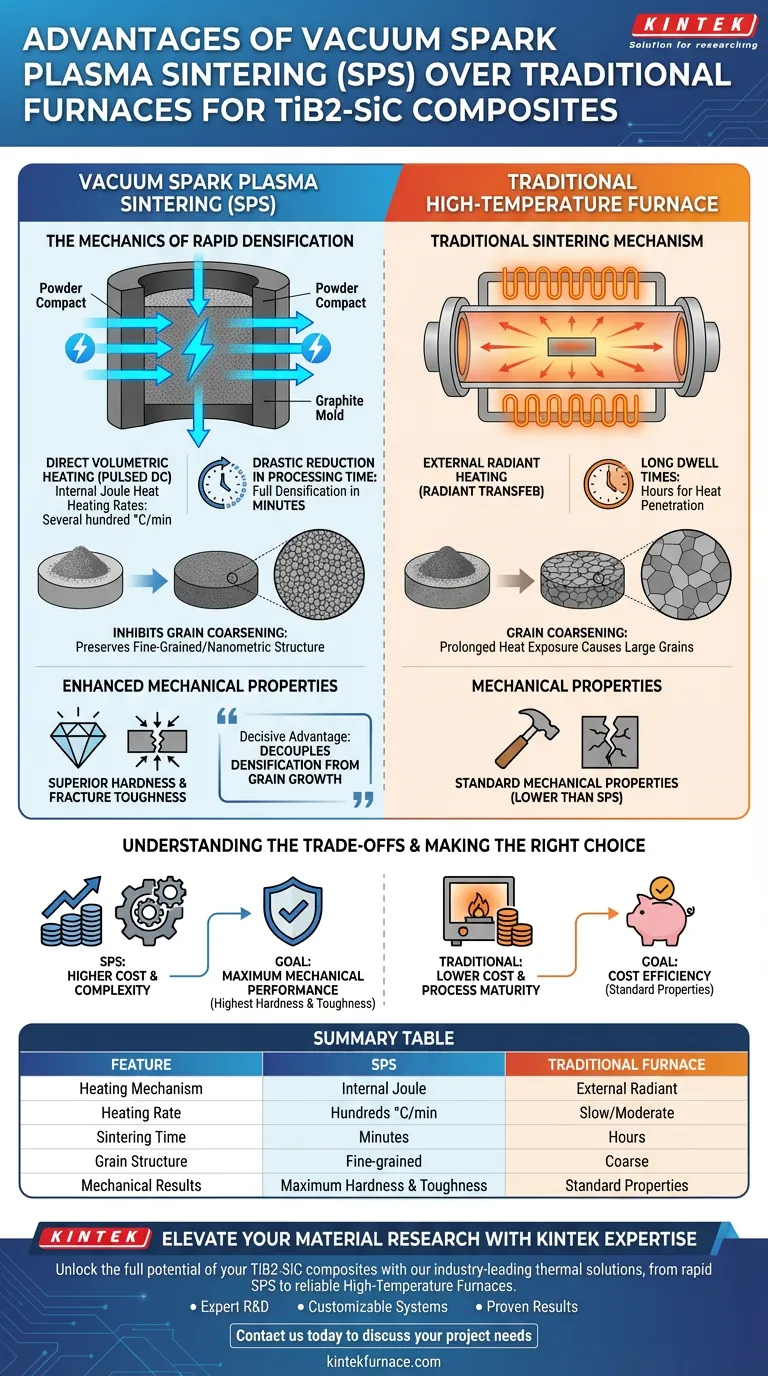
Direct Volumetric Heating
Unlike traditional tube furnaces that rely on external heating elements and radiant heat transfer, SPS employs pulsed direct current (DC).
This current passes directly through the graphite mold and the TiB2-SiC powder compact itself.
This mechanism generates internal Joule heat, allowing the system to achieve heating rates of several hundred degrees per minute.
Drastic Reduction in Processing Time
Traditional sintering often requires long dwell times (holding times) to ensure heat penetrates the sample and closes pores.
SPS achieves full densification in an extremely short duration due to the combination of rapid internal heating and applied pressure.
This efficiency minimizes the material's total exposure to high temperatures.
Microstructural Control and Performance
Inhibiting Grain Coarsening
In traditional sintering, prolonged exposure to high heat typically causes grains to merge and grow (coarsening).
Large grains are detrimental to the mechanical integrity of ceramics like TiB2-SiC.
The rapid cooling and heating cycles of SPS effectively inhibit abnormal grain growth, preserving the material's fine-grained, often nanometric, structure.
Enhanced Mechanical Properties
The physical properties of TiB2-SiC composites are directly tied to their microstructure.
Because SPS maintains a fine grain size while achieving high density, the resulting material exhibits superior hardness.
Furthermore, the refined microstructure improves fracture toughness, making the composite more resistant to cracking under stress compared to conventionally sintered counterparts.
Understanding the Trade-offs
Equipment Cost and Complexity
While SPS offers superior material properties, it involves higher initial capital investment compared to traditional furnaces or vacuum hot presses.
The technology relies on complex pulsed power generators and precise vacuum controls.
Process Maturity
Traditional vacuum hot press furnaces utilize simpler, more mature process control logic.
For applications where extreme speed is not critical, traditional methods may offer a balance of lower energy consumption and reduced equipment costs, provided the specific parameter optimization (like alloying) is managed correctly.
Making the Right Choice for Your Goal
When deciding between SPS and traditional sintering for TiB2-SiC composites, consider your specific performance requirements:
- If your primary focus is Maximum Mechanical Performance: Choose SPS to achieve the highest possible hardness and fracture toughness through fine-grain retention.
- If your primary focus is Cost Efficiency: Evaluate traditional vacuum hot press methods, which offer lower equipment costs and simpler operation, though with longer processing times.
SPS is the definitive choice for high-performance ceramics where microstructural integrity cannot be compromised.
Summary Table:
| Feature | Spark Plasma Sintering (SPS) | Traditional High-Temp Furnace |
|---|---|---|
| Heating Mechanism | Internal Joule Heating (Pulsed DC) | External Radiant Heating |
| Heating Rate | Several hundred degrees per minute | Slow/Moderate |
| Sintering Time | Minutes | Hours |
| Grain Structure | Fine-grained (inhibits growth) | Coarse (due to long dwell times) |
| Mechanical Results | Maximum hardness & toughness | Standard mechanical properties |
Elevate Your Material Research with KINTEK Expertise
Unlock the full potential of your TiB2-SiC composites with KINTEK’s industry-leading thermal solutions. Whether you require the rapid densification of Spark Plasma Sintering (SPS) or the reliable performance of our Vacuum, Tube, or High-Temperature Lab Furnaces, we provide the precision tools necessary for superior microstructural control.
Why partner with KINTEK?
- Expert R&D: Our systems are engineered for advanced material science and ceramic synthesis.
- Customizable Systems: From Muffle and Rotary to CVD and Vacuum systems, we tailor equipment to your unique lab requirements.
- Proven Results: Achieve higher hardness, better fracture toughness, and optimized densification.
Ready to transform your sintering process? Contact us today to discuss your project needs and let our technical team design the perfect solution for your laboratory.
Visual Guide
References
- German Alberto Barragán De Los Rios, Patricia Fernández‐Morales. Numerical Simulation of Aluminum Foams by Space Holder Infiltration. DOI: 10.1007/s40962-024-01287-8
This article is also based on technical information from Kintek Furnace Knowledge Base .
Related Products
- Spark Plasma Sintering SPS Furnace
- Vacuum Heat Treat Sintering Furnace with Pressure for Vacuum Sintering
- 9MPa Air Pressure Vacuum Heat Treat and Sintering Furnace
- 600T Vacuum Induction Hot Press Vacuum Heat Treat and Sintering Furnace
- Vacuum Hot Press Furnace Machine Heated Vacuum Press Tube Furnace
People Also Ask
- Why is it necessary to maintain a high vacuum environment during the SPS of SiC? Key to High-Density Ceramics
- How does the heating mechanism of Spark Plasma Sintering (SPS) function? Enhance TiC/SiC Composite Fabrication
- What are the technical advantages of using an SPS sintering furnace? Elevate Al2O3-TiC Material Performance
- What are the steps in the discharge plasma sintering process? Master Fast, High-Density Material Consolidation
- What are the advantages of spark plasma sintering (SPS) over traditional forging? Precision Microstructural Control