
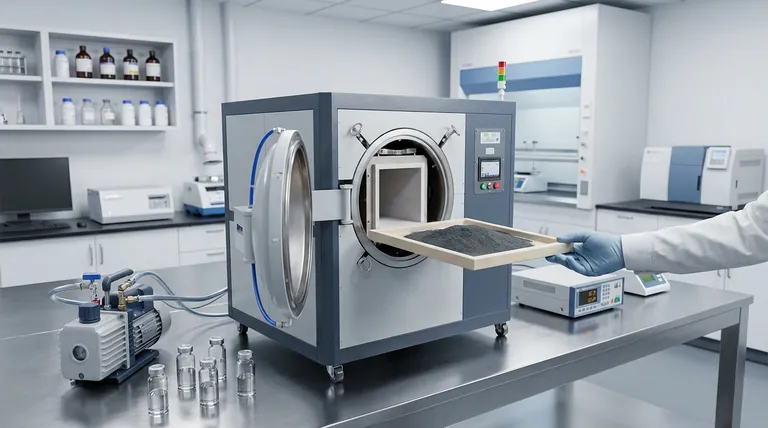
The primary advantages of using a vacuum oven for delithiated NCM powders are the prevention of surface contamination and the ability to dry materials rapidly at lower thermal stress levels. By lowering the ambient pressure, you can remove moisture efficiently without exposing the highly reactive delithiated surface to oxygen, carbon dioxide, or excessive heat.
Core Takeaway The critical value of vacuum drying for delithiated NCM is the preservation of surface purity. It specifically inhibits the formation of resistive impurities like lithium carbonate and prevents oxidative side reactions, ensuring the material remains chemically active and stable for subsequent processing.
Preserving Chemical Integrity via Atmosphere Control
Preventing Surface Side Reactions
Delithiated NCM powders are chemically active and sensitive to their environment. A vacuum oven functions by excluding atmospheric interference, specifically removing oxygen and carbon dioxide from the drying chamber. This isolation prevents unwanted chemical reactions on the surface of the degraded material that would occur in a standard air-filled oven.
Inhibiting Impurity Formation
The most critical advantage is the inhibition of lithium carbonate (Li2CO3) formation. When delithiated NCM is exposed to air containing moisture and CO2, lithium residues on the surface react to form carbonate layers. By eliminating these gases during the drying process, the vacuum oven maintains the chemical purity of the active material surface.
Thermal Management and Efficiency
Rapid Moisture Removal at Low Temperatures
Vacuum drying leverages physics to lower the boiling point of water and solvents. This allows moisture to evaporate rapidly at significantly lower temperatures than required in a conventional oven. This is essential for removing residual moisture without subjecting the material to harsh thermal spikes.
Avoiding Thermal Degradation
High temperatures in conventional ovens can lead to structural degradation or alteration of the NCM crystal lattice. The low-temperature capability of a vacuum oven mitigates this risk. It ensures the effective removal of moisture while preserving the structural integrity of the heat-sensitive delithiated powder.
Understanding the Trade-offs
Process Throughput Limitations
While vacuum ovens offer superior quality control, they generally operate as batch processes. This can be slower compared to continuous conveyor-belt conventional ovens used in high-volume manufacturing. You are trading speed of throughput for higher material fidelity.
Equipment Complexity
Vacuum systems introduce added complexity regarding maintenance. Pumps, seals, and pressure gauges require regular monitoring to ensure a consistent vacuum level. A failure in the vacuum seal can inadvertently expose the sensitive powder to the very atmosphere you are trying to avoid.
Making the Right Choice for Your Goal
While conventional ovens are sufficient for robust, non-sensitive materials, delithiated NCM requires the precision of vacuum drying.
- If your primary focus is Surface Purity: Use a vacuum oven to strictly eliminate CO2 and oxygen, preventing the formation of resistive carbonate layers.
- If your primary focus is Thermal Safety: Use a vacuum oven to ensure complete drying at lower temperatures, protecting the crystal structure from heat-induced degradation.
Summary: For delithiated NCM powders, vacuum drying is not just an alternative; it is a technical necessity to prevent surface passivation and ensure the electrochemical performance of the final battery cell.
Summary Table:
| Feature | Vacuum Oven | Conventional Oven |
|---|---|---|
| Atmosphere Control | Active exclusion of O2 and CO2 | Ambient air exposure |
| Impurity Prevention | Inhibits Li2CO3 formation | High risk of carbonate layers |
| Drying Temperature | Low (protects crystal structure) | High (risk of thermal stress) |
| Moisture Removal | Rapid via reduced boiling point | Slower at equivalent temperatures |
| Surface Integrity | High preservation | Risk of surface passivation |
Elevate Your Material Processing with KINTEK
Precision in battery material drying is non-negotiable. KINTEK provides industry-leading vacuum systems designed to eliminate surface impurities and protect your heat-sensitive NCM powders.
Backed by expert R&D and manufacturing, KINTEK offers Vacuum, Muffle, Tube, Rotary, and CVD systems, all customizable to your laboratory's unique high-temperature and atmospheric requirements. Ensure the electrochemical performance of your battery cells by choosing a drying solution that prevents passivation and preserves chemical integrity.
Ready to optimize your drying workflow? Contact us today to find your custom solution.
References
- Yu Wang, Chris Yuan. Direct upcycling of degraded NCM <i>via</i> low-temperature surface engineering for high performance lithium-ion batteries. DOI: 10.1039/d5eb00018a
This article is also based on technical information from Kintek Furnace Knowledge Base .
Related Products
- Vacuum Heat Treat Sintering and Brazing Furnace
- Vacuum Heat Treat Sintering Furnace Molybdenum Wire Vacuum Sintering Furnace
- Dental Porcelain Zirconia Sintering Ceramic Vacuum Press Furnace
- Vacuum Hot Press Furnace Machine for Lamination and Heating
- Vacuum Hot Press Furnace Machine Heated Vacuum Press
People Also Ask
- What are the benefits of using vacuum heat treating furnaces for metal alloys? Achieve Superior Metal Properties and Performance
- What is one of the most important uses of vacuum heat treating furnaces in aerospace? Achieve Superior Strength in Aircraft Alloys
- How does vacuum heat treating affect the grain structure of metal alloys? Achieve Precise Microstructure Control
- What is the temperature of a vacuum furnace brazing? Optimize Your Joint Strength and Cleanliness
- What are the steps involved in a typical vacuum brazing treatment? Master the Process for Strong, Clean Joints

















