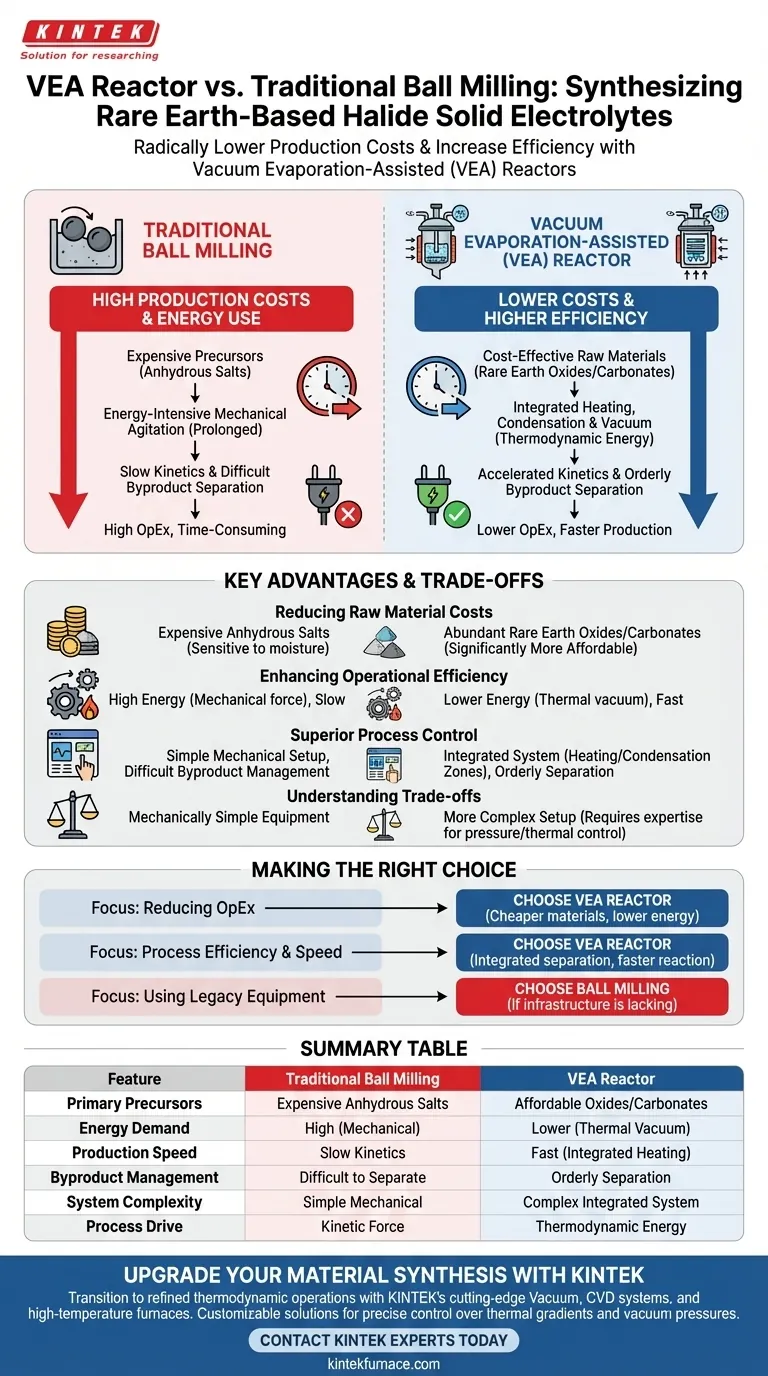
The primary advantage of a Vacuum Evaporation-Assisted (VEA) reactor is its ability to radically lower production costs while increasing synthesis efficiency. By shifting from mechanical force to a thermal vacuum process, you can utilize cost-effective raw materials like rare earth oxides or carbonates, avoiding the need for the expensive anhydrous salt precursors required by traditional ball milling.
Core Takeaway Traditional ball milling is an energy-intensive process that relies on costly, high-purity precursors. In contrast, the VEA reactor integrates heating, condensation, and vacuum systems to enable the direct synthesis of halide electrolytes from cheaper raw materials, ensuring a more efficient process with orderly byproduct separation.
Reducing Raw Material Costs
Moving Away from Expensive Precursors
Traditional mechanical ball milling imposes a strict requirement on input materials. You typically must use anhydrous salt precursors, which are often expensive to procure and difficult to handle due to their sensitivity to moisture.
Utilizing Abundant Alternatives
The VEA reactor eliminates this constraint. It allows for the direct synthesis of halide electrolytes using rare earth oxides or carbonates. These materials are significantly more affordable and readily available than their anhydrous salt counterparts, leading to a substantial reduction in overall raw material costs.
Enhancing Operational Efficiency
Lowering Energy Consumption
Mechanical ball milling is inherently energy-intensive. It relies on prolonged physical agitation to drive chemical reactions, which consumes vast amounts of power over long periods.
Accelerating Production Time
In addition to high energy use, ball milling is time-consuming. The VEA reactor bypasses the slow kinetics of solid-state mechanical grinding. By utilizing integrated heating and vacuum systems, it accelerates the reaction kinetics, significantly shortening the synthesis cycle.
Superior Process Control
Integrated System Design
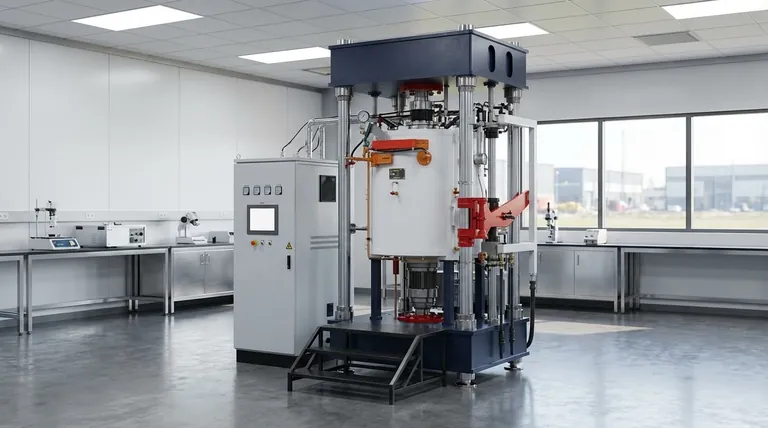
The VEA reactor is not just a heating vessel; it is a sophisticated system that integrates heating zones, condensation zones, and vacuum systems. This integration allows for precise control over the reaction environment that mechanical milling cannot match.
Orderly Separation of Byproducts
One of the distinct technical advantages of the VEA method is the orderly separation of products and byproducts. The vacuum and condensation mechanisms actively manage the removal of reaction byproducts, yielding a cleaner final product without the extensive post-processing often required after ball milling.
Understanding the Trade-offs
Equipment Complexity
While ball milling is energy-intensive, the equipment itself is mechanically simple. The VEA reactor involves a more complex setup, requiring reliable vacuum pumps, precise temperature controllers, and condensation systems. This requires a higher level of operator expertise to manage the system pressures and thermal gradients effectively.
Thermal Sensitivity
Ball milling is a "cold" or low-heat process driven by friction and impact. The VEA process relies on thermal energy. While this is efficient for many halides, you must ensure that your specific target material and the intermediate phases are stable at the temperatures required for the evaporation and condensation steps.
Making the Right Choice for Your Goal
To determine which synthesis method aligns with your project constraints, consider the following:
- If your primary focus is reducing operational expenditure (OpEx): Choose the VEA reactor, as it utilizes significantly cheaper raw materials (oxides/carbonates) and reduces energy consumption.
- If your primary focus is process efficiency and speed: Choose the VEA reactor for its integrated ability to separate byproducts and shorten reaction times compared to the slow kinetics of milling.
- If your primary focus is using legacy equipment: Adhere to ball milling only if you lack the infrastructure for vacuum-thermal systems and are willing to absorb the higher cost of anhydrous precursors.
By leveraging the VEA reactor, you transition from a brute-force mechanical process to a refined, cost-effective thermodynamic operation.
Summary Table:
| Feature | Traditional Ball Milling | VEA Reactor |
|---|---|---|
| Primary Precursors | Expensive Anhydrous Salts | Affordable Oxides/Carbonates |
| Energy Demand | High (Mechanical Agitation) | Lower (Thermal Vacuum) |
| Production Speed | Slow Kinetics | Fast (Integrated Heating) |
| Byproduct Management | Difficult to Separate | Orderly Separation via Condensation |
| System Complexity | Simple Mechanical | Complex Integrated System |
| Process Drive | Kinetic Force | Thermodynamic Energy |
Upgrade Your Material Synthesis with KINTEK
Transition from energy-intensive mechanical milling to refined thermodynamic operations. Backed by expert R&D and manufacturing, KINTEK offers cutting-edge Vacuum, CVD systems, and high-temperature furnaces designed to handle the complexities of VEA reactor processes. Whether you need customizable solutions for rare earth halide synthesis or specialized lab equipment, our systems ensure precise control over thermal gradients and vacuum pressures.
Ready to reduce your OpEx and accelerate production?
Visual Guide
References
- Zhichao Zeng, Yaping Du. Vacuum evaporation-assisted reaction: sustainable solution for application of rare earth-based halide solid-state electrolytes. DOI: 10.1039/d5sc00003c
This article is also based on technical information from Kintek Furnace Knowledge Base .
Related Products
- Custom Made Versatile CVD Tube Furnace Chemical Vapor Deposition CVD Equipment Machine
- Vacuum Induction Melting Furnace
- Slide PECVD Tube Furnace with Liquid Gasifier PECVD Machine
- MPCVD Machine System Reactor Bell-jar Resonator for Lab and Diamond Growth
- 915MHz MPCVD Diamond Machine Microwave Plasma Chemical Vapor Deposition System Reactor
People Also Ask
- What is a CVD tube furnace and what is its primary function? Discover Precision Thin-Film Deposition
- Why are CVD tube furnace sintering systems indispensable for 2D material research and production? Unlock Atomic-Scale Precision
- How does CVD tube furnace sintering enhance graphene growth? Achieve Superior Crystallinity and High Electron Mobility
- Which industries and research fields benefit from CVD tube furnace sintering systems for 2D materials? Unlock Next-Gen Tech Innovations
- What temperature range do standard CVD tube furnaces operate at? Unlock Precision for Your Material Deposition