
Vacuum drying provides a critical protective environment for processing temperature-sensitive composites like PB2T-TEG-TiO2-X. By lowering the system pressure, you allow solvents such as ethanol and chloroform to evaporate rapidly at significantly reduced temperatures (approximately 40 °C), directly avoiding the thermal stress associated with conventional ovens.
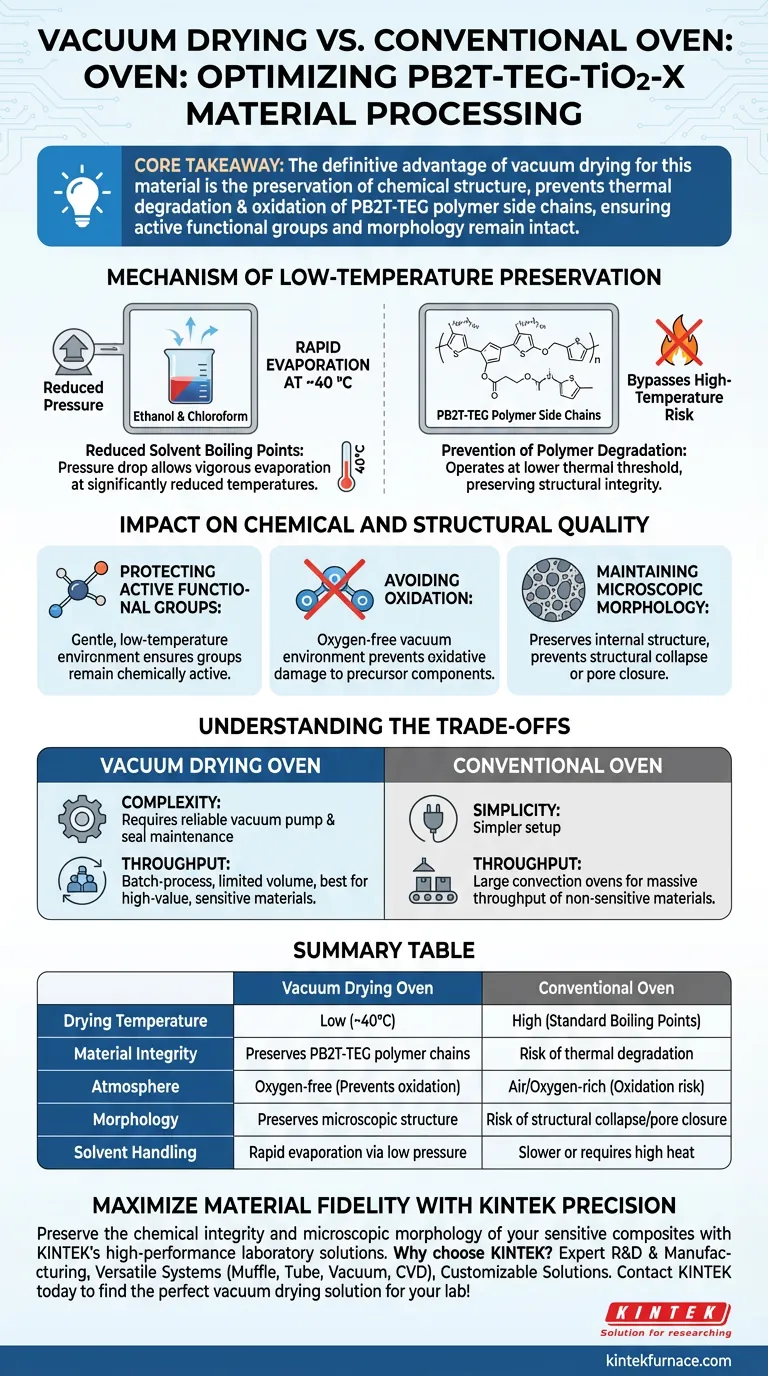
Core Takeaway The definitive advantage of vacuum drying for this specific material is the preservation of chemical structure. It prevents the thermal degradation and oxidation of PB2T-TEG polymer side chains, ensuring that active functional groups and the material's microscopic morphology remain intact.
Mechanism of Low-Temperature Preservation
Reduced Solvent Boiling Points
The primary mechanism at work is the relationship between pressure and vaporization. By reducing the pressure within the chamber, the boiling points of solvents like ethanol and chloroform drop significantly.
This allows these solvents to evaporate vigorously at temperatures as low as 40 °C. In a conventional oven, achieving similar evaporation rates would require temperatures that could compromise the material.
Prevention of Polymer Degradation
PB2T-TEG-TiO2-X composites contain sensitive polymer components. High temperatures in standard ovens risk thermal degradation of the PB2T-TEG polymer side chains.
Vacuum drying bypasses this risk entirely. By operating at a lower thermal threshold, you preserve the structural integrity of the polymer matrix.
Impact on Chemical and Structural Quality
Protecting Active Functional Groups
The functionality of your material depends on its chemical composition. High heat can sever or alter the active functional groups within the composite.
The gentle, low-temperature environment of the vacuum oven ensures these groups remain chemically active and available for their intended reaction or application.
Avoiding Oxidation
Standard ovens operate in an air environment, which introduces oxygen at high temperatures—a recipe for rapid oxidation.
A vacuum oven evacuates oxygen from the chamber. This creates an inert environment that prevents oxidative damage, which is critical for maintaining the stability of the precursor components.
Maintaining Microscopic Morphology
The physical structure of the composite is just as important as its chemistry. Rapid, high-heat drying can cause structural collapse or pore closure.
Vacuum drying preserves the microscopic morphology of the composite. This ensures that the internal structure remains open and consistent, rather than densifying or distorting due to thermal stress.
Understanding the Trade-offs
Equipment Complexity vs. Simplicity
While superior for quality, a vacuum drying setup is more complex than a conventional oven. It requires a reliable vacuum pump and strict maintenance of seals to ensure pressure remains consistent.
Throughput Limitations
Vacuum ovens are generally batch-process devices with limited internal volume compared to large convection ovens.
If your goal is massive throughput of non-sensitive materials, a vacuum oven may be a bottleneck. However, for high-value, sensitive materials like PB2T-TEG-TiO2-X, this trade-off is necessary to prevent batch failure.
Making the Right Choice for Your Goal
To determine if you should strictly adhere to vacuum drying for your specific batch, consider your primary constraints:
- If your primary focus is Material Fidelity: Use the vacuum oven at ~40 °C to strictly protect polymer side chains and prevent oxidation.
- If your primary focus is Solvent Removal Speed: Use the vacuum oven to lower the boiling point of ethanol/chloroform, accelerating drying without adding destructive heat.
By controlling pressure, you control the quality of the final composite, ensuring the PB2T-TEG-TiO2-X retains the precise properties required for its application.
Summary Table:
| Feature | Vacuum Drying Oven | Conventional Oven |
|---|---|---|
| Drying Temperature | Low (~40°C) | High (Standard Boiling Points) |
| Material Integrity | Preserves PB2T-TEG polymer chains | Risk of thermal degradation |
| Atmosphere | Oxygen-free (Prevents oxidation) | Air/Oxygen-rich (Oxidation risk) |
| Morphology | Preserves microscopic structure | Risk of structural collapse/pore closure |
| Solvent Handling | Rapid evaporation via low pressure | Slower or requires high heat |
Maximize Material Fidelity with KINTEK Precision
Preserve the chemical integrity and microscopic morphology of your sensitive composites with KINTEK’s high-performance laboratory solutions. Whether you are working with complex PB2T-TEG-TiO2-X matrices or other heat-sensitive materials, our advanced equipment ensures reproducible results without the risk of oxidation or thermal stress.
Why choose KINTEK?
- Expert R&D & Manufacturing: Decades of experience in high-temperature and vacuum technologies.
- Versatile Systems: From Muffle and Tube furnaces to specialized Vacuum and CVD systems.
- Customizable Solutions: Lab high-temp furnaces tailored to your unique research or production needs.
Contact KINTEK today to find the perfect vacuum drying solution for your lab!
Visual Guide
References
- Bingke Zhang, Ergang Wang. Facile Synthesis of Organic–Inorganic Hybrid Heterojunctions of Glycolated Conjugated Polymer‐TiO<sub>2−X</sub> for Efficient Photocatalytic Hydrogen Evolution. DOI: 10.1002/smll.202402649
This article is also based on technical information from Kintek Furnace Knowledge Base .
Related Products
- Vacuum Heat Treat Sintering and Brazing Furnace
- Vacuum Heat Treat Sintering Furnace Molybdenum Wire Vacuum Sintering Furnace
- Dental Porcelain Zirconia Sintering Ceramic Vacuum Press Furnace
- Molybdenum Vacuum Heat Treat Furnace
- Vacuum Hot Press Furnace Machine Heated Vacuum Press
People Also Ask
- What are the benefits of using vacuum heat treating furnaces for metal alloys? Achieve Superior Metal Properties and Performance
- What is one of the most important uses of vacuum heat treating furnaces in aerospace? Achieve Superior Strength in Aircraft Alloys
- How does vacuum heat treating affect the grain structure of metal alloys? Achieve Precise Microstructure Control
- What is the temperature of a vacuum furnace brazing? Optimize Your Joint Strength and Cleanliness
- What are the steps involved in a typical vacuum brazing treatment? Master the Process for Strong, Clean Joints












