
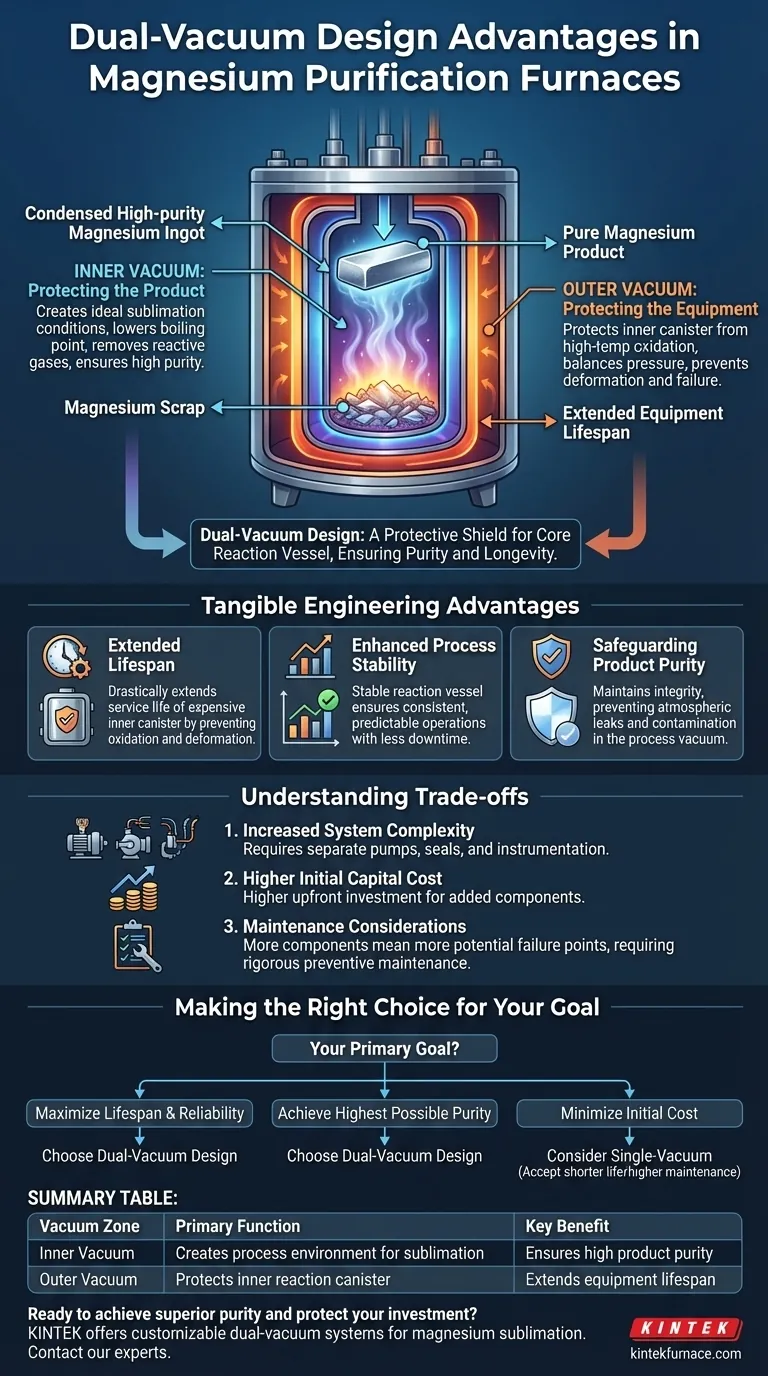
The primary advantage of a dual-vacuum design in a magnesium purification furnace is that it creates a protective shield for the core reaction vessel. This design separates the high-vacuum environment needed for the purification process from a second vacuum that insulates and protects the equipment itself, drastically increasing its lifespan and ensuring operational stability.
A dual-vacuum furnace solves two critical problems at once: the inner vacuum ensures the purity of the product, while the outer vacuum ensures the longevity and integrity of the equipment. This separation is the key to an efficient and reliable purification process.
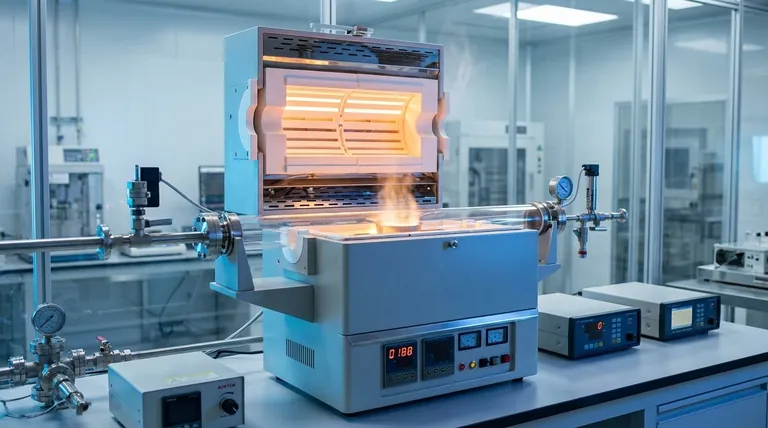
Deconstructing the Dual-Vacuum System
A dual-vacuum furnace essentially operates with two distinct vacuum zones, each serving a separate but equally critical purpose. Understanding these roles is fundamental to grasping the design's value.
The Inner Vacuum: Protecting the Product
The first vacuum is created inside the canister holding the scrap magnesium. This is the process vacuum.
Its function is to create the ideal conditions for purification. By reducing the pressure to extremely low levels (e.g., 10⁻² mmHg), it lowers the boiling point of magnesium, allowing sublimation to occur at more manageable and energy-efficient temperatures.
Critically, this high-vacuum environment also removes reactive gases like oxygen and nitrogen. This prevents the hot magnesium vapor from being contaminated by oxidation or nitridation, which is essential for achieving high purity in the final condensed product.
The Outer Vacuum: Protecting the Equipment
The second vacuum is created in the space between the inner process canister and the outer furnace wall. This is the protective vacuum.
Its sole purpose is to protect the inner canister. At the high temperatures required for sublimation, the metal of the canister would rapidly oxidize and degrade if exposed to ambient air, leading to premature failure. The outer vacuum removes this air, stopping oxidation in its tracks.
Furthermore, it balances the pressure exerted on the canister walls. Without this external vacuum, the high internal vacuum would create a massive pressure differential, which could cause the hot, slightly softened canister to deform or even collapse.
The Tangible Engineering Advantages
This separation of functions translates into significant operational and financial benefits for any industrial magnesium sublimation process.
Extended Lifespan of Core Components
By preventing high-temperature oxidation and pressure-induced deformation, the protective outer vacuum drastically extends the service life of the inner canister. This component is often the most stressed and expensive part of the furnace to replace, making this benefit highly significant.
Enhanced Process Stability and Reliability
A stable, non-degrading reaction vessel ensures a consistent and predictable process. With the risk of canister deformation or failure mitigated, operations can run more reliably with less downtime for unexpected maintenance and repairs.
Safeguarding Product Purity
While the inner vacuum is directly responsible for purity, the outer vacuum plays a crucial supporting role. By ensuring the integrity of the inner canister, it prevents potential leaks that could introduce atmospheric contaminants into the process vacuum, thereby compromising the purity of the final magnesium product.
Understanding the Trade-offs
While highly effective, the dual-vacuum design is not without its considerations. It represents a specific engineering choice with inherent trade-offs.
Increased System Complexity
A dual-vacuum furnace requires two separate vacuum pumping systems, additional seals, and more sophisticated control and monitoring instrumentation. This makes the overall system more complex than a single-vacuum design.
Higher Initial Capital Cost
The added components and complexity naturally lead to a higher upfront investment compared to simpler furnace designs. The economic justification rests on the long-term savings from reduced maintenance and extended component life.
Maintenance Considerations
More components mean more potential points of failure, such as vacuum leaks in seals or issues with one of the two pump systems. A rigorous preventive maintenance schedule is critical to ensuring the long-term reliability that the design promises.
Making the Right Choice for Your Goal
The decision to invest in a dual-vacuum system should be based on your primary operational objectives.
- If your primary focus is maximizing equipment lifespan and operational reliability: The dual-vacuum design is the definitive choice, as it directly protects the most vulnerable component from failure.
- If your primary focus is achieving the highest possible product purity: This system provides the most stable and controlled environment, minimizing the risk of contamination and ensuring consistent results.
- If your primary focus is minimizing initial capital expenditure: A single-vacuum design might be considered, but you must accept the significant trade-off of shorter component life and higher long-term maintenance costs.
Ultimately, the dual-vacuum architecture is an investment in process robustness, protecting both your product and your equipment for more efficient long-term operation.
Summary Table:
| Vacuum Zone | Primary Function | Key Benefit |
|---|---|---|
| Inner Vacuum | Creates the process environment for sublimation | Ensures high product purity by removing contaminants |
| Outer Vacuum | Protects the inner reaction canister | Extends equipment lifespan and ensures process stability |
Ready to achieve superior purity and protect your investment in magnesium purification?
Backed by expert R&D and manufacturing, KINTEK offers a range of high-temperature vacuum furnaces, including customizable dual-vacuum systems designed for demanding processes like magnesium sublimation. Our solutions are engineered to deliver the reliability and longevity your operation demands.
Contact our experts today to discuss how a KINTEK dual-vacuum furnace can optimize your purification process.
Visual Guide
Related Products
- Magnesium Extraction and Purification Condensing Tube Furnace
- Spark Plasma Sintering SPS Furnace
- Electric Rotary Kiln Pyrolysis Furnace Plant Machine Small Rotary Kiln Calciner
- Electric Rotary Kiln Continuous Working Small Rotary Furnace Kiln for Pyrolysis Plant Heating
- Electric Rotary Kiln Small Rotary Furnace for Activated Carbon Regeneration
People Also Ask
- What are the advantages of using a condensing tube furnace for magnesium extraction? Achieve High Purity and Efficient Metal Recovery
- What is the critical role of a tube furnace in the preparation of beta-PbO powder? Optimize Lead-Acid Battery Recycling
- How do tube furnaces contribute to transport reactions and crystal production? Master High-Purity Synthesis with Precision Control
- Why are a tube furnace and nitrogen flow required? Master Carbon Microsphere Activation with Precision
- Why is temperature range important when choosing a tube furnace? It Dictates Cost, Materials, and Performance



















