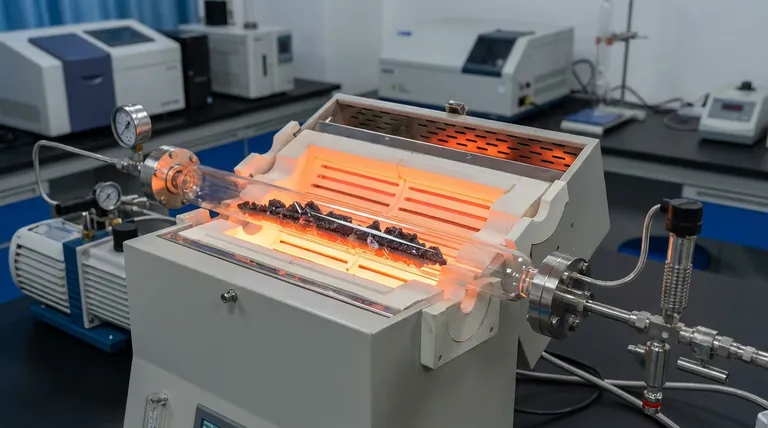
The primary function of a vacuum-sealed quartz tube in MnBi2Te4 growth is to create a strictly controlled, isolated chemical environment. By sealing precursors like Bi2Te3 and MnTe under vacuum, the tube prevents the oxidation of these reactive materials during high-temperature synthesis. Simultaneously, it maintains a specific vapor pressure within the vessel, a condition that is critical for the nucleation and growth of high-quality single crystals.
Core Takeaway The quartz tube is not merely a container; it is an active component of the thermodynamic system. It acts as a hermetic barrier that locks in precise stoichiometric ratios and locks out atmospheric contaminants, ensuring the crystal lattice forms without impurity defects.
Establishing a Controlled Chemical Environment
Prevention of Oxidation
The synthesis of MnBi2Te4 involves high temperatures where materials are most vulnerable to chemical degradation.
Bi2Te3 and MnTe are highly reactive when exposed to oxygen.
The vacuum-sealed tube eliminates atmospheric oxygen, preventing these precursors from degrading into unwanted oxides before they can crystallize.
Isolation from Atmospheric Moisture
Beyond oxygen, humidity is a significant threat to crystal purity.
Water vapor can interfere with the chemical reaction, leading to structural defects or side reactions.
The vacuum seal ensures the environment remains chemically inert, allowing the intended reaction path to proceed undisturbed.
Regulating Thermodynamics and Kinetics
Maintaining Specific Vapor Pressure
Successful crystal growth requires more than just heat; it requires pressure management.
The sealed nature of the quartz tube allows the internal environment to reach and maintain a specific vapor pressure.
This pressure equilibrium is essential for the transport and deposition of atoms into a highly ordered lattice structure.
Ensuring Stoichiometric Precision
To grow a single crystal like MnBi2Te4, the ratio of elements must remain exact throughout the process.
In an open system, volatile components (like Tellurium) might evaporate disproportionately, altering the formula.
The sealed tube creates a closed system, confining all atomic species to ensure the final crystal retains the correct chemical composition.
Understanding the Critical Dependencies
The Necessity of High-Vacuum Levels
The effectiveness of the quartz tube is entirely dependent on the quality of the initial vacuum.
Supplementary data suggests that for similar processes, vacuum levels as high as 1 x 10^-8 bar or 0.01 Pa are often required to ensure sufficient isolation.
If the vacuum level is insufficient, even a sealed tube will not prevent partial oxidation or "doping" by residual gases.
Thermal and Structural Limitations
While quartz is robust, it serves as the physical limit for the reaction's parameters.
The tube must withstand sustained high temperatures (often exceeding 800 K in similar syntheses) without softening or reacting with the load.
Any breach in the physical integrity of the tube immediately destroys the vapor pressure equilibrium and ruins the crystal growth.
Making the Right Choice for Your Goal
When designing a growth experiment for MnBi2Te4, prioritize the integrity of your vessel setup.
- If your primary focus is Crystal Purity: Ensure the initial evacuation of the quartz tube reaches high-vacuum standards (low Pa range) to eliminate all traces of oxygen and moisture.
- If your primary focus is Stoichiometric Control: Verify the seal integrity to prevent the loss of volatile elements like Tellurium, ensuring the final ratio matches your precursor input.
The vacuum-sealed quartz tube is the fundamental guardian of your material's chemistry; its preparation is as critical as the synthesis recipe itself.
Summary Table:
| Feature | Function in MnBi2Te4 Growth | Benefit to Single Crystal |
|---|---|---|
| Vacuum Seal | Eliminates oxygen and moisture | Prevents oxidation and structural defects |
| Closed System | Confines volatile species like Tellurium | Maintains exact stoichiometric ratios |
| Pressure Control | Regulates internal vapor pressure | Facilitates atom transport for ordered lattices |
| Hermetic Barrier | Isolates precursors from the atmosphere | Ensures chemical purity and inert reaction path |
Achieve precision in your crystal growth with KINTEK. Backed by expert R&D and manufacturing, KINTEK offers a full suite of Muffle, Tube, Rotary, Vacuum, and CVD systems designed for the rigors of high-temperature synthesis. Whether you are growing MnBi2Te4 or advanced semiconductors, our customizable lab furnaces provide the thermal stability and atmospheric control you need for high-quality single crystals. Contact us today to find the perfect thermal solution for your lab!
Visual Guide

References
- Yaoxin Li, Chang Liu. Fabrication-induced even-odd discrepancy of magnetotransport in few-layer MnBi2Te4. DOI: 10.1038/s41467-024-47779-3
This article is also based on technical information from Kintek Furnace Knowledge Base .
Related Products
- High Pressure Laboratory Vacuum Tube Furnace
- Vacuum Sealed Continuous Working Rotary Tube Furnace Rotating Tube Furnace
- Vertical Laboratory Quartz Tube Furnace Tubular Furnace
- Multi Zone Laboratory Quartz Tube Furnace Tubular Furnace
- CF KF Flange Vacuum Electrode Feedthrough Lead Sealing Assembly for Vacuum Systems
People Also Ask
- What role does a high vacuum tube furnace play in Co-Al sintering? Master High-Purity Porous Material Synthesis
- What are the different types of tube furnaces available? Find the Perfect Fit for Your Lab's Needs
- What is the role of a vacuum tube furnace during the final thermal treatment stage of Fe3O4@CSAC catalysts?
- What are the main advantages of vacuum tube furnaces in the market? Achieve Purity and Precision in Material Processing
- What conditions does a tube furnace provide for post-ion-implantation? Achieve Precise Microstructural Repair