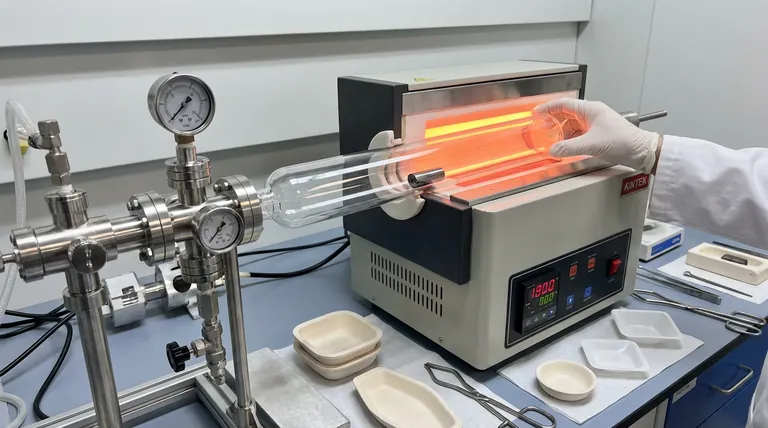
High-vacuum quartz sealing tubes serve as a critical isolation barrier during the heat treatment of TiCo1-xCrxSb alloys. By evacuating the environment to pressures below 1.0 Pa, these tubes prevent chemical degradation and compositional shifts during long-term homogenization annealing.
Core Takeaway The quartz sealing tube acts as a dual-purpose shield: it physically contains volatile elements like antimony (Sb) to maintain the correct alloy ratio, while simultaneously creating a vacuum environment that eliminates the risk of severe oxidation common in standard high-temperature furnaces.
Preserving Chemical Integrity
Preventing Atmospheric Oxidation
Standard muffle furnaces expose materials to oxygen, which can be disastrous for Titanium-based alloys.
Without protection, TiCo1-xCrxSb samples suffer from severe oxidation and surface contamination.
The quartz tube, evacuated to high vacuum (< 1.0 Pa), removes reactive gases, ensuring the material remains pure and maintains its surface brightness.
Controlling Volatile Components
The specific chemistry of TiCo1-xCrxSb relies on precise ratios of its constituent elements.
Antimony (Sb) is particularly volatile and prone to evaporation or sublimation at the high temperatures required for annealing.
Sealing the alloy inside the quartz tube traps these vapors, stopping the loss of Sb and ensuring the final phase structure matches the intended stoichiometry.
Facilitating Long-Term Homogenization
The Need for Extended Stability
Creating a uniform alloy structure requires "homogenization annealing," a process that often takes a significant amount of time.
High-vacuum tubes provide the stable, inert environment necessary for this long-duration processing.
They allow the material to be held at high temperatures without the cumulative degradation that would occur in an open system.
Temperature Resilience
While the vacuum handles the chemistry, the quartz material itself handles the thermal load.
It effectively encapsulates the sample during high-temperature holding phases (potentially exceeding 1000°C), acting as a physical barrier against the furnace atmosphere.
Operational Considerations and Trade-offs
Vacuum Integrity is Paramount
The effectiveness of this method relies entirely on the quality of the seal and the depth of the vacuum.
If the pressure rises above 1.0 Pa due to a leak or poor sealing, the protective mechanism fails, leading to immediate oxidation.
Managing Internal Pressure
While the vacuum protects the sample, the volatility of antimony can create internal pressure within the sealed tube.
Operators must ensure the quartz tube has sufficient wall thickness and structural integrity to withstand the vapor pressure generated by volatile components during the heating cycle.
Ensuring Successful Heat Treatment
To apply this to your material synthesis effectively, consider the following regarding your specific goals:
- If your primary focus is compositional accuracy: Ensure the tube is sealed tightly to prevent any escape of Antimony (Sb) vapor, as even minor losses will alter the $x$ value of your alloy.
- If your primary focus is surface quality: Verify that your vacuum pump achieves a baseline pressure consistently below 1.0 Pa to prevent the formation of oxide layers.
Success in synthesizing TiCo1-xCrxSb relies on treating the encapsulation process as strictly as the heating profile itself.
Summary Table:
| Feature | Function in TiCo1-xCrxSb Treatment | Benefit to Material |
|---|---|---|
| High Vacuum (<1.0 Pa) | Removes atmospheric oxygen and reactive gases | Prevents oxidation and surface contamination |
| Quartz Encapsulation | Physical barrier against furnace atmosphere | Enables high-temperature resilience (1000°C+) |
| Hermetic Sealing | Traps volatile elements like Antimony (Sb) | Maintains stoichiometry and phase structure |
| Inert Environment | Stabilizes sample during long-term annealing | Ensures uniform homogenization and purity |
Elevate Your Material Synthesis with KINTEK
Precision heat treatment of advanced alloys like TiCo1-xCrxSb demands more than just heat—it requires a controlled environment. KINTEK provides industry-leading thermal solutions backed by expert R&D and manufacturing.
Whether you need specialized CVD systems, high-temperature vacuum furnaces, Muffle, Tube, or Rotary systems, our equipment is fully customizable to meet your unique laboratory requirements. Ensure compositional accuracy and eliminate oxidation in your research today.
Ready to optimize your annealing process? Contact KINTEK for a custom solution
References
- Volodymyr Krayovskyy, А. Horyn. SIMULATION OF CHARACTERISTICS OF SENSITIVE ELEMENTS OF TEMPERATURE CONVERTERS BASED ON TiCo1-xCrxSb. DOI: 10.23939/istcmtm2024.04.030
This article is also based on technical information from Kintek Furnace Knowledge Base .
Related Products
- High Pressure Laboratory Vacuum Tube Furnace
- Ultra-High Vacuum Flange Aviation Plug Glass Sintered Airtight Circular Connector for KF ISO CF
- Ultra Vacuum Electrode Feedthrough Connector Flange Power Lead for High Precision Applications
- Vertical Laboratory Quartz Tube Furnace Tubular Furnace
- Vacuum Sealed Continuous Working Rotary Tube Furnace Rotating Tube Furnace
People Also Ask
- What role does a high vacuum tube furnace play in Co-Al sintering? Master High-Purity Porous Material Synthesis
- What are the different types of tube furnaces available? Find the Perfect Fit for Your Lab's Needs
- What are the main advantages of vacuum tube furnaces in the market? Achieve Purity and Precision in Material Processing
- What is the role of a vacuum tube furnace during the final thermal treatment stage of Fe3O4@CSAC catalysts?
- What parameters must be controlled when calcining freeze-dried oxide precursors in a laboratory tube furnace? A Guide