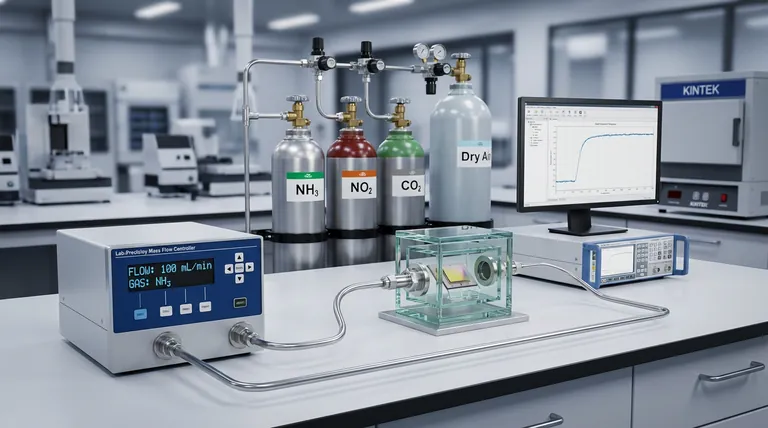
A high-precision mass flow controller (MFC) serves as the fundamental calibration tool for validating Gallium Sulfide (GaS) sensors. It is responsible for accurately regulating the mixing ratios of target gases—specifically ammonia (NH3), nitrogen dioxide (NO2), and carbon dioxide (CO2)—with a carrier gas like dry air. By maintaining a strict total flow rate, typically at 100 mL min⁻¹, the MFC ensures that the sensor is tested against exact, stable concentrations at the parts-per-million (ppm) level.
To determine if a sensor is truly selective, you must eliminate environmental variables. The mass flow controller guarantees that response differences are caused by the chemistry of the gas, not by inconsistencies in flow rate or concentration.
The Mechanics of Assessing Selectivity
To prove that a Gallium Sulfide sensor can distinguish between different gases, you need an experimental setup that offers absolute consistency. The MFC provides this by isolating the variables of flow and concentration.
Regulating Gas Mixtures
Selectivity is the ability of a sensor to detect a specific gas while ignoring others. To test this, the MFC precisely dictates the mixing ratios of various analytes.
It blends target gases (NH3, NO2, CO2) with a background carrier gas, such as dry air. This allows researchers to expose the sensor to each gas individually under identical conditions to compare response magnitudes.
Controlling Concentration Levels
Real-world applications often require the detection of trace gases. The MFC is critical for creating these low-concentration environments in a lab setting.
It regulates the input to achieve specific concentrations at the parts-per-million (ppm) level. This precision allows you to determine the sensor's sensitivity threshold for each distinct gas type.
Establishing Experimental Stability
Data is only useful if it can be reproduced. The role of the MFC extends beyond mixing; it anchors the experiment in a stable baseline.
Maintaining Total Flow Rate
Fluctuations in the speed of the gas moving across the sensor can alter its thermal properties or adsorption rates. The MFC prevents this by locking the total flow rate, often standardized at 100 mL min⁻¹.
Ensuring Data Repeatability
When the flow rate and concentration are chemically locked, the resulting data becomes reliable. The MFC ensures that if you run the same test on different GaS samples, the results are comparable.
Without this control, you cannot determine if a variation in sensor signal is due to the sensor's material properties or a glitch in the gas delivery system.
Common Pitfalls in Flow Control
While an MFC is a powerful tool, relying on it requires an understanding of potential errors in the experimental setup.
The Impact of Flow Variation
If the MFC fails to maintain the target 100 mL min⁻¹ rate, the sensor response curve may skew. A variable flow rate can simulate a false change in concentration, leading to incorrect conclusions about the sensor's selectivity.
Concentration Drift
At the ppm level, even minor inaccuracies in the MFC's mixing valve can significantly alter the actual concentration reaching the sensor. This makes the sensor appear more or less sensitive than it actually is, compromising the validity of the selectivity assessment.
Making the Right Choice for Your Goal
To maximize the effectiveness of your Gallium Sulfide sensor assessment, align your flow control strategy with your specific experimental objectives.
- If your primary focus is Selectivity: Ensure the MFC is programmed to deliver distinct gases (NH3, NO2, CO2) sequentially at identical flow rates to directly compare signal strength.
- If your primary focus is Reproducibility: rigorous adherence to a stable total flow rate (e.g., 100 mL min⁻¹) is required to ensure data is comparable across different sample batches.
Precision in flow control is the prerequisite for precision in chemical sensing.
Summary Table:
| Feature | Role in GaS Sensor Assessment | Impact on Data Quality |
|---|---|---|
| Mixing Ratios | Blends NH3, NO2, CO2 with carrier gas | Ensures accurate gas concentration (ppm level) |
| Flow Regulation | Maintains steady flow (e.g., 100 mL min⁻¹) | Eliminates variables caused by flow fluctuations |
| Repeatability | Standardizes experimental conditions | Allows comparison between different sensor batches |
| Baseline Stability | Isolates gas chemistry effects | Prevents false signals from pressure or speed changes |
Precision Control for Advanced Chemical Sensing
Accurate gas selectivity testing requires the absolute stability that only professional-grade equipment can provide. KINTEK empowers your research with industry-leading laboratory solutions. Backed by expert R&D and manufacturing, we offer high-performance Muffle, Tube, Rotary, Vacuum, and CVD systems, alongside customizable high-temperature furnaces designed for the most demanding sensor validation and material synthesis needs.
Ready to elevate your laboratory precision? Contact our technical experts today to find the perfect customizable solution for your unique research requirements.
References
- Danil Bukhvalov, Antonio Politano. Self‐Assembled Gallium Sulfide (GaS) Heterostructures Enabling Efficient Water Splitting and Selective Ammonia Sensing. DOI: 10.1002/adfm.202507388
This article is also based on technical information from Kintek Furnace Knowledge Base .
Related Products
- Ultra Vacuum Electrode Feedthrough Connector Flange Power Lead for High Precision Applications
- High Performance Vacuum Bellows for Efficient Connection and Stable Vacuum in Systems
- Cylindrical Resonator MPCVD Machine System for Lab Diamond Growth
- Ultra High Vacuum CF Observation Window Flange with High Borosilicate Glass Sight Glass
People Also Ask
- Why is a high-precision vacuum sealing system necessary for CrSb? Ensure Pure Crystal Growth & Prevent Oxidation
- Why is an Ultra-High Vacuum (UHV) System Required for In2Se3? Achieving Atomic-Level Ferroelectric Clarity
- What is the function of quartz vacuum encapsulation in RhSeCl CVT? Mastering Pure Crystal Growth
- Why is vacuum sealing technology essential for K2In2As3 synthesis? Master High-Purity Solid-State Reactions
- What role do vacuum-sealed high-purity silica ampoules play in phase equilibrium experiments? Enhance Sample Integrity