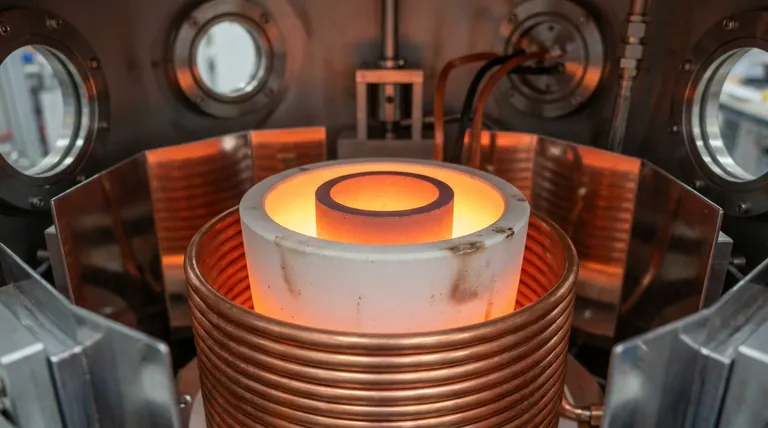
In an induction heating furnace, the ceramic crucible and graphite sleeve serve distinct, complementary functions: containment and energy conversion. The ceramic crucible acts as a thermally insulating vessel that resists high temperatures, while the graphite sleeve, placed inside, acts as the active heating element (susceptor) that converts electromagnetic energy into heat.
The efficiency of this system relies on the synergy between the graphite sleeve, which captures induction currents to generate heat, and the ceramic crucible, which provides the necessary thermal insulation and structural containment.
The Role of the Ceramic Crucible
Acting as the Containment Vessel
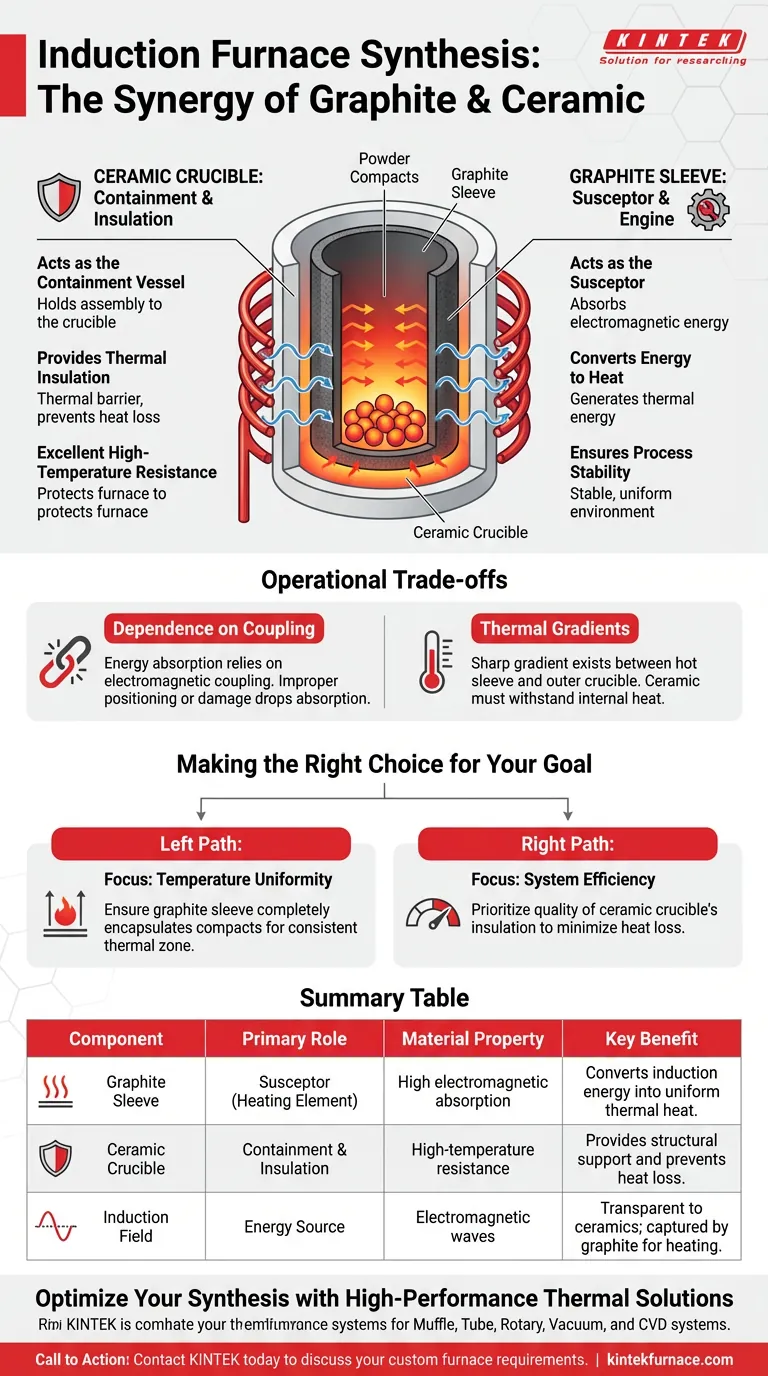
The primary function of the ceramic crucible is structural containment. It holds the entire assembly, including the graphite sleeve and the powder compacts intended for synthesis.
Providing Thermal Insulation
Crucially, the ceramic material is characterized by excellent high-temperature resistance.
It serves as a thermal barrier, preventing excessive heat loss to the furnace exterior.
This insulation helps maintain the high temperatures generated inside the vessel while protecting the outer components of the furnace.
The Function of the Graphite Sleeve
Acting as the Susceptor
The graphite sleeve is the "engine" of the heating process. Placed inside the ceramic crucible, it functions as the susceptor.
Because ceramic is generally transparent to induction fields, it does not heat up significantly on its own. The graphite sleeve, however, efficiently absorbs electromagnetic energy generated by the induction currents.
Converting Energy to Heat
Once the graphite absorbs this energy, it directly converts it into thermal energy.
This conversion is what actually raises the temperature within the furnace, rather than the induction coil heating the material directly (unless the material itself is conductive).
Ensuring Process Stability
The graphite sleeve does more than just generate heat; it regulates the environment.
It provides a stable and uniform high-temperature environment for the powder compacts. This uniformity is critical for consistent material synthesis.
Understanding the Operational Trade-offs
Dependence on Coupling
The system relies entirely on the electromagnetic coupling of the graphite.
If the sleeve is damaged or improperly positioned, energy absorption drops, and the furnace cannot reach the required synthesis temperatures, regardless of the power input.
Thermal Gradients
While the graphite sleeve ensures uniformity inside the reaction zone, a sharp thermal gradient exists between the sleeve and the outer ceramic crucible.
The ceramic must be robust enough to withstand this internal heat without cracking, highlighting the importance of the crucible's high-temperature resistance properties mentioned in your reference.
Making the Right Choice for Your Goal
When designing or operating an induction setup for material synthesis, consider how these components align with your objectives:
- If your primary focus is Temperature Uniformity: Ensure the graphite sleeve encapsulates the powder compacts completely to create a consistent thermal zone.
- If your primary focus is System Efficiency: Prioritize the quality of the ceramic crucible's insulation to minimize heat loss from the active graphite element.
Ultimately, successful synthesis depends on the graphite sleeve efficiently generating heat while the ceramic crucible effectively traps it.
Summary Table:
| Component | Primary Role | Material Property | Key Benefit |
|---|---|---|---|
| Graphite Sleeve | Susceptor (Heating Element) | High electromagnetic absorption | Converts induction energy into uniform thermal heat. |
| Ceramic Crucible | Containment & Insulation | High-temperature resistance | Provides structural support and prevents heat loss. |
| Induction Field | Energy Source | Electromagnetic waves | Transparent to ceramics; captured by graphite for heating. |
Optimize Your Synthesis with High-Performance Thermal Solutions
Precise material synthesis requires the perfect balance of heat generation and containment. At KINTEK, we understand the critical synergy between susceptors and insulation. Backed by expert R&D and manufacturing, we offer a comprehensive range of lab high-temp equipment including Muffle, Tube, Rotary, Vacuum, and CVD systems—all fully customizable to your unique research needs.
Ready to enhance your lab’s thermal efficiency? Contact KINTEK today to discuss your custom furnace requirements and leverage our expertise in advanced material processing.
Visual Guide
References
- Gülizar Sarıyer, H. Erdem Çamurlu. Production and Characterization of Ni0.50 Al0.50 and Ni0.55 Al0.45 Powders by Volume Combustion Synthesis. DOI: 10.17776/csj.1280582
This article is also based on technical information from Kintek Furnace Knowledge Base .
Related Products
- 600T Vacuum Induction Hot Press Vacuum Heat Treat and Sintering Furnace
- Vacuum Induction Melting Furnace
- 2200 ℃ Graphite Vacuum Heat Treat Furnace
- Vacuum Heat Treat Furnace with Ceramic Fiber Liner
- Multi Heating Zones CVD Tube Furnace Machine for Chemical Vapor Deposition Equipment
People Also Ask
- Why use Vacuum Hot Press (VHP) for ZnS Ceramics? Achieve Superior IR Transparency and Mechanical Strength
- How does a vacuum hot press sintering furnace mitigate copper sintering swelling? Solve Fe-Cu Expansion Issues
- What are the benefits of using a vacuum hot press sintering furnace for the preparation of SiCw/2024 aluminum matrix composites? Achieve High-Performance Aerospace Materials
- How does the vacuum environment in a vacuum hot press sintering furnace protect chromium-containing ceramics? Find out.
- What are the key advantages of vacuum hot press sintering furnaces? Achieve Superior Density and Purity in Materials