
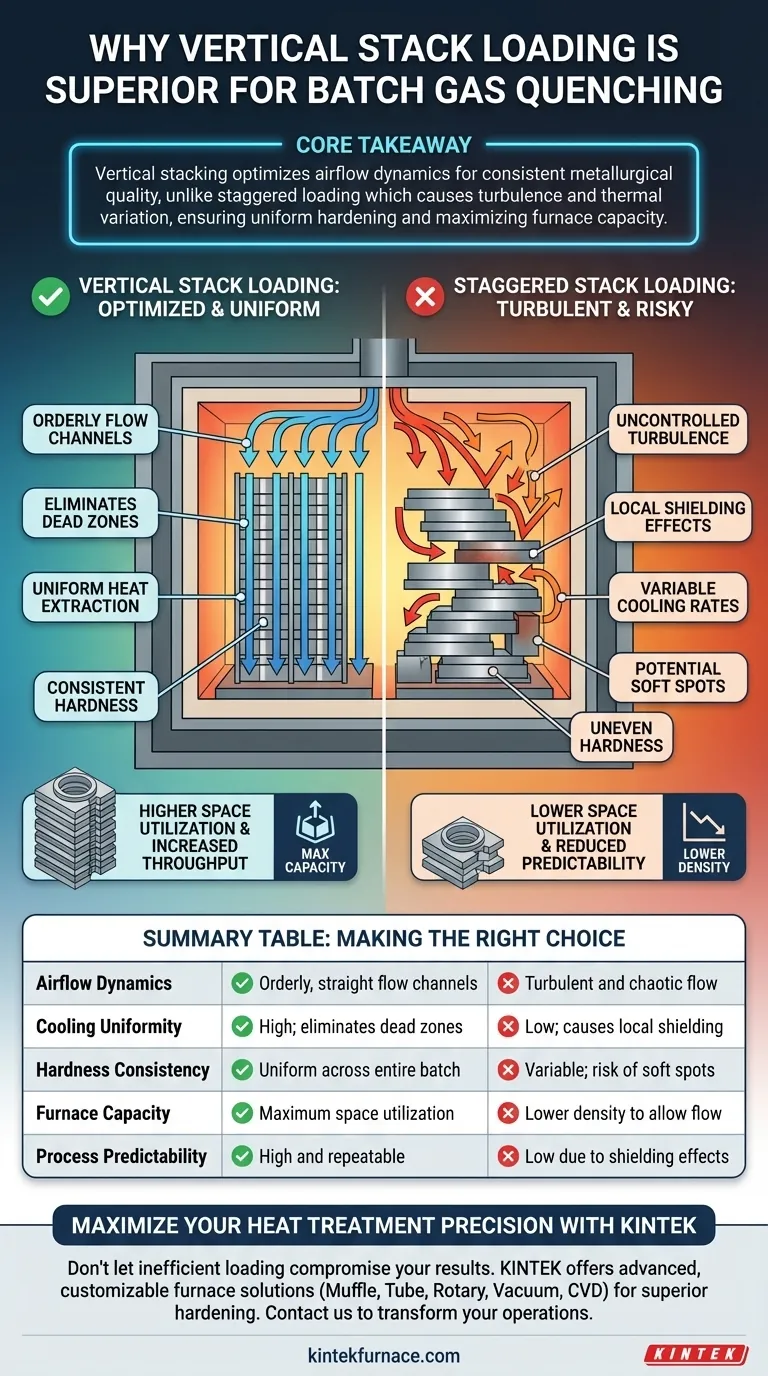
Vertical stack loading is the superior choice for batch gas quenching because it optimizes airflow dynamics to ensure consistent metallurgical quality. Unlike staggered arrangements, which disrupt gas velocity and create thermal variation, vertical stacking aligns workpieces to allow an orderly, unobstructed flow of cooling medium while simultaneously maximizing furnace capacity.
Core Takeaway: Staggered loading introduces turbulence and "shielding" effects that lead to uneven cooling and potential soft spots. Vertical stacking solves this by creating clear flow channels for the gas, ensuring uniform hardening across the entire batch while increasing the total number of parts processed per cycle.
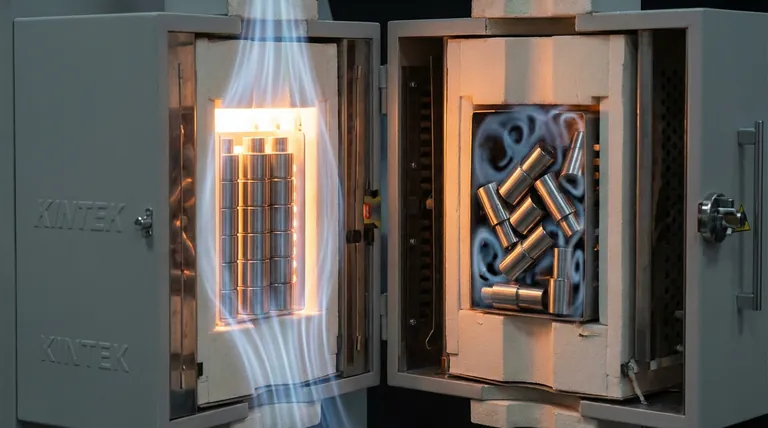
Achieving Metallurgical Consistency
Optimizing the Flow Field
To achieve uniform hardness, the quenching gas must extract heat at the same rate from every part. Vertical stack loading facilitates this by creating straight, vertical channels between workpieces.
This configuration allows the gas to move in an orderly fashion, maintaining high velocity from the top to the bottom of the load.
Eliminating Low-Speed Zones
A critical flaw in non-optimized loading is the creation of "dead zones" where gas velocity drops. The primary reference indicates that vertical configurations effectively eliminate low-speed zones, particularly near the outer walls of the furnace.
By maintaining consistent gas speed throughout the chamber, you prevent the formation of soft spots on parts located at the periphery of the load.
The Risks of Staggered Loading
The Problem of Local Shielding
Staggered stacking creates a physical barrier to the cooling medium. Parts positioned upstream effectively shield those behind or below them, preventing fresh, cold gas from reaching the surfaces of downstream parts.
This results in significant variations in cooling rates, meaning parts from the same batch may have different metallurgical properties.
Turbulence and Unpredictability
While some turbulence is inevitable in high-pressure quenching, staggered loading generates uncontrolled turbulence.
Instead of flowing smoothly over the surfaces, the gas is forced to change direction rapidly. This chaotic movement disrupts the heat transfer process, making it difficult to predict or control the final quality of the parts.
Production Efficiency and Capacity
Maximizing Space Utilization
Beyond quality, vertical stacking offers a distinct economic advantage. It provides higher space utilization, allowing you to fit a larger volume of parts into the furnace chamber without compromising airflow.
Increasing Throughput
Because the flow field is optimized, you can safely load the furnace to its maximum capacity. This results in larger furnace loading capacities per cycle, reducing the cost per part and increasing overall plant throughput.
Operational Considerations and Trade-offs
Fixturing Stability
While vertical stacking is superior for airflow, it requires robust fixturing. Parts must be secured so they do not touch or impede the vertical channels. Poorly stabilized vertical stacks can lead to parts shifting during the rapid pressure changes of quenching.
Geometry Dependence
Vertical loading is ideal for many geometries, but not all. Complex parts with deep recesses may still require specific orientation adjustments. You must ensure that the vertical orientation does not trap gas or liquid (if washing is involved) in internal cavities.
Making the Right Choice for Your Goal
To maximize the efficiency of your batch gas quenching production, align your loading pattern with your specific objectives:
- If your primary focus is Quality Consistency: Adopt vertical stacking to eliminate shielding and ensure every part experiences the same cooling rate.
- If your primary focus is Production Volume: Use vertical configurations to maximize the density of the load without risking the "dead zones" associated with staggered packing.
By matching your loading strategy to the physics of gas flow, you turn a variable process into a reliable, high-yield operation.
Summary Table:
| Feature | Vertical Stack Loading | Staggered Stack Loading |
|---|---|---|
| Airflow Dynamics | Orderly, straight flow channels | Turbulent and chaotic flow |
| Cooling Uniformity | High; eliminates dead zones | Low; causes local shielding |
| Hardness Consistency | Uniform across entire batch | Variable; risk of soft spots |
| Furnace Capacity | Maximum space utilization | Lower density to allow flow |
| Process Predictability | High and repeatable | Low due to shielding effects |
Maximize Your Heat Treatment Precision with KINTEK
Don't let inefficient loading patterns compromise your metallurgical results. KINTEK provides industry-leading thermal solutions backed by expert R&D and manufacturing. Whether you require Muffle, Tube, Rotary, Vacuum, or CVD systems, our high-temperature lab furnaces are fully customizable to meet your unique production needs.
Ready to achieve superior hardening and increased throughput? Contact us today to discover how our advanced furnace technology can transform your batch quenching operations.
Visual Guide
References
- Zaiyong Ma, Jingbo Ma. Research on the uniformity of cooling of gear ring parts under vacuum high-pressure gas quenching. DOI: 10.1088/1742-6596/3080/1/012130
This article is also based on technical information from Kintek Furnace Knowledge Base .
Related Products
- 1200℃ Controlled Inert Nitrogen Atmosphere Furnace
- Vacuum Heat Treat Sintering Furnace with Pressure for Vacuum Sintering
- Vacuum Heat Treat Sintering and Brazing Furnace
- Mesh Belt Controlled Atmosphere Furnace Inert Nitrogen Atmosphere Furnace
- Controlled Inert Nitrogen Hydrogen Atmosphere Furnace
People Also Ask
- What controlled-atmosphere furnace conditions are required for sintering powder metallurgy copper alloy compacts? Ideal Setup
- What Roles Do a Controlled Atmosphere Furnace and Oil Quenching Tank Play in AISI 5140 Steel Heat Treatment?
- What causes discrepancies between theoretical and experimental grain boundary mobility during ceramic sintering? Explained
- How Sintering Temp Affects Density & Resistivity of Cu-Oxide Composites
- Why is a controlled atmosphere furnace required for 316L debinding? Ensure Structural Integrity & Zero Cracks



















