
The high-temperature vacuum sintering furnace is the decisive tool responsible for transforming Ho:Y2O3 (Holmium-doped Yttrium Oxide) from an opaque powder compact into a highly transparent optical ceramic. By generating an extreme environment characterized by temperatures around 1780°C and a vacuum level of 10^-3 Pa, this equipment eliminates the microscopic pores that otherwise scatter light and ruin optical clarity.
Core Takeaway The significance of this furnace lies in its ability to remove environmental gas interference while providing the thermal energy for atomic diffusion. This dual action enables the complete closure of pores between grain boundaries, driving the physical transition of the ceramic from opaque to transparent.
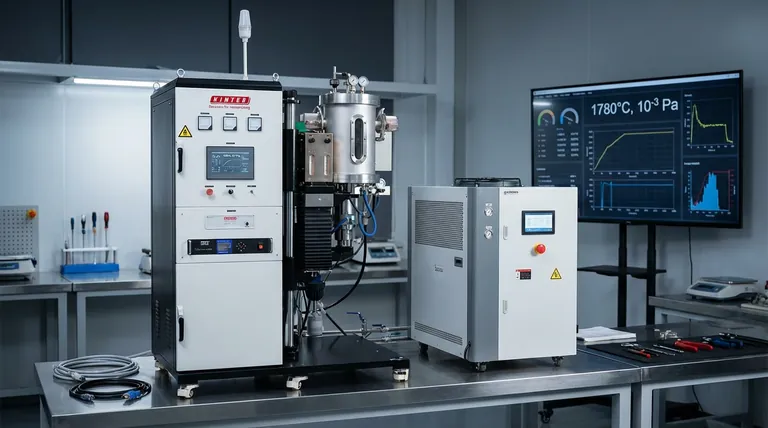
The Physics of Achieving Transparency
Eliminating Light Scattering
The primary obstacle to transparency in ceramics is porosity. Microscopic pores trapped between grains act as scattering centers for light, making the material look opaque or milky.
To achieve glass-like transparency, the relative density of the ceramic must exceed 99%. The vacuum sintering furnace is the mechanism used to close these final, stubborn pores.
The Role of High Vacuum
The furnace maintains a high vacuum, specifically at the magnitude of 10^-3 Pa. This is not merely about keeping the chamber clean; it is a functional requirement for densification.
By creating a vacuum, the furnace removes gases trapped within the tiny pores of the ceramic green body. If this gas were not removed, it would become pressurized as the pores shrank, eventually preventing them from closing completely.
Mechanism of Densification
Thermal Driving Force
The furnace provides a stable thermal field reaching approximately 1780°C. This extreme heat provides the necessary energy for solid-state reactions.
At this temperature, the atoms within the ceramic gain enough energy to move. This mobility is essential for the grains to merge and densify.
Atomic Diffusion at Grain Boundaries
The combination of high heat and vacuum promotes atomic diffusion specifically at the grain boundaries of the yttrium oxide.
As atoms diffuse across these boundaries, they fill in the voids (pores). Because the vacuum has removed the gas, there is no resistance to this closure, allowing the grains to bond perfectly and eliminating the solid-gas interfaces that cause optical scattering.
Understanding the Trade-offs
Process Sensitivity
While vacuum sintering is essential for transparency, it relies entirely on thermal diffusion to close pores. Unlike "hot pressing," which uses mechanical force to crush pores shut, vacuum sintering requires precise control over temperature and time to let physics take its course.
Risk of Contamination
Even in a vacuum, the purity of the furnace environment is critical. At 1780°C, any contaminants in the furnace can react with the ceramic.
Thermal Stress
The high temperatures required for Ho:Y2O3 sintering can induce internal stresses. While the sintering furnace achieves transparency, a secondary low-pressure annealing process is often required later to release these stresses and repair lattice defects.
Making the Right Choice for Your Goal
To maximize the quality of your Ho:Y2O3 ceramics, you must tune the furnace parameters to your specific objectives.
- If your primary focus is Optical Transparency: Ensure your vacuum system can reliably maintain 10^-3 Pa throughout the heating cycle to prevent gas entrapment in the final stage of densification.
- If your primary focus is Microstructural Homogeneity: Prioritize the stability of the 1780°C thermal field to ensure uniform atomic diffusion across the entire sample volume, preventing abnormal grain growth.
Ultimately, the vacuum sintering furnace is not just a heating device; it is a pore-elimination engine that dictates the optical success of your ceramic material.
Summary Table:
| Feature | Specification/Action | Impact on Ho:Y2O3 Ceramic |
|---|---|---|
| Operating Temperature | ~1780°C | Provides thermal energy for atomic diffusion and grain merging |
| Vacuum Level | 10^-3 Pa | Removes trapped gases to prevent pore pressure and light scattering |
| Core Mechanism | Pore Elimination | Drives relative density above 99% for glass-like clarity |
| Material Result | Densification | Transforms opaque powder into a high-performance optical medium |
Elevate Your Material Science with KINTEK Precision
Are you looking to achieve perfect optical clarity and structural integrity in your advanced ceramics? KINTEK provides industry-leading high-temperature vacuum sintering systems engineered for the most demanding R&D and manufacturing requirements.
Why choose KINTEK?
- Expert Engineering: Our Muffle, Tube, Rotary, Vacuum, and CVD systems are backed by professional R&D to ensure thermal stability up to 1780°C and beyond.
- Customizable Solutions: We tailor our lab furnaces to your unique atmospheric and vacuum needs, ensuring 10^-3 Pa precision for pore-free densification.
- Proven Reliability: Trusted by researchers and manufacturers for producing superior Ho:Y2O3 and other transparent ceramic materials.
Ready to optimize your sintering process? Contact us today to discuss your custom furnace needs!
References
- Yan Liu, Hetuo Chen. Fabrication and Luminescence Properties of Highly Transparent Green-Emitting Ho:Y2O3 Ceramics for Laser Diode Lighting. DOI: 10.3390/ma17020402
This article is also based on technical information from Kintek Furnace Knowledge Base .
Related Products
- 2200 ℃ Tungsten Vacuum Heat Treat and Sintering Furnace
- 2200 ℃ Graphite Vacuum Heat Treat Furnace
- Vacuum Heat Treat Sintering Furnace Molybdenum Wire Vacuum Sintering Furnace
- Molybdenum Vacuum Heat Treat Furnace
- 9MPa Air Pressure Vacuum Heat Treat and Sintering Furnace
People Also Ask
- How does a tungsten-heated vacuum sintering furnace prepare (TbxY1-x)2O3 ceramics? Achieve 99%+ Density & Purity
- What wear-resistance enhancements are achieved by powder coating? The Role of Vacuum Sintering Furnaces
- How do compaction pressure and vacuum sintering optimize porous ceramics? Maximize Density & Toughness
- What role does a high-temperature vacuum sintering furnace play in the densification of WC-10(Ni, Ni/Co) alloys?
- What core role does a high-temperature vacuum sintering furnace play in Sm:YAG ceramics? Mastering Optical Clarity



















