
In modern vacuum furnaces, automation is driven by integrated programmable controllers, real-time sensor feedback, and intelligent software. These systems work together to manage everything from complex heating and cooling cycles to safety interlocks and data logging. This transforms the furnace from a manually operated piece of equipment into a precise, repeatable, and largely autonomous system.
The core purpose of modern furnace automation is not just convenience, but the achievement of unparalleled process control. By removing human variability, these systems ensure every batch meets exact specifications, enhancing product quality, operational efficiency, and safety.
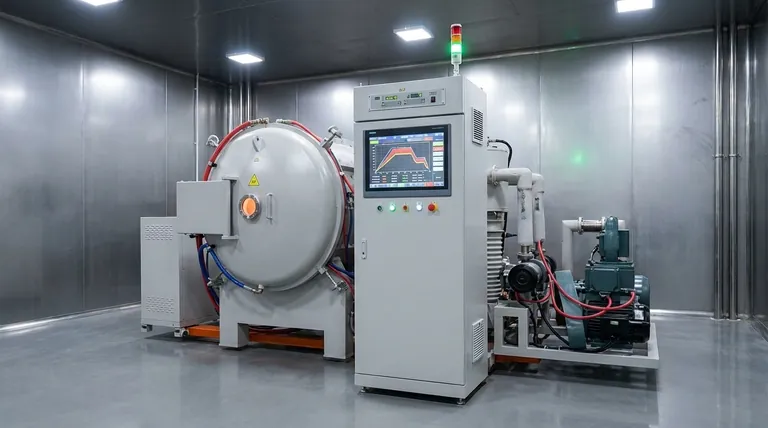
The Pillars of Furnace Automation
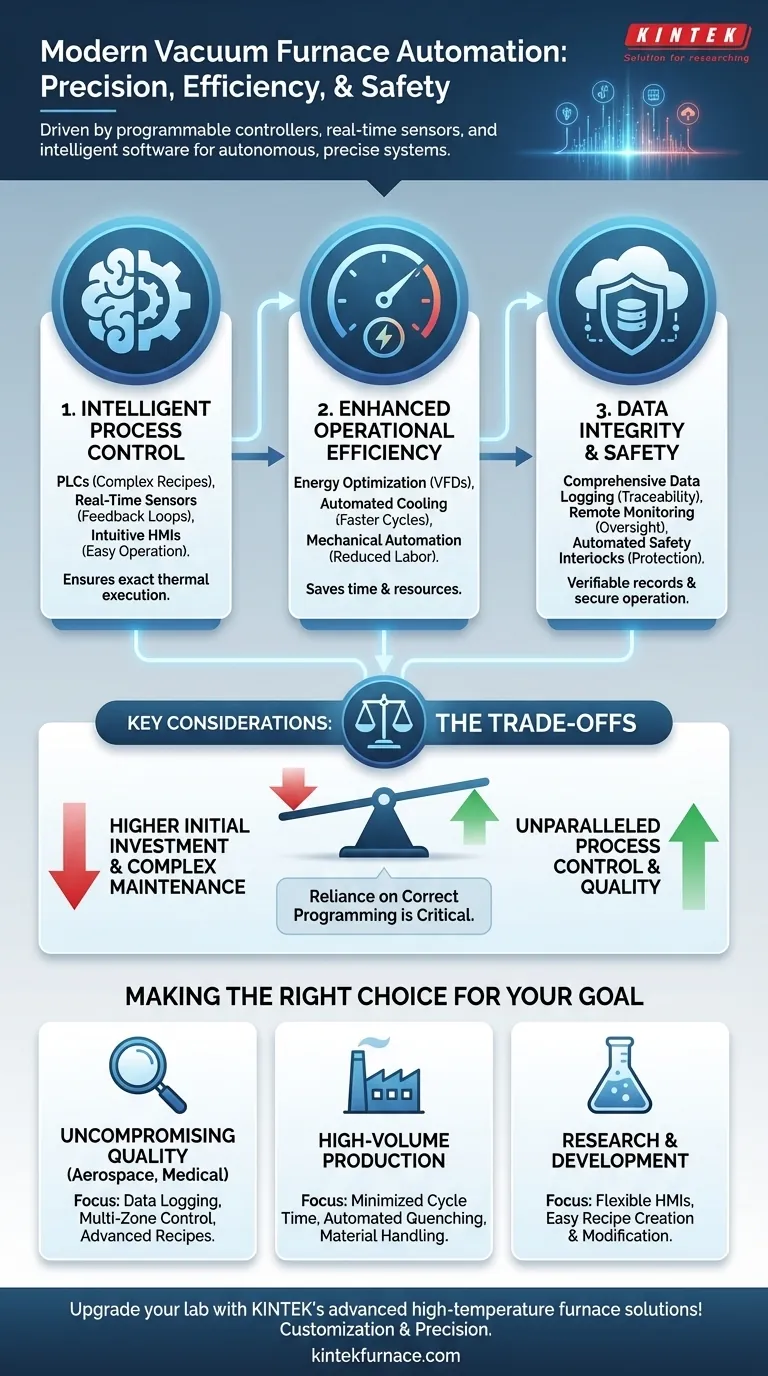
Modern furnace automation is built on three key pillars: process control, operational efficiency, and data management. Each pillar relies on specific hardware and software to function.
Pillar 1: Intelligent Process Control
This is the brain of the operation, ensuring the furnace executes the desired thermal recipe with extreme precision.
Programmable Logic Controllers (PLCs) A PLC acts as the central controller, executing pre-programmed instructions. Advanced systems can handle recipes with dozens of distinct steps, such as specific ramp rates, dwell times, and cooling profiles.
Real-Time Sensor Feedback Embedded sensors for temperature, pressure, and gas flow act as the furnace's nervous system. They constantly feed data back to the PLC, which makes micro-adjustments to maintain perfect conditions.
Human-Machine Interfaces (HMIs) Modern furnaces use intuitive touchscreen interfaces. These HMIs allow operators to easily select recipes, monitor process status in real-time, and make authorized adjustments without needing to be programming experts.
Pillar 2: Enhanced Operational Efficiency
Automation extends beyond the thermal cycle to include features that save energy, reduce manual labor, and shorten overall process time.
Energy Optimization Systems Features like Variable Frequency Drives (VFDs) automatically adjust the speed of pumps and fans, consuming only the energy necessary for the current process step. This drastically reduces electricity costs compared to older, fixed-speed systems.
Automated Cooling and Gas Quenching Instead of waiting for passive cooling, modern systems use computer-controlled fans and gas injection to cool the workload rapidly and uniformly. This significantly shortens the total cycle time, increasing throughput.
Mechanical Automation For specific applications like vacuum casting, automation includes mechanical systems. Features like automated mold clamping and tilt-and-pour mechanisms reduce the need for operator intervention during the most critical phases.
Pillar 3: Data Integrity and Safety
Automation provides a robust framework for ensuring operator safety and creating a verifiable record of the entire process for quality assurance.
Comprehensive Data Logging Every critical process parameter—temperature in multiple zones, vacuum level, gas flow—is recorded throughout the cycle. This creates a permanent digital record, or "birth certificate," for each batch, which is essential for traceability in industries like aerospace and medical.
Remote Monitoring and Control PC integration allows engineers and supervisors to monitor furnace status, review data, and even manage operations remotely. This enhances flexibility and allows for expert oversight without being physically present.
Automated Safety Interlocks The control system continuously monitors for unsafe conditions. It will trigger automatic shutdowns for events like over-temperature, loss of cooling water, or vacuum leaks, protecting both the equipment and personnel.
Understanding the Trade-offs
While automation offers significant advantages, it's important to recognize the associated considerations.
Increased Initial Investment
Furnaces equipped with advanced PLC controls, VFDs, and comprehensive sensor packages have a higher upfront cost than simpler, manually operated models.
Maintenance Complexity
Sophisticated automated systems require technicians with specialized skills for troubleshooting and maintenance. A faulty sensor or PLC programming issue is not a simple mechanical fix.
Reliance on Correct Programming
An automated system will execute its programmed recipe perfectly, even if that recipe is wrong. The initial process validation and programming are critical, as the furnace will not correct a flawed human input.
Making the Right Choice for Your Goal
Your choice of automation features should align directly with your primary objective.
- If your primary focus is uncompromising quality and traceability (aerospace, medical): Prioritize furnaces with comprehensive data logging, multi-zone temperature control, and advanced PLC/PID recipe management.
- If your primary focus is high-volume production: Look for features that minimize cycle time, such as powerful automated gas quenching and mechanical automation for material handling.
- If your primary focus is research and development: Seek a system with a highly flexible and user-friendly HMI that allows for easy creation and modification of complex thermal recipes.
Ultimately, modern automation transforms a vacuum furnace from a simple heat source into an intelligent and reliable manufacturing partner.
Summary Table:
| Automation Feature | Key Components | Primary Benefits |
|---|---|---|
| Intelligent Process Control | PLCs, Real-Time Sensors, HMIs | Precise temperature control, repeatable cycles, easy operation |
| Enhanced Operational Efficiency | VFDs, Automated Cooling, Mechanical Systems | Energy savings, reduced cycle times, less manual labor |
| Data Integrity and Safety | Data Logging, Remote Monitoring, Safety Interlocks | Traceability, remote oversight, enhanced safety |
Upgrade your laboratory with KINTEK's advanced high-temperature furnace solutions! Leveraging exceptional R&D and in-house manufacturing, we provide diverse labs with precise automation features like Muffle, Tube, Rotary Furnaces, Vacuum & Atmosphere Furnaces, and CVD/PECVD Systems. Our strong deep customization capability ensures your unique experimental requirements are met, boosting efficiency, quality, and safety. Contact us today to discuss how our tailored solutions can transform your processes!
Visual Guide
Related Products
- Vacuum Hot Press Furnace Machine Heated Vacuum Press Tube Furnace
- Vacuum Hot Press Furnace Machine Heated Vacuum Press
- 600T Vacuum Induction Hot Press Vacuum Heat Treat and Sintering Furnace
- 2200 ℃ Tungsten Vacuum Heat Treat and Sintering Furnace
- Vacuum Heat Treat Sintering Furnace with Pressure for Vacuum Sintering
People Also Ask
- Why use Vacuum Hot Press (VHP) for ZnS Ceramics? Achieve Superior IR Transparency and Mechanical Strength
- What are the benefits of the vacuum environment system in a vacuum hot press furnace? Unlock High-Density Sintering
- What safety features are incorporated in vacuum hot press furnaces? Ensure Operator and Equipment Protection
- What temperature control features do vacuum hot press furnaces have? Achieve Precision in High-Temp Material Processing
- Which process parameters must be optimized for specific materials in a vacuum hot press furnace? Achieve Optimal Density and Microstructure



















