
In the aerospace industry, furnace brazing is a critical joining process used to manufacture high-performance components like engine parts, heat exchangers, and complex structural assemblies. It is the preferred method for creating strong, durable, and oxidation-free joints in lightweight, high-strength materials such as titanium alloys and nickel-based superalloys, which are essential for modern aircraft.
Furnace brazing is more than a simple joining technique; it is a precision manufacturing process that enables the creation of complex, lightweight, and incredibly reliable components that are often impossible to produce with conventional welding or other methods.
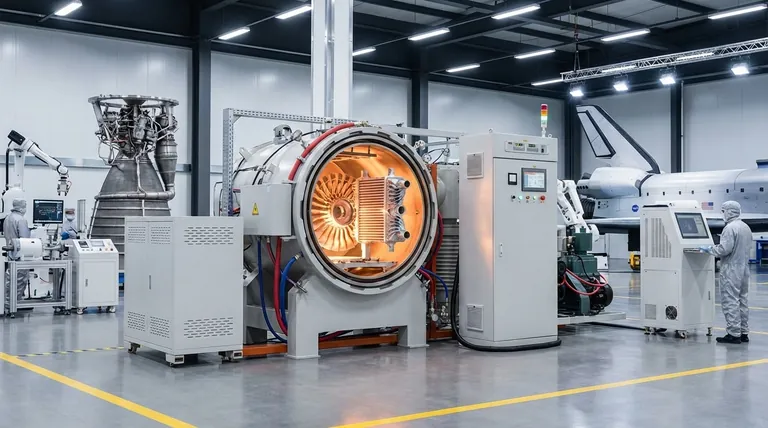
The Role of Furnace Brazing in Aerospace Manufacturing
Furnace brazing is a process where a filler metal with a lower melting point is used to join two or more base materials. The entire assembly is heated in a controlled-atmosphere furnace, causing the filler metal to melt and flow into the joint by capillary action without melting the base materials.
The Core Principle: Joining Without Melting
The fundamental advantage of brazing is its ability to create a strong metallurgical bond without compromising the integrity of the parent materials. This is crucial for high-performance alloys that can be damaged by the intense, localized heat of welding.
The process ensures minimal thermal distortion, allowing for the assembly of intricate parts with very tight tolerances.
The Controlled Atmosphere is Key
Aerospace brazing is almost always performed in a vacuum or a controlled inert gas environment. This prevents the formation of oxides on the metal surfaces, which would otherwise weaken the joint.
This clean, flux-free process results in a strong, leak-tight, and contaminant-free bond, which is a non-negotiable requirement for critical flight components.
Key Aerospace Applications
The unique capabilities of furnace brazing make it indispensable for several specific applications where performance and reliability are paramount.
Aircraft Engine Components
Furnace brazing is used to assemble complex parts within turbine engines, such as blades, vanes, and combustion chambers. These components are often made from nickel-based superalloys that must withstand extreme temperatures and stresses.
Heat Exchangers
The ability to join thin, complex geometries makes furnace brazing ideal for manufacturing compact and highly efficient heat exchangers. These are vital for managing thermal loads in engine, hydraulic, and environmental control systems.
Structural Assemblies
The process is used to join lightweight structural components, including honeycomb panels and other complex assemblies. This allows for the creation of rigid, lightweight structures that reduce overall aircraft weight while maintaining strength.
Understanding the Trade-offs and Distinctions
While powerful, furnace brazing is one of several high-temperature furnace processes used in aerospace. Understanding the distinctions is crucial.
Brazing for Joining
The sole purpose of furnace brazing is to join separate components into a single assembly. It is selected when high joint integrity, complex geometry, or the use of sensitive materials makes welding impractical.
Heat Treatment for Properties
Other furnace processes, like vacuum heat treating, are used to alter the properties of a single material, not to join it. For example, aluminum alloys used in aircraft structures are heat-treated to achieve optimal strength and durability. This is a material enhancement process.
Material Testing for Safety
Finally, specialized muffle furnaces are used for testing, not production. They subject materials to extreme heat to evaluate flame retardancy and thermal resistance, ensuring all components meet strict aerospace safety standards.
Making the Right Choice for Your Goal
The selection of furnace brazing is a strategic decision driven by specific engineering requirements for performance, weight, and reliability.
- If your primary focus is performance and weight reduction: Furnace brazing is the definitive method for joining complex, lightweight superalloys in critical systems like engines.
- If your primary focus is reliability and safety: The oxidation-free, high-integrity joints created by this process are essential for components that absolutely cannot fail.
- If your primary focus is manufacturing complex designs: Furnace brazing allows for the creation of intricate assemblies with thin walls and internal channels that are impossible to produce otherwise.
Ultimately, furnace brazing is a foundational technology that enables the design and production of advanced, safe, and efficient aerospace systems.
Summary Table:
| Application | Key Benefit of Furnace Brazing |
|---|---|
| Aircraft Engine Components | Joins heat-resistant superalloys without damaging them. |
| Heat Exchangers | Creates leak-tight seals in complex, thin-walled geometries. |
| Structural Assemblies | Enables lightweight, high-strength designs like honeycomb panels. |
Need a reliable, high-integrity joining solution for your aerospace components?
Furnace brazing is essential for creating the strong, oxidation-free joints required in critical flight systems. At KINTEK, our expertise in high-temperature furnace technology directly supports this advanced manufacturing process.
Backed by expert R&D and manufacturing, KINTEK offers Muffle, Tube, Rotary, Vacuum, and CVD furnace systems—all customizable for your unique brazing and heat treatment needs. Let us help you achieve the performance and reliability your applications demand.
Contact our experts today to discuss your project requirements.
Visual Guide

Related Products
- Vacuum Heat Treat Sintering and Brazing Furnace
- Small Vacuum Heat Treat and Tungsten Wire Sintering Furnace
- High Temperature Muffle Oven Furnace for Laboratory Debinding and Pre Sintering
- Dental Porcelain Zirconia Sintering Ceramic Vacuum Press Furnace
- Vacuum Dental Porcelain Sintering Furnace for Dental Laboratories
People Also Ask
- What is one of the most important uses of vacuum heat treating furnaces in aerospace? Achieve Superior Strength in Aircraft Alloys
- What are the benefits of using vacuum heat treating furnaces for metal alloys? Achieve Superior Metal Properties and Performance
- How does vacuum heat treating affect the grain structure of metal alloys? Achieve Precise Microstructure Control
- What is the temperature of a vacuum furnace brazing? Optimize Your Joint Strength and Cleanliness
- What are the steps involved in a typical vacuum brazing treatment? Master the Process for Strong, Clean Joints



















