
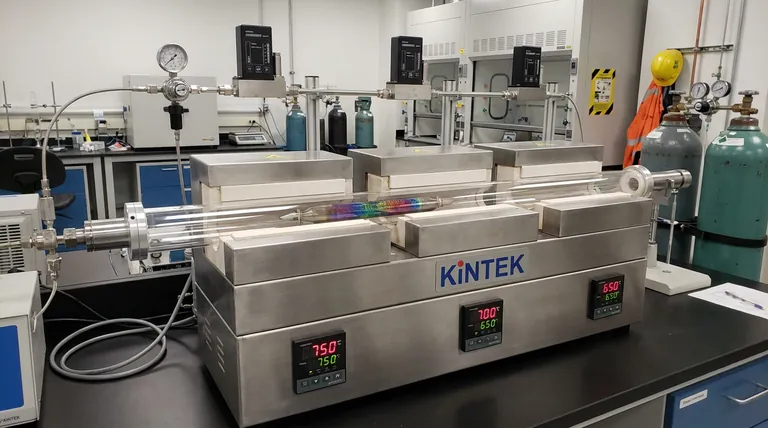
The primary advantage of using a three-zone tube furnace for Fe3GeTe2 thermal treatment is the ability to independently control temperatures across distinct heating sections. Unlike a single-zone furnace, which is designed for uniform heating, a three-zone system allows you to establish a precise and stable temperature gradient between the source and growth zones.
Core Insight: The structural quality of Fe3GeTe2 crystals relies heavily on the Chemical Vapor Transport (CVT) process. A three-zone furnace is essential because it generates the specific thermal gradient required to control gaseous precursor supersaturation, which directly dictates the nucleation rate and final crystal purity.
The Role of Gradient Control in Crystal Growth
Establishing Distinct Thermal Environments
A single-zone furnace typically maintains one uniform temperature throughout the tube. In contrast, a three-zone furnace allows you to set different temperatures for the left, center, and right zones.
The Source vs. Growth Configuration
For Fe3GeTe2, this capability allows you to create a specific thermal profile essential for transport. You can maintain a high-temperature "source zone" (e.g., 750 °C) while simultaneously maintaining a lower-temperature "growth zone" (e.g., 650 °C).
Stability Across the Tube
The three-zone configuration ensures that these temperature differences are stable over time. This stability prevents fluctuations that could disrupt the delicate transport of materials from the hot end to the cool end.
Impact on the Chemical Vapor Transport (CVT) Process
Driving the Transport Mechanism
The temperature gradient is the "engine" of the CVT process. By precisely controlling the difference between the 750 °C source and the 650 °C growth zone, you create the thermodynamic drive necessary to move the material through the tube.
Controlling Supersaturation
The specific gradient determines the supersaturation of the gaseous precursor in the growth zone. If the gradient is too shallow or too steep, the saturation levels will not support optimal growth.
Regulating Nucleation and Quality
Supersaturation directly influences the nucleation rate. By fine-tuning the zones to manage this rate, you ensure the Fe3GeTe2 crystals grow with high structural quality rather than forming amorphous or defect-heavy solids.
Broader Operational Benefits
Mitigation of Edge Effects
Even if you aim for a relatively flat profile, single-zone furnaces often suffer from heat loss at the ends of the tube. A three-zone furnace can compensate for this by applying slightly higher power to the outer zones, ensuring true uniformity across the central length.
Process Flexibility
The ability to customize profiles provides significant versatility. You can run complex, multi-stage temperature programs that a single-zone controller cannot replicate, adapting to different material requirements beyond Fe3GeTe2.
Understanding the Trade-offs
Complexity of Calibration
With three independent controllers, the system is inherently more complex. Achieving a linear or specific non-linear gradient requires careful calibration to ensure one zone's heat does not inadvertently destabilize the adjacent zone.
Application Mismatch
If your goal is purely isothermal treatment—such as long-term annealing where the entire sample must stay at exactly 700 °C to eliminate segregation—a three-zone furnace may be unnecessary. In such cases, the simplicity of a single-zone furnace is often sufficient and more cost-effective.
Making the Right Choice for Your Goal
To maximize the quality of your Fe3GeTe2 crystals, align your equipment choice with your specific process step:
- If your primary focus is Chemical Vapor Transport (CVT): You must use a three-zone furnace to establish the precise 750 °C to 650 °C gradient required for controlled nucleation.
- If your primary focus is simple solid-phase annealing: A single-zone furnace may suffice, provided it offers a stable isothermal field for long-duration treatments.
- If your primary focus is process reproducibility: The three-zone system offers superior control over thermal profiles, reducing material waste and ensuring consistent output batches.
By leveraging the independent control of a three-zone system, you move from simple heating to precise thermodynamic engineering of your crystal growth environment.
Summary Table:
| Feature | Single-Zone Tube Furnace | Three-Zone Tube Furnace |
|---|---|---|
| Temperature Profile | Uniform / Isothermal | Customizable Gradient |
| Control Mechanism | Single Controller | Three Independent Controllers |
| CVT Suitability | Low (Difficult to maintain gradient) | High (Ideal for source/growth zones) |
| Edge Effect Mitigation | Poor (Heat loss at ends) | Excellent (Compensated by outer zones) |
| Best Use Case | Basic Annealing & Sintering | Complex Crystal Growth & CVD/CVT |
Elevate Your Crystal Growth Precision with KINTEK
Unlock the full potential of your Fe3GeTe2 synthesis and Chemical Vapor Transport (CVT) processes. KINTEK provides industry-leading thermal solutions backed by expert R&D and precision manufacturing. Whether you need advanced Three-Zone Tube Furnaces, CVD systems, or custom high-temperature lab furnaces, our equipment is designed to deliver the exact thermal gradients required for high-purity results.
Ready to optimize your lab’s efficiency and reproducibility?
Contact KINTEK today to discuss your customizable furnace needs
References
- Microthermoreflectance Characterization of the Band‐Structure Transformations Observed During the Magnetic‐Ordering Transitions of Multilayered 2D Fe <sub>3</sub> GeTe <sub>2</sub> Ferromagnetic Metals. DOI: 10.1002/smsc.202500293
This article is also based on technical information from Kintek Furnace Knowledge Base .
Related Products
- Laboratory Quartz Tube Furnace RTP Heating Tubular Furnace
- Multi Heating Zones CVD Tube Furnace Machine for Chemical Vapor Deposition Equipment
- Multi Zone Laboratory Quartz Tube Furnace Tubular Furnace
- Split Multi Heating Zone Rotary Tube Furnace Rotating Tube Furnace
- Magnesium Extraction and Purification Condensing Tube Furnace
People Also Ask
- What physical conditions does a laboratory Tube Furnace provide for SOEC? Precision Heat for Solid Oxide Characterization
- What are the main features and functions of a laboratory tube furnace? Unlock Precise High-Temp Control for Your Lab
- Why is a laboratory tube furnace necessary for BiVO4/RGO synthesis? Achieve Precise Nano-Structure Control
- What conditions does a tube furnace provide for post-ion-implantation? Achieve Precise Microstructural Repair
- Why is control of heating rate and gas flow in a lab tube furnace critical for EM wave absorption materials?



















