
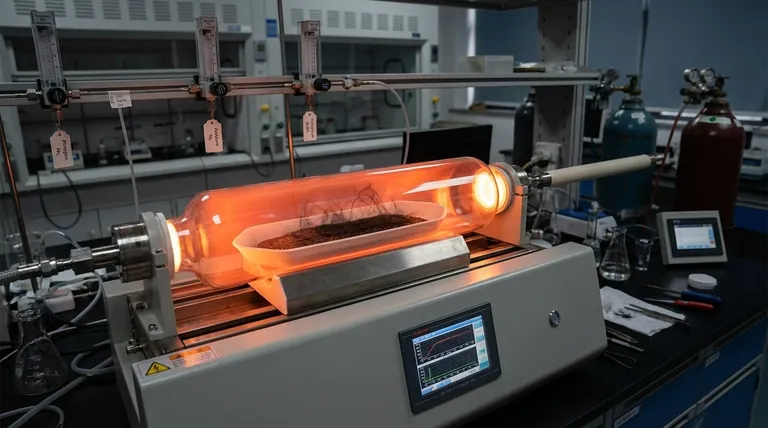
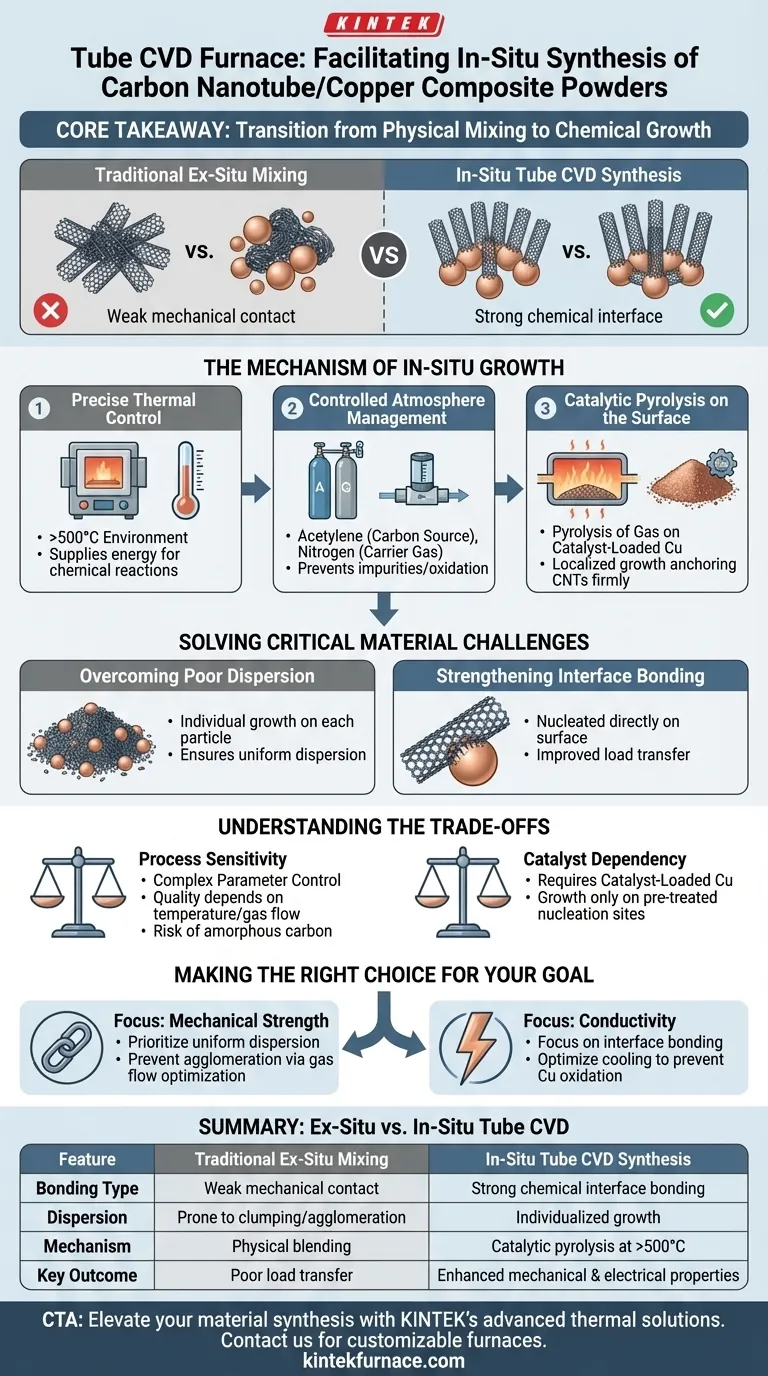
The Tube CVD furnace facilitates in-situ synthesis by creating a precisely controlled thermal and chemical environment that grows carbon nanotubes (CNTs) directly onto copper particles. Specifically, it maintains temperatures typically above 500°C while introducing a carbon-rich gas mixture, such as acetylene and nitrogen. This setup triggers the pyrolysis of the gas on catalyst-loaded copper, resulting in nanotubes that are chemically bonded to the metal substrate rather than just mechanically mixed.
Core Takeaway The primary advantage of using a Tube CVD furnace is the transition from physical mixing to chemical growth. By growing CNTs directly on the copper surface (in-situ), this process eliminates the agglomeration and weak interface bonding issues inherent in traditional ex-situ mixing methods.
The Mechanism of In-Situ Growth
Precise Thermal Control
The fundamental role of the Tube CVD furnace is to provide a high-temperature environment, typically exceeding 500°C.
This heat is critical for initiating the chemical reactions necessary for synthesis. It supplies the energy required to break down carbon precursor gases into atomic carbon.
Controlled Atmosphere Management
The tube design allows for the introduction of specific gas mixtures, such as acetylene (the carbon source) and nitrogen (the carrier or protective gas).
By strictly controlling this atmosphere, the furnace ensures that the carbon is available for growth without introducing unwanted impurities or uncontrolled oxidation.
Catalytic Pyrolysis on the Surface
Inside the heated zone, the carbon source gas undergoes pyrolysis (thermal decomposition).
Because the copper powder is loaded with a catalyst, this decomposition happens specifically on the surface of the copper particles. This localization ensures that the carbon nanotubes grow outwards from the copper, anchoring them firmly to the metal.
Solving Critical Material Challenges
Overcoming Poor Dispersion
Traditional methods often involve physically mixing loose CNTs with copper powder, which leads to clumping and uneven distribution.
The Tube CVD method solves this by growing the nanotubes individually on each copper particle. This ensures uniform dispersion throughout the composite powder before it is ever consolidated into a solid part.
Strengthening Interface Bonding
In ex-situ mixing, the CNTs and copper interact only through weak mechanical contact.
The in-situ growth facilitated by the furnace creates a strong interface bond. Since the CNTs are nucleated directly on the copper surface, the load transfer between the matrix (copper) and the reinforcement (CNT) is significantly improved.
Understanding the Trade-offs
Process Sensitivity
While the Tube CVD furnace creates superior materials, it introduces complexity regarding parameter control.
The quality of the CNTs depends heavily on maintaining exact temperatures and gas flow rates. Deviations can lead to incomplete growth or the formation of amorphous carbon rather than structured nanotubes.
Catalyst Dependency
The process described relies on catalyst-loaded copper powder.
The furnace facilitates the growth, but the copper powder must be pre-treated with a catalyst to serve as effective nucleation sites. The furnace cannot force growth on inert, untreated copper surfaces without this catalytic driver.
Making the Right Choice for Your Goal
To maximize the effectiveness of a Tube CVD furnace for this application, consider your specific end-goals:
- If your primary focus is mechanical strength: Prioritize the uniform dispersion aspect; ensure your gas flow rates prevent carbon saturation that could lead to agglomeration.
- If your primary focus is conductivity: Focus on the interface bonding; optimize the cooling phase in the controlled atmosphere to prevent post-growth oxidation of the copper.
The Tube CVD furnace is not just a heater; it is a reactor that replaces the mechanical limitations of mixing with the chemical precision of growth.
Summary Table:
| Feature | Traditional Ex-Situ Mixing | In-Situ Tube CVD Synthesis |
|---|---|---|
| Bonding Type | Weak mechanical contact | Strong chemical interface bonding |
| Dispersion | Prone to clumping/agglomeration | Individualized growth on each particle |
| Mechanism | Physical blending of powders | Catalytic pyrolysis at >500°C |
| Key Outcome | Poor load transfer | Enhanced mechanical & electrical properties |
Elevate your material synthesis with KINTEK’s advanced thermal solutions. Backed by expert R&D and manufacturing, KINTEK offers customizable Muffle, Tube, Rotary, Vacuum, and CVD systems designed to meet the rigorous demands of in-situ synthesis and material research. Whether you are optimizing interface bonding or ensuring uniform dispersion for next-generation composites, our lab high-temp furnaces provide the precision you need. Contact KINTEK today to discuss your unique project requirements!
Visual Guide
Related Products
- Custom Made Versatile CVD Tube Furnace Chemical Vapor Deposition CVD Equipment Machine
- Split Chamber CVD Tube Furnace with Vacuum Station CVD Machine
- Multi Heating Zones CVD Tube Furnace Machine for Chemical Vapor Deposition Equipment
- Slide PECVD Tube Furnace with Liquid Gasifier PECVD Machine
- Inclined Rotary Plasma Enhanced Chemical Deposition PECVD Tube Furnace Machine
People Also Ask
- Why are CVD tube furnace sintering systems indispensable for 2D material research and production? Unlock Atomic-Scale Precision
- What is a CVD tube furnace and what is its primary function? Discover Precision Thin-Film Deposition
- How does CVD tube furnace sintering enhance graphene growth? Achieve Superior Crystallinity and High Electron Mobility
- Which industries and research fields benefit from CVD tube furnace sintering systems for 2D materials? Unlock Next-Gen Tech Innovations
- What are the key application fields of CVD tube furnaces? Unlock Precision in Thin-Film Synthesis



















