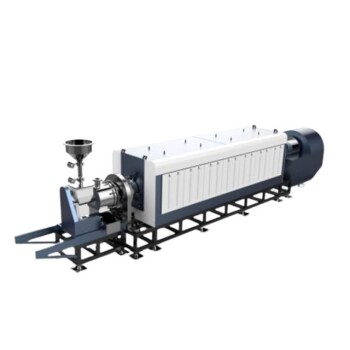
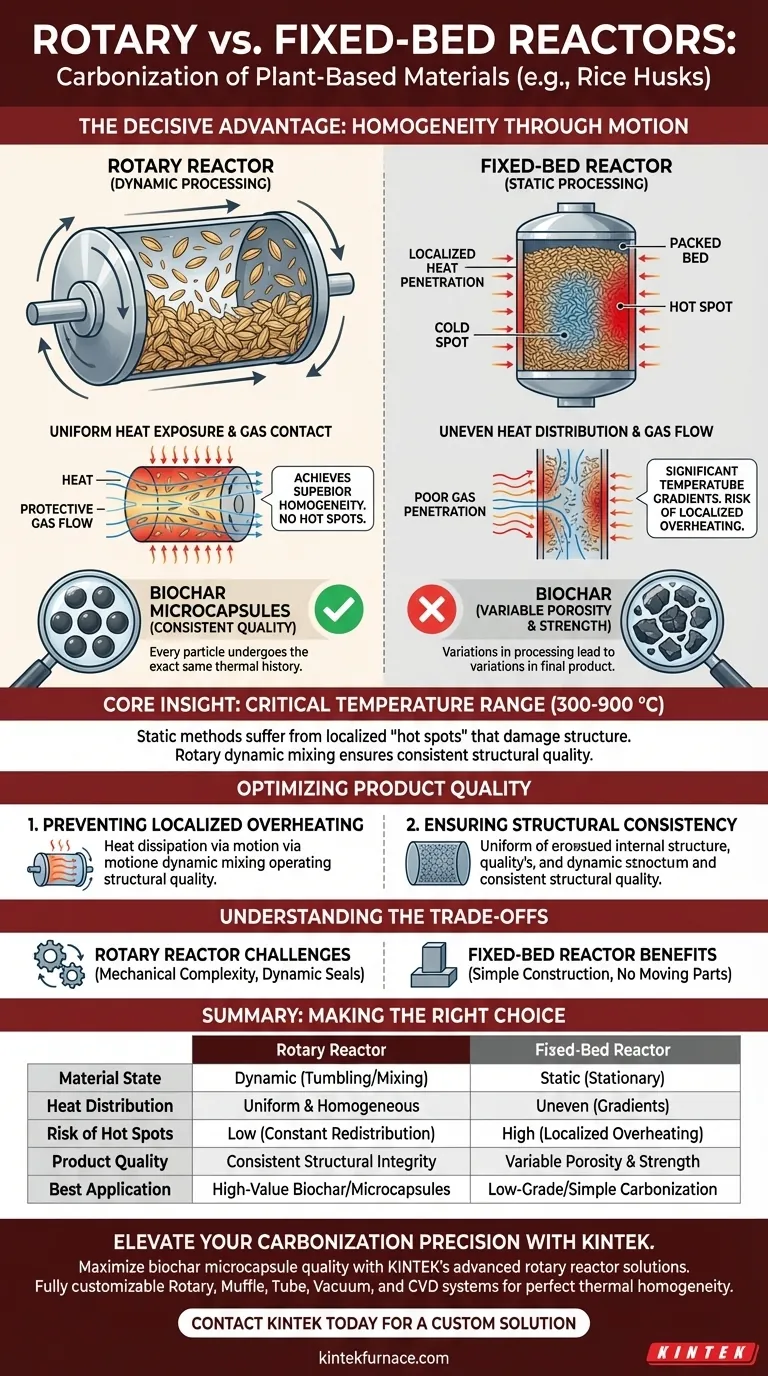
The decisive advantage of a rotary reactor over a fixed-bed reactor for carbonizing rice husks lies in its ability to achieve superior homogeneity through continuous mechanical motion. While a fixed-bed reactor keeps material static—often leading to uneven heat distribution—a rotary reactor tumbles the biomass, ensuring uniform exposure to heat and protective gases.
Core Insight: In the critical temperature range of 300 to 900 °C, static processing methods often suffer from localized "hot spots" that damage product structure. A rotary reactor solves this by dynamically mixing the raw material, ensuring that every particle undergoes the exact same thermal history to produce biochar microcapsules of consistent structural quality.
The Mechanics of Uniformity
The Limit of Static Processing
In a standard fixed-bed reactor, the biomass (such as rice husks) remains stationary throughout the process. Heat must penetrate the material via conduction, which is often inefficient in porous plant fibers.
This static arrangement frequently leads to significant temperature gradients. Material closest to the heat source may burn or overheat, while material in the center may remain under-processed.
Achieving Dynamic Contact
The rotary reactor introduces a continuous rotation mechanism. This creates a tumbling motion that constantly redistributes the rice husks within the chamber.
According to technical observations, this motion ensures "thorough contact" between three critical elements: the raw material, the heat source, and the protective gas. This interaction is virtually impossible to achieve in a packed, static bed.
Optimizing Product Quality
Preventing Localized Overheating
One of the most significant risks in carbonization is localized overheating. In a fixed bed, trapped heat can degrade the biomass beyond the desired carbonization point, effectively destroying the microstructure.
The rotary reactor’s dynamic mixing effectively prevents this. By constantly moving the particles, heat is dissipated evenly, ensuring no single section of the batch is exposed to excessive temperatures for prolonged periods.
Ensuring Structural Consistency
For applications involving biochar microcapsules, the internal structure of the carbonized husk is paramount. Variations in processing lead to variations in the final product's porosity and strength.
The rotary process guarantees "structural consistency." Because the tumbling motion eliminates uneven carbonization, the resulting biochar exhibits a uniform quality that is difficult to replicate in static systems.
Understanding the Trade-offs
Mechanical Complexity
While the rotary reactor offers superior product quality, it introduces mechanical complexity. Fixed-bed reactors have no moving parts, making them simpler to construct and maintain.
Sealing and Atmosphere Control
Rotary reactors require dynamic seals to maintain the protective gas atmosphere while the drum rotates. This adds a layer of engineering difficulty compared to the sealed, static vessel of a fixed-bed reactor.
Making the Right Choice for Your Goal
When selecting a reactor type for plant-based carbonization, align your choice with your specific product requirements:
- If your primary focus is Product Consistency: Choose the rotary reactor to ensure uniform heat transfer and high-quality, structurally sound biochar microcapsules.
- If your primary focus is System Simplicity: A fixed-bed reactor may suffice for lower-grade applications where slight variations in carbonization are acceptable.
Ultimately, for high-value biochar microcapsules where structural integrity is non-negotiable, the dynamic mixing of a rotary reactor is the superior technical solution.
Summary Table:
| Feature | Rotary Reactor | Fixed-Bed Reactor |
|---|---|---|
| Material State | Dynamic (Tumbling/Mixing) | Static (Stationary) |
| Heat Distribution | Uniform & Homogeneous | Uneven (Temperature Gradients) |
| Risk of Hot Spots | Low (Constant Redistribution) | High (Localized Overheating) |
| Product Quality | Consistent Structural Integrity | Variable Porosity & Strength |
| Best Application | High-Value Biochar/Microcapsules | Low-Grade/Simple Carbonization |
Elevate Your Carbonization Precision with KINTEK
Maximize the quality of your biochar microcapsules with KINTEK’s advanced rotary reactor solutions. Backed by expert R&D and world-class manufacturing, we offer Rotary, Muffle, Tube, Vacuum, and CVD systems—all fully customizable to meet your specific laboratory or industrial high-temperature needs.
Don't settle for uneven results. Let our experts help you design a system that ensures perfect thermal homogeneity and structural consistency for your plant-based materials.
Contact KINTEK Today for a Custom Solution
Visual Guide
References
- Alibek Mutushev, Dauren Mukhanov. Development and application of microcapsules based on rice husk and metallurgical sludge to improve soil fertility. DOI: 10.1038/s41598-024-73329-4
This article is also based on technical information from Kintek Furnace Knowledge Base .
Related Products
- Electric Rotary Kiln Small Rotary Furnace for Activated Carbon Regeneration
- Electric Rotary Kiln Small Rotary Furnace Biomass Pyrolysis Plant Rotating Furnace
- Inclined Rotary Plasma Enhanced Chemical Deposition PECVD Tube Furnace Machine
- Inclined Rotary Plasma Enhanced Chemical Deposition PECVD Tube Furnace Machine
- Electric Rotary Kiln Continuous Working Small Rotary Furnace Kiln for Pyrolysis Plant Heating
People Also Ask
- What are the main applications of a rotary kiln electric furnace? Achieve Uniform Heat Treatment for Powders
- What are the key components of a rotary kiln electric furnace? Unlock Efficient Thermal Processing
- What is the significance of the refractory lining in a rotary kiln electric furnace? Unlock Efficiency and Longevity
- What advantages do electric rotary kilns offer over fuel-based kilns? Boost Efficiency and Purity in Your Process
- What materials can be processed in an electric rotary kiln? Versatile Solutions for Advanced Materials