The C-type thermocouple offers superior precision and stability for experiments conducted in extreme environments. Specifically, it provides reliable real-time temperature monitoring in conditions exceeding 1000 °C, ensuring that thermal fluctuations are kept within a tight error margin to guarantee data integrity.
The defining advantage of the C-type (tungsten-rhenium) thermocouple is its excellent thermoelectric potential stability. This characteristic allows researchers to control temperatures with ±2 °C precision, which is critical for the scientific reliability of partitioning coefficient measurements.
Engineering for Extreme Environments
Composition and Durability
The C-type thermocouple is constructed from tungsten-rhenium alloys. This material composition is specifically selected to withstand the rigors of high-temperature and high-pressure experimentation.
Stability at Temperatures Exceeding 1000 °C
Standard sensors often degrade or drift when pushed beyond certain thermal limits. The C-type thermocouple maintains excellent thermoelectric potential stability even in environments that exceed 1000 °C.
Resistance to Oxidation
In addition to thermal stability, this specific thermocouple type exhibits oxidation resistance in these extremely high-temperature settings. This resistance is vital for maintaining the sensor's physical integrity and calibration over the duration of an experiment.
Precision in Measurement
Minimizing Error Margins
For sensitive scientific measurements, temperature control is paramount. The C-type thermocouple ensures that temperature fluctuations are strictly controlled within an error margin of ±2 °C.
Real-Time Monitoring Capabilities
This tool allows for precise, real-time monitoring of conditions within the sample chamber. Immediate feedback on temperature changes allows for dynamic adjustments to maintain experimental conditions.
Ensuring Scientific Reliability
The ultimate goal of using such a precise instrument is valid data. By stabilizing the environment, the C-type thermocouple guarantees the reliability of complex metrics, such as partitioning coefficient measurements.
Operational Considerations
The Cost of Precision
While the C-type thermocouple provides exceptional accuracy, it is a specialized tool. Relying on this level of precision requires a setup capable of interpreting and managing the data to maintain the ±2 °C standard.
Application Specificity
This thermocouple is optimized for "sample chamber" environments where potential stability is the priority. It is most effective when the experiment demands high scientific rigor regarding thermal fluctuations.
Making the Right Choice for Your Experiment
To determine if the C-type thermocouple is the correct sensor for your specific application, consider your tolerance for error and your environmental baselines.
- If your primary focus is High-Temperature Precision: Use this thermocouple to ensure temperature fluctuations remain strictly within the ±2 °C error margin.
- If your primary focus is Data Integrity: Rely on the C-type's thermoelectric stability to validate partitioning coefficient measurements in environments over 1000 °C.
By selecting a sensor with high potential stability and oxidation resistance, you transform temperature from a variable of uncertainty into a controlled constant.
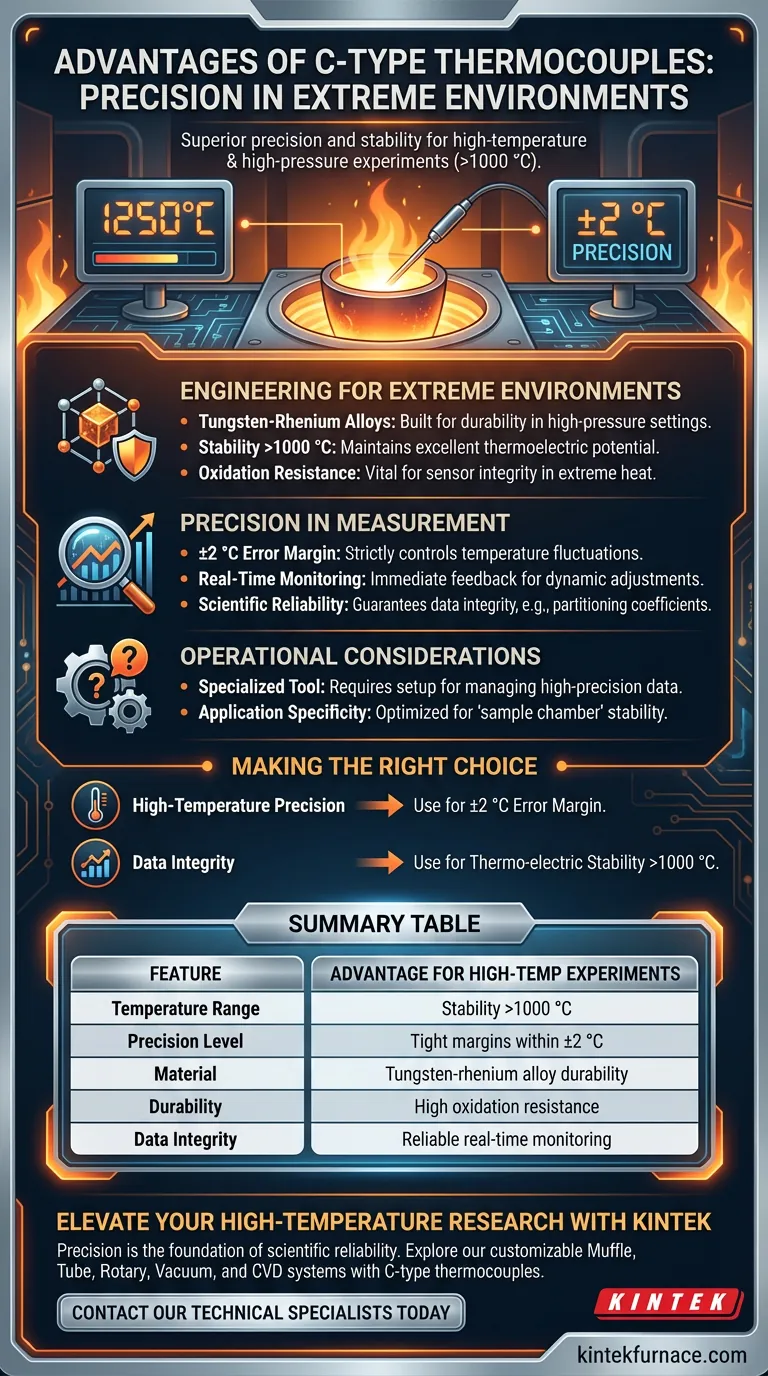
Summary Table:
| Feature | Advantage for High-Temp Experiments |
|---|---|
| Temperature Range | Excellent stability in environments exceeding 1000 °C |
| Precision Level | Maintains tight error margins within ±2 °C |
| Material | Tungsten-rhenium alloy for superior durability |
| Durability | High resistance to oxidation in extreme conditions |
| Data Integrity | Reliable real-time monitoring for partitioning measurements |
Elevate Your High-Temperature Research with KINTEK
Precision is the foundation of scientific reliability. Whether you are conducting complex partitioning coefficient measurements or high-pressure material synthesis, KINTEK provides the advanced thermal solutions you need.
Backed by expert R&D and manufacturing, we offer a comprehensive range of lab high-temp systems—including Muffle, Tube, Rotary, Vacuum, and CVD systems—all of which can be customized with high-precision C-type thermocouples to meet your unique experimental needs.
Don't let thermal fluctuations compromise your data. Contact our technical specialists today to discover how our customizable furnaces can transform your laboratory efficiency and ensure absolute control over your thermal environment.
Visual Guide
References
- Wanying Wang, Yuan Li. Redox control of the partitioning of platinum and palladium into magmatic sulfide liquids. DOI: 10.1038/s43247-024-01366-y
This article is also based on technical information from Kintek Furnace Knowledge Base .
Related Products
- Multi Heating Zones CVD Tube Furnace Machine for Chemical Vapor Deposition Equipment
- Multi Zone Laboratory Quartz Tube Furnace Tubular Furnace
- High Temperature Muffle Oven Furnace for Laboratory Debinding and Pre Sintering
- Vertical Laboratory Quartz Tube Furnace Tubular Furnace
- 1700℃ High Temperature Laboratory Tube Furnace with Alumina Tube
People Also Ask
- What is the function of a multi-zone tube furnace in CVD synthesis? Master 2D In2Se3 Nanosheet Precision
- What environmental protection applications utilize multi zone tube furnaces? Unlock Precision in Waste Treatment and Green Tech
- What role do multi zone tube furnaces play in new energy research? Unlock Precise Thermal Control for Innovation
- Why are multi zone tube furnaces particularly useful for nanomaterial research? Unlock Precise Thermal Control for Advanced Synthesis
- What temperature-related capabilities make multi zone tube furnaces valuable for research? Unlock Precision Thermal Control