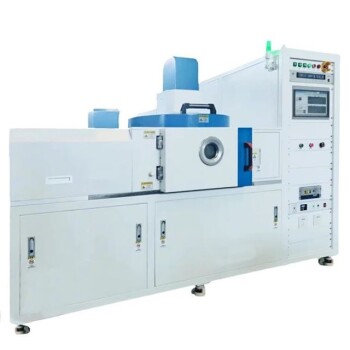
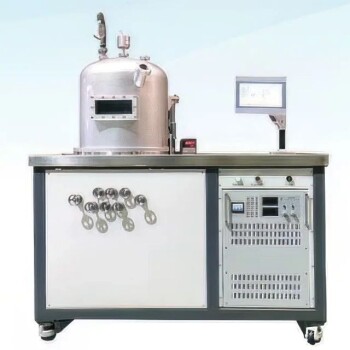
At its core, Microwave Plasma Chemical Vapor Deposition (MPCVD) is a foundational technology used in industries where material purity and performance are non-negotiable. It is most commonly found in the manufacturing of high-purity gems, advanced electronics, precision optics, and specialized medical devices, with growing applications in material science and electrochemistry. The system's primary function is to grow exceptionally high-quality diamond films and other carbon nanostructures.
The true value of MPCVD is not just the industries it serves, but the specific capability it enables: the controlled, low-contamination growth of ultra-pure materials like synthetic diamond. This ability to engineer materials with superior properties at the atomic level is what makes it indispensable for creating next-generation components.
What Makes MPCVD a Critical Technology?
To understand MPCVD's role, you must first understand what it does better than any other process. It isn't just about making coatings; it's about creating a fundamentally superior material from a gaseous state.
The Principle: Creating Diamond from Gas
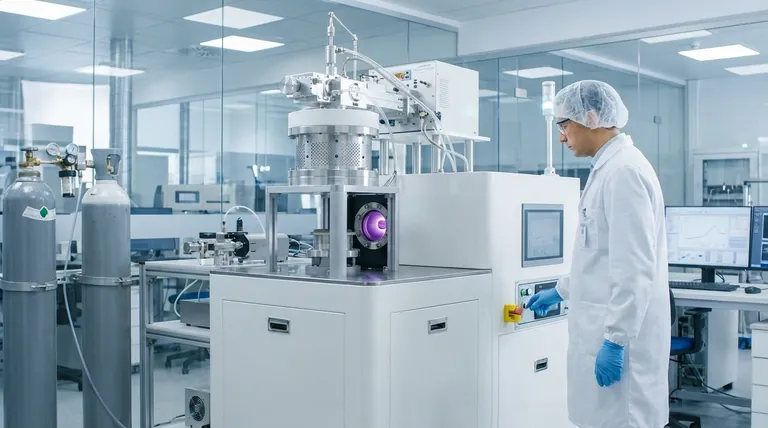
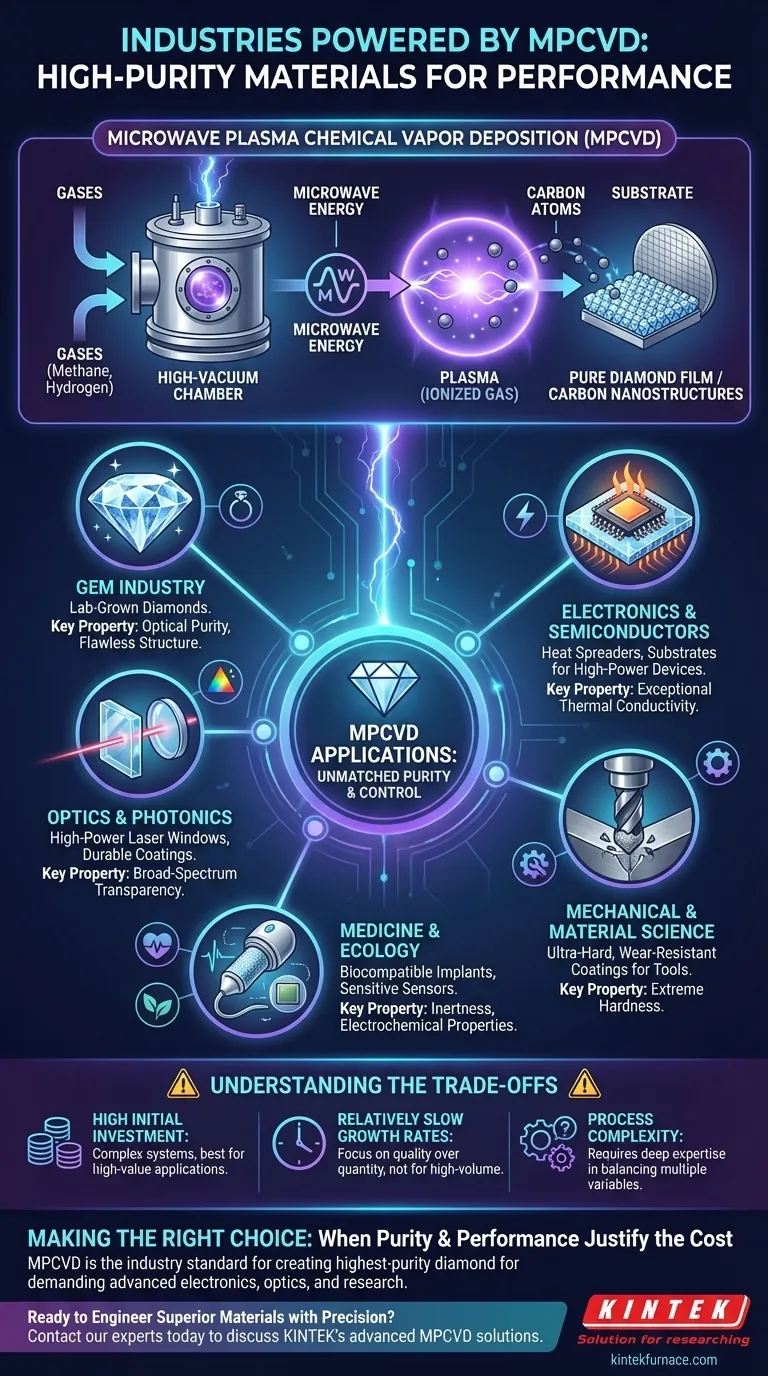
The process begins by introducing specific gases (like methane and hydrogen) into a high-vacuum chamber. Microwave energy is then used to excite these gases into a plasma, an ionized state of matter. Within this plasma, carbon atoms are precisely deposited onto a substrate, layer by layer, to form a pure, crystalline diamond film.
Unmatched Purity and Control
The MPCVD system is engineered for perfection. Its metal reactor design and high-vacuum environment minimize contamination, which is critical for achieving high-purity diamond. The ability to maintain a stable plasma across a wide range of pressures and temperatures (from 600 to 2300°C) gives operators unparalleled control over the final material's properties.
The Primary Output: High-Performance Materials
The main output is synthetic diamond in its various forms: monocrystalline (a single, perfect crystal), polycrystalline (many small crystals), and nanocrystalline. The system is also highly effective for producing other advanced materials like carbon nanotubes and nanowires.
A Breakdown of Key Industrial Applications
The unique ability to create high-purity diamond makes MPCVD essential in several advanced fields. Each industry leverages a different property of this remarkable material.
Gem Industry: The Quest for Perfection
MPCVD is a leading method for creating high-quality, lab-grown diamonds for the jewelry market. The precise control over the growth process allows for the production of large, flawless stones that are chemically and optically identical to their mined counterparts.
Electronics and Semiconductors: The Next Generation of Speed
Diamond is one of the best thermal conductors known. This property is crucial for high-power and high-frequency electronics, where dissipating heat is the primary performance bottleneck. MPCVD is used to create diamond substrates and heat spreaders that keep sensitive components cool, enabling faster and more powerful devices.
Optics and Photonics: Engineering Light
Because high-purity diamond is transparent across a very broad spectrum (from ultraviolet to radio frequencies), it is an ideal material for high-performance optical components. It is used to create durable windows for high-power lasers, anti-reflective films, and robust coatings for lenses that must operate in harsh environments.
Mechanical and Material Science: The Ultimate Hard Coatings
Nothing is harder than diamond. MPCVD is used to apply ultra-hard, wear-resistant coatings on cutting tools, industrial drills, and other mechanical parts. These diamond coatings dramatically extend the life and performance of the components, reducing downtime and replacement costs.
Medicine and Ecology: Biocompatible and Resilient
Diamond is a completely inert and biocompatible material, meaning it does not cause a reaction when placed inside the human body. This makes it an excellent coating for medical implants and surgical tools. Its unique electrochemical properties also create opportunities for developing highly sensitive sensors for medical diagnostics and environmental monitoring.
Understanding the Trade-offs
While powerful, MPCVD is not a universal solution. Understanding its limitations is key to using it effectively.
High Initial Investment
MPCVD systems are complex, precision instruments. The initial capital expenditure for the equipment is significant, making it best suited for high-value applications where the performance benefits justify the cost.
Relatively Slow Growth Rates
Compared to other deposition methods, growing thick diamond films with MPCVD can be a slow, time-consuming process. The focus is on quality over quantity, making it less suitable for high-volume, low-cost coating applications.
Process Complexity
Achieving the desired film properties requires deep expertise. The operator must precisely balance a complex interplay of variables, including gas mixture, pressure, temperature, and microwave power. It is a process that demands technical skill and careful monitoring.
Making the Right Choice for Your Application
Selecting the right technology depends entirely on your end goal. MPCVD is a specialized tool for demanding tasks.
- If your primary focus is creating the highest-purity diamond films for advanced electronics or optics: MPCVD is the industry standard due to its unparalleled control and low-contamination environment.
- If your primary focus is producing general-purpose hard coatings at a lower cost: You might investigate alternative methods like Physical Vapor Deposition (PVD) or other, less-precise forms of CVD.
- If your primary focus is research and development of novel carbon-based materials: The flexibility and precision of an MPCVD system make it an ideal platform for experimentation with diamond, nanotubes, and nanowires.
Ultimately, adopting MPCVD is about recognizing when the unmatched performance of an engineered material justifies the investment in the process required to create it.
Summary Table:
| Industry | Primary Application | Key Material Property Utilized |
|---|---|---|
| Gem Industry | Manufacturing lab-grown diamonds | Optical purity, flawless structure |
| Electronics & Semiconductors | Diamond heat spreaders & substrates | Exceptional thermal conductivity |
| Optics & Photonics | High-power laser windows, durable coatings | Broad-spectrum transparency |
| Mechanical & Material Science | Ultra-hard, wear-resistant coatings | Extreme hardness |
| Medicine & Ecology | Biocompatible implants, sensitive sensors | Inertness, electrochemical properties |
Ready to Engineer Superior Materials with Precision?
If your projects in electronics, optics, or advanced manufacturing demand the highest purity and performance from materials like synthetic diamond, KINTEK's advanced MPCVD solutions are your key to success.
Leveraging exceptional R&D and in-house manufacturing, KINTEK provides diverse laboratories with advanced high-temperature furnace solutions. Our product line, including Muffle, Tube, Rotary Furnaces, Vacuum & Atmosphere Furnaces, and specialized CVD/PECVD Systems, is complemented by our strong deep customization capability to precisely meet unique experimental requirements.
Contact our experts today to discuss how our MPCVD technology and deep customization can be tailored to push the boundaries of your material science research and production.
Visual Guide
Related Products
- 915MHz MPCVD Diamond Machine Microwave Plasma Chemical Vapor Deposition System Reactor
- MPCVD Machine System Reactor Bell-jar Resonator for Lab and Diamond Growth
- RF PECVD System Radio Frequency Plasma Enhanced Chemical Vapor Deposition
- Slide PECVD Tube Furnace with Liquid Gasifier PECVD Machine
- Cylindrical Resonator MPCVD Machine System for Lab Diamond Growth
People Also Ask
- What is the MPCVD method and why is it considered effective for diamond deposition? Superior Purity & High Growth Rates
- What factors influence the quality of diamond deposition in the MPCVD method? Master the Critical Parameters for High-Quality Diamond Growth
- What are some key features and benefits of the microwave plasma chemical vapor deposition system? Achieve Unmatched Material Synthesis
- What is the purpose of a microwave plasma chemical vapor deposition system? Grow High-Purity Diamonds and Advanced Materials
- What is the basic principle of operation for the microwave plasma chemical vapor deposition system? Unlock High-Purity Material Growth