
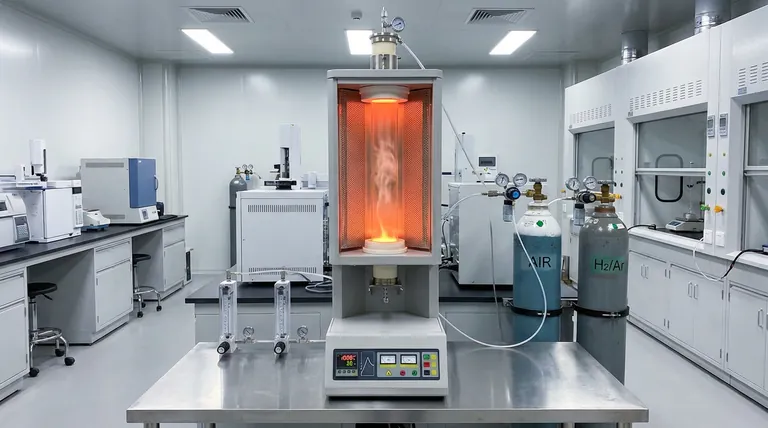
Addressing silver contamination requires a rigorous thermal cleaning cycle. To remove deposits caused by high vapor pressure, the quartz tube is heated in a furnace to 1000°C. This temperature is maintained for 30 minutes under a controlled flow of either air or a hydrogen-argon mixture.
Because silver exhibits high vapor pressure during the Chemical Vapor Deposition (CVD) process, residues inevitably coat the reactor walls. Thermal treatment is the definitive method to reset the environment, ensuring that subsequent experiments remain uncompromised by previous runs.
The Mechanism of Contamination
Understanding Vapor Pressure
During the CVD process, silver is subjected to conditions that induce high vapor pressure.
This causes the silver to volatilize effectively for the intended reaction.
The Deposition Problem
However, this vapor does not stay suspended indefinitely.
It inevitably condenses and accumulates on the inner walls of the quartz tube, creating a persistent layer of silver residue.
The Decontamination Protocol
Temperature and Duration
The standard solution for removing these deposits is high-temperature thermal cleaning.
The tube must be heated to 1000°C.
This temperature must be held for a duration of 30 minutes to ensure the cleaning is thorough.
Atmospheric Conditions
Thermal cleaning is not performed in a static environment.
It requires a continuous gas flow to facilitate the removal of contaminants.
Operators typically utilize a flow of air or a hydrogen-argon mixture during the heating cycle.
Operational Implications and Trade-offs
The Necessity of Routine Maintenance
This cleaning step is not optional; it is a critical component of the experimental workflow.
Skipping this process directly impacts the integrity of the quartz tube.
Impact on Reproducibility
The primary trade-off is the time required for cleaning versus the quality of data.
If the silver is not removed, it contaminates subsequent experiments.
This leads to a loss of purity and makes it impossible to achieve reproducible reaction environments in the CVD system.
Making the Right Choice for Your Goal
To maintain a reliable CVD system, you must integrate this cleaning protocol into your standard operating procedure.
- If your primary focus is Experimental Purity: Strictly adhere to the 1000°C limit for the full 30 minutes to eliminate cross-contamination risks.
- If your primary focus is Process Consistency: Standardize the gas flow choice (air vs. hydrogen-argon) to ensure the cleaning environment remains constant across all runs.
Treat the cleaning cycle as part of the experiment itself, not just an after-thought.
Summary Table:
| Protocol Step | Parameter | Purpose |
|---|---|---|
| Cleaning Temperature | 1000°C | Volatilizes and removes silver deposits |
| Duration | 30 Minutes | Ensures complete decontamination of walls |
| Atmosphere Options | Air or H2-Ar Mixture | Facilitates the removal of silver contaminants |
| Key Outcome | Experimental Purity | Prevents cross-contamination in subsequent runs |
Ensure Uncompromised CVD Purity with KINTEK
Silver contamination can derail your research, but the right equipment makes maintenance seamless. KINTEK provides high-performance, customizable CVD systems, Tube, and Vacuum furnaces designed to withstand rigorous thermal cleaning cycles and demanding laboratory environments.
Backed by expert R&D and manufacturing, our systems are built for researchers who prioritize reproducibility and process consistency.
Ready to upgrade your lab's thermal processing capabilities? Contact us today to discuss your unique needs and see how our advanced furnace solutions can elevate your results!
Visual Guide

References
- Hikaru Iwatani, Fumihiko Maeda. Graphene Synthesis on Silver Foil by Chemical Vapor Deposition Using Ethanol. DOI: 10.1380/ejssnt.2025-026
This article is also based on technical information from Kintek Furnace Knowledge Base .
Related Products
- Custom Made Versatile CVD Tube Furnace Chemical Vapor Deposition CVD Equipment Machine
- Split Chamber CVD Tube Furnace with Vacuum Station CVD Machine
- Multi Heating Zones CVD Tube Furnace Machine for Chemical Vapor Deposition Equipment
- Slide PECVD Tube Furnace with Liquid Gasifier PECVD Machine
- Inclined Rotary Plasma Enhanced Chemical Deposition PECVD Tube Furnace Machine
People Also Ask
- What is a CVD tube furnace and what is its primary function? Discover Precision Thin-Film Deposition
- Why are CVD tube furnace sintering systems indispensable for 2D material research and production? Unlock Atomic-Scale Precision
- Which industries and research fields benefit from CVD tube furnace sintering systems for 2D materials? Unlock Next-Gen Tech Innovations
- How does CVD tube furnace sintering enhance graphene growth? Achieve Superior Crystallinity and High Electron Mobility
- How can integrating CVD tube furnaces with other technologies benefit device fabrication? Unlock Advanced Hybrid Processes



















