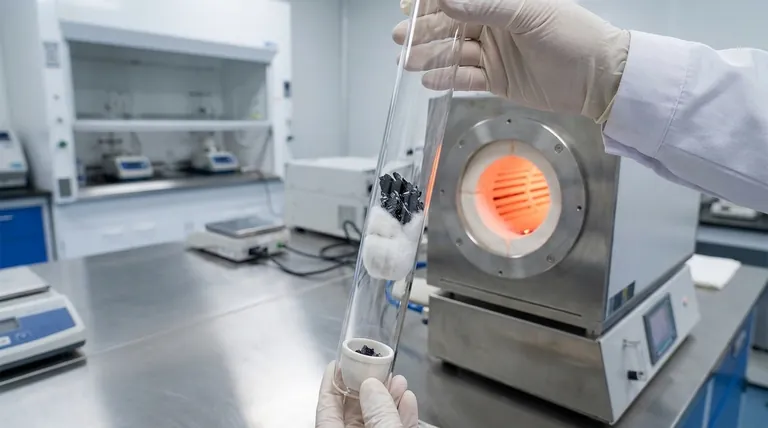
Quartz wool acts as a high-temperature filtration barrier effectively integrated into reaction tube assemblies to separate solid products from liquid byproducts. Specifically, it is positioned above the crucible to mechanically intercept grown crystals while allowing molten flux to pass through during centrifugation.
The Core Insight By utilizing quartz wool as an in-situ sieve, researchers can separate crystals from flux immediately following thermal reactions without breaking the vacuum seal. This prevents contamination and allows for physical separation purely through centrifugal force while the materials remain hot.
The Mechanics of In-Situ Separation
Strategic Placement
The quartz wool is not placed randomly; it is positioned directly above the alumina crucible within the sealed reaction tube.
This placement divides the tube into two functional zones: the growth zone (crucible) and the collection zone (bottom of the tube).
Filtration During Centrifugation
The primary utility of the wool becomes active during the centrifugal separation process following the thermal reaction.
As the tube is spun, the quartz wool acts as a porous stopper. It catches and holds the grown single crystals, preventing them from moving further down the tube.
Permeability to Flux
While it stops solids, the quartz wool allows the liquid bismuth flux to flow through its fibers.
The liquid passes through the wool and collects at the bottom of the tube, effectively isolating the desired crystals from the solvent.
Why Quartz Material is Critical
Thermal Stability
The assembly must withstand the extreme heat required for crystal growth (often exceeding 600°C to 750°C).
Quartz wool maintains its structural integrity at these temperatures, ensuring the "filter" does not melt or deform during the reaction or subsequent separation.
Chemical Inertness
Just as quartz tubes are selected for their resistance to corrosive chemicals, quartz wool offers high chemical inertness.
It does not react with the bismuth flux or the developing crystals, ensuring that no impurities are introduced into the lattice structure of the final product.
Understanding the Trade-offs
Packing Density Variables
The effectiveness of the separation relies heavily on how tightly the quartz wool is packed.
If packed too loosely, smaller crystals may slip through with the flux; if packed too tightly, the liquid flux may become trapped, failing to separate completely.
Potential for Physical Contamination
While chemically inert, quartz wool consists of fine fibers that can be brittle.
Care must be taken during assembly to ensure loose fibers do not detach and physically contaminate the crystal batch, which would require post-processing to remove.
Optimizing Your Assembly for Separation
To ensure successful crystal isolation, tailor your use of quartz wool to your specific experimental needs:
- If your primary focus is High Purity: Ensure the quartz wool is pre-cleaned and of high grade to prevent any trace impurities from leaching into the hot flux.
- If your primary focus is Yield Efficiency: Experiment with the density of the wool packing to find the perfect balance that traps all crystals while allowing rapid, complete drainage of the liquid flux.
The correct application of quartz wool turns a complex extraction process into a simple, single-step physical separation.
Summary Table:
| Feature | Role of Quartz Wool in Assembly |
|---|---|
| Primary Function | High-temperature filtration and mechanical solid-liquid separation |
| Strategic Location | Positioned above the crucible to divide growth and collection zones |
| Thermal Resistance | Maintains integrity at extreme temperatures (600°C - 750°C+) |
| Chemical Property | High inertness prevents contamination of crystals or bismuth flux |
| Separation Method | Facilitates in-situ centrifugal separation without breaking vacuum |
Elevate Your Material Research with KINTEK
Precision in crystal growth requires more than just high-quality components; it requires reliable laboratory solutions. Backed by expert R&D and manufacturing, KINTEK offers a comprehensive range of Muffle, Tube, Rotary, Vacuum, and CVD systems, along with customizable lab high-temp furnaces tailored to your unique experimental needs.
Whether you are refining in-situ separation techniques or scaling up high-purity production, our equipment provides the thermal stability and vacuum integrity your research demands. Contact us today to find the perfect thermal solution for your lab!
Visual Guide

References
- Hope A. Long, Vladislav V. Klepov. Synthesis of U<sub>0.92</sub>Mn<sub>3</sub>Si<sub>2</sub>C Using Organic Carbon Source. DOI: 10.1002/zaac.202500047
This article is also based on technical information from Kintek Furnace Knowledge Base .
Related Products
- Multi Zone Laboratory Quartz Tube Furnace Tubular Furnace
- Vertical Laboratory Quartz Tube Furnace Tubular Furnace
- Small Vacuum Heat Treat and Tungsten Wire Sintering Furnace
- High Temperature Muffle Oven Furnace for Laboratory Debinding and Pre Sintering
- Laboratory Quartz Tube Furnace RTP Heating Tubular Furnace
People Also Ask
- What temperature-related capabilities make multi zone tube furnaces valuable for research? Unlock Precision Thermal Control
- What environmental protection applications utilize multi zone tube furnaces? Unlock Precision in Waste Treatment and Green Tech
- Why are multi zone tube furnaces particularly useful for nanomaterial research? Unlock Precise Thermal Control for Advanced Synthesis
- What role do multi zone tube furnaces play in new energy research? Unlock Precise Thermal Control for Innovation
- What are the main applications of multi zone tube furnaces in university laboratories? Unlock Precision in Material Science and Energy Research