
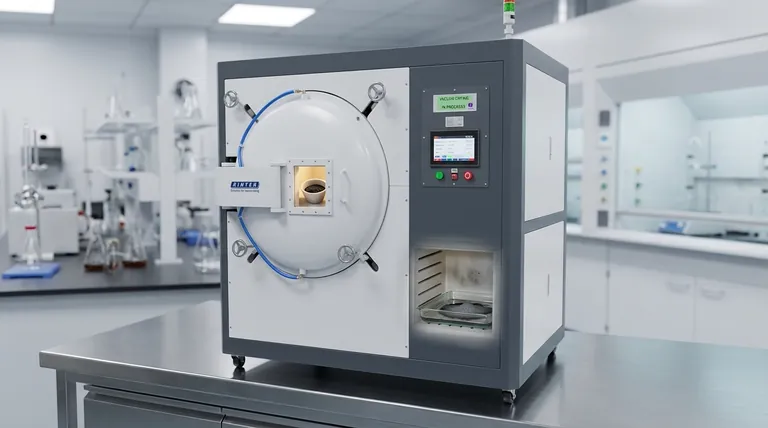
In the processing of NVP/C gel, the vacuum oven is utilized to heat the reaction gel overnight under reduced pressure conditions. This specific environment lowers the boiling point of moisture, enabling the thorough removal of excess water and volatile impurities at significantly lower temperatures than standard drying methods require.
By decoupling temperature from evaporation, vacuum drying preserves the chemical architecture of the gel. It prevents heat-induced degradation while ensuring the final raw material is a dry, compositionally consistent solid powder.
The Mechanics of Preservation and Drying
Lowering the Thermal Threshold
The primary utility of the vacuum oven is its ability to manipulate the boiling point of liquid components. By reducing the internal pressure, the oven forces moisture and volatile impurities within the NVP/C gel to evaporate without requiring extreme heat.
This allows for effective dehydration at temperatures that are safe for the material. It ensures that the solvent removal process is driven by pressure differentials rather than thermal intensity alone.
Preventing Premature Differentiation
The most critical role of this process is the prevention of premature differentiation. In standard ovens, the high temperatures required to drive off water can inadvertently trigger chemical reactions or structural changes in the precursors before they are ready.
By keeping the temperature low, the vacuum oven ensures the precursors remain in their intended state. This preserves the specific chemical potential required for the subsequent calcination or synthesis steps.
Ensuring Compositional Consistency
The vacuum environment promotes a uniform drying profile throughout the gel. Because the evaporation is controlled and steady, it prevents the formation of gradients that might occur with rapid, high-heat surface drying.
The result is a solid powder raw material that is chemically homogeneous. This consistency is vital for the performance of the final NVP/C material, as any irregularities in the precursor powder will propagate into the final product.
Understanding the Trade-offs
Time Intensity vs. Material Quality
While a vacuum oven offers superior protection for the NVP/C gel, it is an inherently slower process. The primary reference notes that the gel is heated overnight, indicating a significant time investment compared to rapid drying techniques like spray drying.
Batch Processing Limitations
Vacuum drying is typically a batch process rather than a continuous one. This can introduce bottlenecks in high-throughput manufacturing environments. You are trading processing speed for the assurance of structural integrity and high purity.
Making the Right Choice for Your Goal
When determining if vacuum drying is the correct approach for your specific NVP/C synthesis, consider your priorities regarding material performance versus production speed.
- If your primary focus is Electrochemical Performance: Prioritize the vacuum oven to prevent premature differentiation and ensure the highest precursor purity, even at the cost of processing time.
- If your primary focus is Process Efficiency: Recognize that the "overnight" duration is a bottleneck; ensure your batch sizes are maximized to compensate for the slow drying cycle.
The vacuum oven is not merely a drying tool; it is a stabilization chamber that safeguards the chemical identity of your precursors.
Summary Table:
| Feature | Vacuum Drying Impact on NVP/C Gel |
|---|---|
| Mechanism | Lowered pressure reduces moisture boiling point |
| Thermal Safety | Prevents heat-induced degradation/differentiation |
| Material Quality | Ensures uniform, chemically homogeneous solid powder |
| Process Duration | Overnight heating for thorough volatile removal |
| Batch Control | Maximizes precursor purity for electrochemical performance |
Elevate Your Material Synthesis with KINTEK Precision
Maintaining the structural integrity of NVP/C gel requires exact thermal and pressure control. KINTEK provides state-of-the-art Vacuum, Muffle, and Tube furnace systems designed to meet the rigorous demands of advanced lab research and industrial manufacturing.
Backed by expert R&D, our customizable high-temperature solutions ensure your precursors achieve the highest compositional consistency and electrochemical performance.
Ready to optimize your drying and calcination workflows?
Contact KINTEK Experts Today to find the perfect system for your unique laboratory needs.
References
- Madhav Sharma, R. S. Dhaka. Understanding the Electrochemical Performance and Diffusion Kinetics of HC||Na3V2(PO4)3/C Full Cell Battery for Energy Storage Applications. DOI: 10.56042/ijpap.v62i2.7371
This article is also based on technical information from Kintek Furnace Knowledge Base .
Related Products
- Vacuum Heat Treat Sintering and Brazing Furnace
- Vacuum Heat Treat Sintering Furnace Molybdenum Wire Vacuum Sintering Furnace
- Dental Porcelain Zirconia Sintering Ceramic Vacuum Press Furnace
- Vacuum Hot Press Furnace Machine for Lamination and Heating
- Vacuum Hot Press Furnace Machine Heated Vacuum Press
People Also Ask
- How does vacuum heat treating affect the grain structure of metal alloys? Achieve Precise Microstructure Control
- What is one of the most important uses of vacuum heat treating furnaces in aerospace? Achieve Superior Strength in Aircraft Alloys
- What are the benefits of using vacuum heat treating furnaces for metal alloys? Achieve Superior Metal Properties and Performance
- What is the temperature of a vacuum furnace brazing? Optimize Your Joint Strength and Cleanliness
- What are the steps involved in a typical vacuum brazing treatment? Master the Process for Strong, Clean Joints



















