
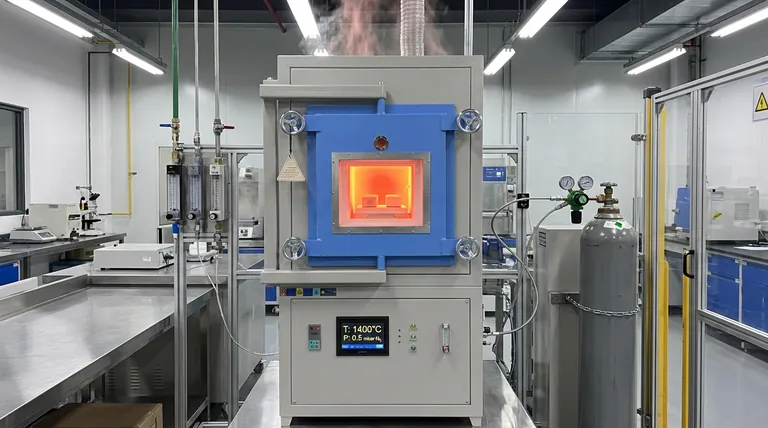
The primary function of introducing 0.5 mbar of nitrogen pressure during high-temperature sintering is to actively suppress the evaporation of chromium (Cr) from the cermet’s binder phase. Under high vacuum conditions, chromium’s high vapor pressure leads to rapid volatilization, which this specific nitrogen atmosphere counteracts to maintain the material's chemical stability.
Core Takeaway High-temperature vacuum environments induce chromium loss due to its high vapor pressure. Introducing a controlled nitrogen atmosphere creates a partial pressure balance that prevents this evaporation, ensuring the Ti(C,N)-FeCr cermet retains the exact chemical composition required for durability and corrosion resistance.
The Challenge of Vacuum Sintering
The Volatility of Chromium
In the context of sintering Ti(C,N)-FeCr cermets, the binder phase relies heavily on chromium.
However, chromium possesses a significantly high vapor pressure when subjected to elevated temperatures.
The Vacuum Effect
Standard sintering is often conducted in a vacuum to prevent oxidation and remove impurities.
Unfortunately, a deep vacuum exacerbates chromium's volatility, effectively "pulling" chromium atoms out of the binder and converting them into gas.
Without intervention, this leads to a substantial uncontrolled loss of material from the binder matrix.
The Mechanism of Nitrogen Stabilization
Establishing Partial Pressure Balance
The introduction of nitrogen at a specific pressure (0.5 mbar) serves as a thermodynamic countermeasure.
By introducing this gas, you establish a partial pressure balance within the furnace chamber.
This external pressure effectively raises the boiling point of the chromium or creates an equilibrium that opposes the vapor pressure of the metal, keeping it in its solid or liquid phase within the cermet.
Stabilizing the Chemical Composition
This process is not merely about keeping the furnace clean; it is about stoichiometric precision.
The nitrogen pressure locks the chromium into the FeCr binder, preventing the alloy from drifting away from its intended formulation.
Critical Impacts on Material Properties
Ensuring Corrosion Resistance
Chromium is the primary element responsible for the corrosion resistance of the binder phase (similar to its role in stainless steel).
If evaporation occurs, the surface and internal structure become chromium-depleted, rendering the final part susceptible to chemical attack and environmental degradation.
Maintaining Mechanical Integrity
The mechanical strength of a cermet is dictated by the interaction between the hard phase (TiCN) and the tough binder phase (FeCr).
Loss of chromium alters the volume fraction and ductility of the binder.
By retaining the chromium, the nitrogen atmosphere ensures the material achieves its intended mechanical properties, such as toughness and hardness.
Understanding the Process Risks
The Consequence of Pressure Deviation
It is vital to maintain the specific pressure (0.5 mbar) mentioned.
If the pressure is too low (closer to a high vacuum), chromium depletion will inevitably occur, leading to a porous or chemically weak surface.
The Implication for Process Control
This step indicates that standard vacuum sintering profiles are insufficient for FeCr-bonded cermets.
Operators must transition from pure vacuum to a partial pressure sintering atmosphere specifically during the high-temperature hold to guarantee quality.
Applying This to Your Sintering Profile
If your primary focus is corrosion resistance:
- Strictly adhere to the 0.5 mbar nitrogen introduction to prevent chromium depletion, which is the root cause of reduced chemical resistance.
If your primary focus is mechanical consistency:
- Utilize this pressure step to ensure the binder phase volume and chemistry remain uniform throughout the batch, preventing variations in toughness.
By balancing the vapor pressure of chromium with nitrogen, you transform a potentially unstable vacuum process into a controlled environment that yields high-performance cermets.
Summary Table:
| Feature | Impact of High Vacuum | Impact of 0.5 mbar Nitrogen |
|---|---|---|
| Chromium (Cr) Stability | High volatility/evaporation | Suppressed evaporation via partial pressure |
| Chemical Composition | Stoichiometric drift/depletion | Precision retention of FeCr binder phase |
| Corrosion Resistance | Significantly reduced | Maintained at intended design levels |
| Mechanical Integrity | Altered ductility and toughness | Consistent hardness and material strength |
Maximize Material Performance with KINTEK Precision
Don't let chromium depletion compromise the integrity of your high-performance cermets. Backed by expert R&D and world-class manufacturing, KINTEK provides advanced Vacuum and Muffle systems designed for the most demanding thermal profiles. Our systems offer precise partial pressure controls (including 0.5 mbar nitrogen stabilization) to ensure your Ti(C,N)-FeCr materials retain their exact chemical composition and corrosion resistance.
Whether you need customized CVD, Tube, or Rotary furnaces, KINTEK is your partner in achieving laboratory excellence. Contact us today to optimize your sintering process!
References
- T.H. Pampori, Jakob Kübarsepp. Exploring Microstructural Properties, Phase Transformations, and Wettability in High-Chromium Content Iron-bonded Ti(C,N)-based Cermet. DOI: 10.2497/jjspm.16p-t14-06
This article is also based on technical information from Kintek Furnace Knowledge Base .
Related Products
- Vacuum Heat Treat Sintering Furnace with Pressure for Vacuum Sintering
- Spark Plasma Sintering SPS Furnace
- Vacuum Heat Treat Sintering Furnace Molybdenum Wire Vacuum Sintering Furnace
- Small Vacuum Heat Treat and Tungsten Wire Sintering Furnace
- Vacuum Dental Porcelain Sintering Furnace for Dental Laboratories
People Also Ask
- What is one of the most important uses of vacuum heat treating furnaces in aerospace? Achieve Superior Strength in Aircraft Alloys
- What are the benefits of using vacuum heat treating furnaces for metal alloys? Achieve Superior Metal Properties and Performance
- How does vacuum heat treating affect the grain structure of metal alloys? Achieve Precise Microstructure Control
- What is the purpose of setting a mid-temperature dwell stage? Eliminate Defects in Vacuum Sintering
- What are the key components of a vacuum sintering furnace? Essential Parts for Precision Material Processing



















