
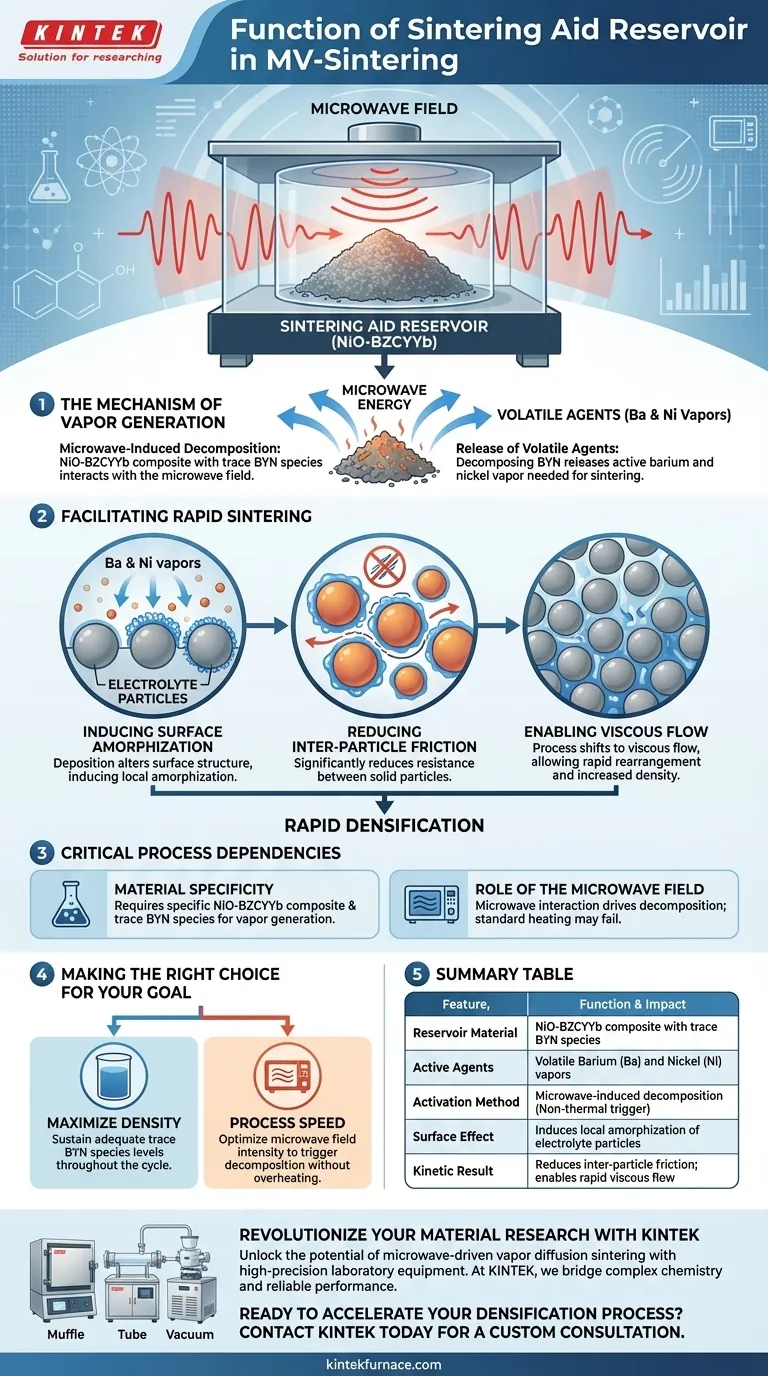
The primary function of the sintering aid reservoir in microwave-driven vapor diffusion sintering (MV-sintering) is to act as a dynamic source of volatile chemical species that catalyze the densification of electrolyte particles. Constructed from NiO-BZCYYb composite materials, the reservoir decomposes under microwave irradiation to release essential vapors that modify particle surfaces and reduce friction.
Core Takeaway The reservoir utilizes microwave energy to transform solid precursors into an active vapor containing barium and nickel. This vapor coats the target particles, inducing a "viscous flow" state that allows the material to densify significantly faster than it would through thermal energy alone.
The Mechanism of Vapor Generation
Microwave-Induced Decomposition
The reservoir is composed of NiO-BZCYYb composite materials which contain trace BYN species. Unlike a passive container, this material interacts directly with the microwave field. This interaction triggers the decomposition of the trace species within the reservoir.
Release of Volatile Agents
As the BYN species decompose, they release a vapor media specifically containing barium and nickel. These are not inert byproducts; they are the active agents required for the sintering process. Once released, these species diffuse from the reservoir to the electrolyte particles being processed.
Facilitating Rapid Sintering
Inducing Surface Amorphization
When the barium and nickel vapors deposit onto the electrolyte particles, they alter the material's surface structure. This deposition induces local amorphization, meaning the crystalline structure at the particle surface becomes disordered or glass-like.
Reducing Inter-Particle Friction
The physical consequence of this amorphization is a significant reduction in inter-particle friction. The solid particles are no longer grinding against one another with high resistance.
Enabling Viscous Flow
With friction reduced, the process shifts to a viscous flow mechanism. This allows the particles to slide and rearrange rapidly, filling gaps and increasing density much more efficiently than traditional solid-state diffusion.
Critical Process Dependencies
Material Specificity
The success of this process is strictly tied to the chemical composition of the reservoir. Without the specific NiO-BZCYYb composite and its trace BYN species, the necessary barium and nickel vapors will not be generated.
The Role of the Microwave Field
The reservoir functions only under the influence of a microwave field. It is the specific interaction between the microwaves and the trace species that drives the decomposition; standard thermal heating may not trigger the release of these specific volatile agents.
Making the Right Choice for Your Goal
To optimize the MV-sintering process, you must view the reservoir not just as a tool, but as a chemical reagent that dictates the speed of your results.
- If your primary focus is maximizing density: Ensure your reservoir material maintains adequate levels of trace BYN species to sustain the vapor supply throughout the cycle.
- If your primary focus is process speed: Optimize the microwave field intensity to sufficiently trigger the decomposition of the reservoir material without overheating the target electrolyte.
By precise control of the reservoir's activation, you leverage vapor diffusion to achieve rapid, high-quality material consolidation.
Summary Table:
| Feature | Function & Impact |
|---|---|
| Reservoir Material | NiO-BZCYYb composite containing trace BYN species |
| Active Agents | Volatile Barium (Ba) and Nickel (Ni) vapors |
| Activation Method | Microwave-induced decomposition (Non-thermal trigger) |
| Surface Effect | Induces local amorphization of electrolyte particles |
| Kinetic Result | Reduces inter-particle friction; enables rapid viscous flow |
Revolutionize Your Material Research with KINTEK
Unlock the full potential of microwave-driven vapor diffusion sintering with high-precision laboratory equipment. At KINTEK, we bridge the gap between complex sintering chemistry and reliable performance.
Backed by expert R&D and world-class manufacturing, we provide high-performance Muffle, Tube, Rotary, Vacuum, and CVD systems, all of which can be customized to meet your specific research or industrial needs. Whether you are optimizing electrolyte density or exploring advanced vapor-phase catalysis, our technical team is ready to help you engineer the perfect thermal environment.
Ready to accelerate your densification process?
Contact KINTEK today for a custom consultation
Visual Guide
References
- Dongyeon Kim, Kang Taek Lee. Sub‐1000 °C Sintering of Protonic Ceramic Electrochemical Cells via Microwave‐Driven Vapor Phase Diffusion. DOI: 10.1002/adma.202506905
This article is also based on technical information from Kintek Furnace Knowledge Base .
Related Products
- Vacuum Heat Treat Sintering Furnace with Pressure for Vacuum Sintering
- 9MPa Air Pressure Vacuum Heat Treat and Sintering Furnace
- Small Vacuum Heat Treat and Tungsten Wire Sintering Furnace
- Spark Plasma Sintering SPS Furnace
- Chairside Dental Porcelain Zirconia Sintering Furnace with Transformer for Ceramic Restorations
People Also Ask
- What are the benefits of using vacuum heat treating furnaces for metal alloys? Achieve Superior Metal Properties and Performance
- How does vacuum heat treating affect the grain structure of metal alloys? Achieve Precise Microstructure Control
- What is one of the most important uses of vacuum heat treating furnaces in aerospace? Achieve Superior Strength in Aircraft Alloys
- What are the key components of a vacuum sintering furnace? Essential Parts for Precision Material Processing
- What is the purpose of setting a mid-temperature dwell stage? Eliminate Defects in Vacuum Sintering










