
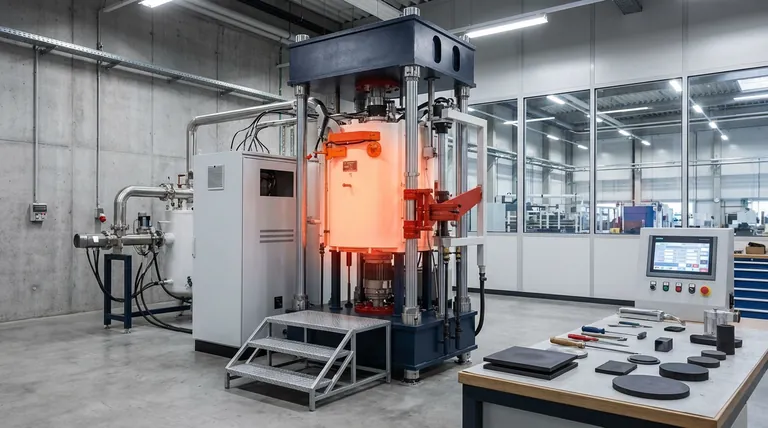
An industrial-grade hot press sintering system acts as a dual-force fabrication tool, contributing to high-performance ceramics by establishing a precise, synchronous coupling of temperature and mechanical pressure. By applying 30 to 40 MPa of pressure during the heating phase, the system physically forces ceramic particles to rearrange, overcoming the natural resistance that typically hinders densification in standard sintering processes.
Core Takeaway The system's defining advantage is its ability to lower the diffusion activation energy required for sintering. This allows Al2O3/TiC/SiC(w) composites to achieve near-theoretical density at lower temperatures, effectively suppressing abnormal grain growth to produce a material that is simultaneously hard and tough.
The Physics of Densification
Coupling Pressure and Temperature
The primary mechanism driving performance is the simultaneous application of thermal energy and uniaxial mechanical pressure.
While standard sintering relies solely on heat to facilitate particle bonding, this system introduces a mechanical driving force.
This allows for plastic flow and particle rearrangement that would otherwise be impossible without significantly higher temperatures.
Lowering Diffusion Activation Energy
The application of 30 to 40 MPa significantly reduces the diffusion activation energy required for the material to consolidate.
This reduction means the ceramic particles encounter less resistance when shifting into a denser configuration.
Consequently, the sintering process becomes more efficient, achieving higher density in a shorter duration.
Microstructural Control
Inhibiting Abnormal Grain Growth
A critical challenge in fabricating Al2O3-based ceramics is the tendency for grains to grow excessively at high temperatures, which weakens the material.
Because the hot press system achieves densification at lower temperatures and faster rates, it effectively "freezes" the grain structure before it can coarsen.
Achieving Superior Mechanical Properties
The result of this controlled process is a fine-grained microstructure.
For Al2O3/TiC/SiC(w) composites, this fine structure is directly responsible for maintaining high hardness.
Simultaneously, the dense, defect-free structure enhances fracture toughness, making the material suitable for demanding industrial applications.
The Role of the Graphite Mould System
Uniform Force and Heat Transfer
High-strength graphite molds are not merely containers; they are active components in the sintering process.
Leveraging superior thermal conductivity, the graphite ensures the ceramic specimen is heated uniformly, even at temperatures reaching thousands of degrees.
Simultaneously, the mold maintains its structural integrity to transfer the hydraulic pressure uniformly to the powder body.
Atmospheric Protection
The system often operates in a high-vacuum environment facilitated by the mold's properties.
This vacuum removes residual gases from sintering necks, which is crucial for achieving high density.
Furthermore, the graphite creates a micro-reducing atmosphere that prevents the oxidation or decarburization of the non-oxide components (TiC and SiC) within the composite.
Understanding the Trade-offs
Geometric Limitations
The pressure applied in this system is typically uniaxial (from top and bottom).
This limits the complexity of the shapes that can be fabricated; the process is best suited for simple geometries like plates or discs.
Complex 3D shapes often require post-sintering machining, which can be difficult given the extreme hardness of the material.
Production Throughput
Hot press sintering is inherently a batch process involving the assembly and disassembly of graphite molds.
Compared to continuous pressureless sintering, this method generally has lower throughput and higher operational costs per unit.
Making the Right Choice for Your Goal
To maximize the potential of your Al2O3/TiC/SiC(w) fabrication, align the process with your specific performance targets:
- If your primary focus is maximum mechanical integrity: Prioritize the precise control of the 30-40 MPa pressure range to ensure near-theoretical density and high fracture toughness.
- If your primary focus is material purity: Leverage the vacuum and graphite mold environment to strictly inhibit the oxidation of the TiC and SiC components.
- If your primary focus is dimensional precision: Rely on the high-strength graphite mold to maintain geometric accuracy and uniform density distribution under load.
By utilizing the synchronous coupling of heat and pressure, you transform a difficult-to-sinter composite into a high-performance industrial tool.
Summary Table:
| Feature | Mechanism | Benefit for Al2O3/TiC/SiC(w) |
|---|---|---|
| Pressure Coupling | 30-40 MPa uniaxial force | Forces particle rearrangement and reduces activation energy |
| Thermal Control | Lower sintering temperatures | Inhibits abnormal grain growth and maintains fine microstructure |
| Atmospheric Control | High-vacuum & graphite molds | Prevents oxidation of TiC/SiC and eliminates residual gas |
| Mechanical Output | Enhanced densification | Achieves near-theoretical density and high fracture toughness |
Elevate Your Advanced Ceramic Production with KINTEK
Precision is paramount when fabricating Al2O3/TiC/SiC(w) composites. Backed by expert R&D and world-class manufacturing, KINTEK provides high-performance Hot Press, Muffle, Tube, Rotary, and Vacuum CVD systems tailored to your specific material requirements.
Our customizable high-temperature laboratory furnaces ensure uniform heat transfer and precise mechanical pressure to help you achieve superior hardness and fracture toughness in every batch.
Ready to optimize your sintering process? Contact our technical experts today to discuss a custom solution for your unique laboratory or industrial needs.
References
- Song‐Jeng Huang, Murugan Subramani. Mechanical and Corrosion Tests for Magnesium–Zinc/Ti-6Al-4V Composites by Gravity Casting. DOI: 10.3390/ma17081836
This article is also based on technical information from Kintek Furnace Knowledge Base .
Related Products
- 600T Vacuum Induction Hot Press Vacuum Heat Treat and Sintering Furnace
- Vacuum Hot Press Furnace Machine Heated Vacuum Press Tube Furnace
- Vacuum Heat Treat Sintering Furnace with Pressure for Vacuum Sintering
- 9MPa Air Pressure Vacuum Heat Treat and Sintering Furnace
- Vacuum Hot Press Furnace Machine Heated Vacuum Press
People Also Ask
- Why use Vacuum Hot Press (VHP) for ZnS Ceramics? Achieve Superior IR Transparency and Mechanical Strength
- How does a vacuum hot press sintering furnace mitigate copper sintering swelling? Solve Fe-Cu Expansion Issues
- What are the key advantages of vacuum hot press sintering furnaces? Achieve Superior Density and Purity in Materials
- What are the benefits of using a vacuum hot press sintering furnace for the preparation of SiCw/2024 aluminum matrix composites? Achieve High-Performance Aerospace Materials
- What is the core function of a vacuum hot press sintering furnace in the preparation of high-density RuTi alloys? Achieve Maximum Density and Purity



















