
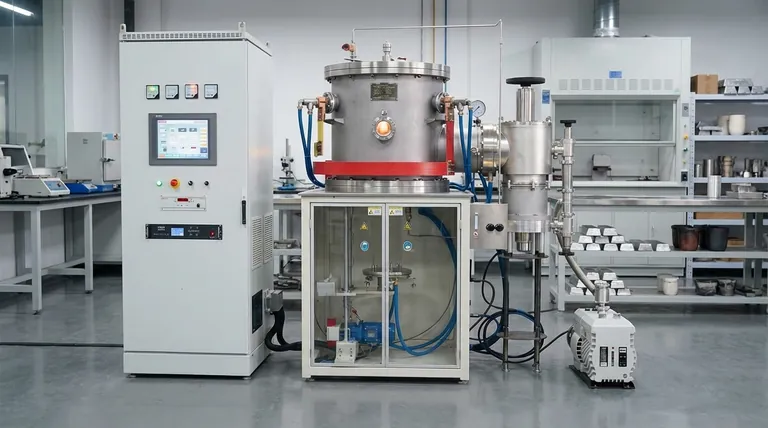
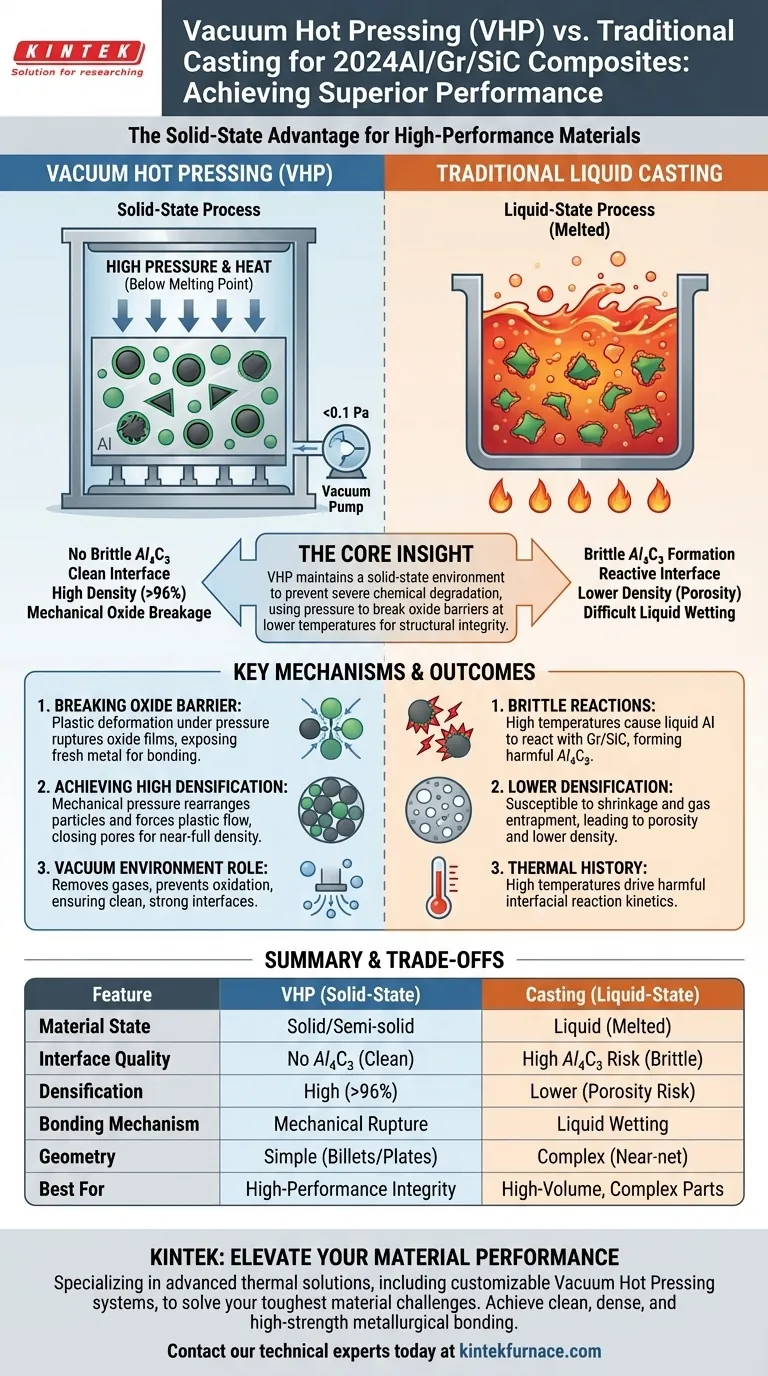
Vacuum hot pressing (VHP) provides a critical advantage over casting by maintaining a solid-state environment, effectively bypassing the severe chemical degradation that occurs when aluminum is melted in the presence of carbon-based reinforcements.
By applying simultaneous high pressure and heat below the melting point, VHP achieves metallurgical bonding and high densification while preventing the formation of brittle reaction products that plague liquid casting processes.
The Core Insight Manufacturing 2024Al/Gr/SiC composites requires navigating a delicate trade-off between bonding and chemical stability. VHP solves this by using pressure to mechanically break oxide barriers at lower temperatures, ensuring structural integrity where liquid casting would otherwise dissolve the reinforcements into brittle contaminants.
The Problem with Liquid State Processing
Preventing Brittle Interfacial Reactions
The primary danger in traditional casting is the high temperature required to melt the aluminum matrix (typically 750-850°C).
At these temperatures, liquid aluminum reacts aggressively with Graphite (Gr) and Silicon Carbide (SiC).
This reaction creates aluminum carbide ($Al_4C_3$), a brittle compound that severely degrades the mechanical properties and thermal conductivity of the final composite.
Controlling the Thermal History
VHP operates at a significantly lower temperature, keeping the aluminum in a solid or semi-solid state.
This "low-temperature" approach effectively inhibits the chemical kinetics required for harmful interfacial reactions.
By avoiding the liquid phase, you preserve the integrity of the Gr and SiC reinforcements.
Mechanisms of Superior Bonding
Breaking the Oxide Barrier
Aluminum particles are naturally coated with a stubborn oxide film that inhibits bonding with other materials.
In liquid casting, wetting these reinforcements is difficult without excessive heat.
VHP solves this through plastic deformation. The combination of high heat and axial pressure deforms the aluminum particles, physically rupturing the oxide film and exposing fresh metal for metallurgical bonding.
Achieving High Densification
Standard vacuum sintering often leaves material porous, achieving densities of only around 71%.
VHP utilizes mechanical pressure to rearrange particles and force plastic flow, effectively closing internal pores.
This process drives density levels to over 96%, approaching a fully dense state that liquid casting often struggles to match due to shrinkage and gas entrapment.
The Role of the Vacuum Environment
The high vacuum (e.g., <0.1 Pa) is not merely for cleanliness; it is an active processing tool.
It removes adsorbed gases from the powder surfaces that would otherwise create voids or inclusions in a cast part.
Furthermore, it prevents the oxidation of the aluminum matrix and reinforcements during the heating cycle, ensuring that the interface between the matrix and the reinforcement remains clean and strong.
Understanding the Trade-offs
While VHP offers superior material properties, it is important to acknowledge the operational constraints compared to casting.
Geometric Limitations Casting allows for the production of complex, near-net-shape components. VHP is typically limited to simple geometries (billets or plates) that require subsequent machining.
Throughput and Cost VHP is a batch process that is generally slower and more capital-intensive per unit than continuous or bulk casting methods. It is a process chosen for performance, not high-volume economy.
Making the Right Choice for Your Goal
When selecting a manufacturing method for 2024Al/Gr/SiC composites, align your choice with the component's critical requirements.
- If your primary focus is maximum mechanical strength and thermal conductivity: Use Vacuum Hot Pressing. The mitigation of brittle carbides and high densification are non-negotiable for high-performance applications.
- If your primary focus is complex geometry without machining: Use Casting, but recognize that you will likely sacrifice material properties due to interface reactions and lower density.
Summary: Vacuum hot pressing is the definitive choice for critical applications where the material's internal structural integrity outweighs the need for complex geometric shaping.
Summary Table:
| Feature | Vacuum Hot Pressing (VHP) | Traditional Liquid Casting |
|---|---|---|
| Material State | Solid-state / Semi-solid | Liquid-state (Melted) |
| Interface Quality | No $Al_4C_3$ (brittle carbides) | High risk of brittle reactions |
| Densification | High (>96% density) | Lower (risk of shrinkage/voids) |
| Bonding Mechanism | Mechanical rupture of oxide films | Liquid wetting of reinforcements |
| Geometry | Simple billets/plates | Complex near-net shapes |
| Best For | High-performance integrity | High-volume, complex parts |
Elevate Your Material Performance with KINTEK
Are you struggling with brittle interfaces or low density in your composite manufacturing? KINTEK specializes in advanced thermal solutions designed to solve your most complex material challenges. Backed by expert R&D and precision manufacturing, we offer high-performance Vacuum Hot Pressing systems, Muffle, Tube, Rotary, and CVD furnaces—all fully customizable to your specific research or production needs.
Don't compromise on structural integrity. Our vacuum systems ensure clean, dense, and high-strength metallurgical bonding for your target applications.
Contact our technical experts today to find the perfect customizable furnace solution for your lab.
Visual Guide
Related Products
- Vacuum Hot Press Furnace Machine for Lamination and Heating
- 600T Vacuum Induction Hot Press Vacuum Heat Treat and Sintering Furnace
- Vacuum Hot Press Furnace Machine Heated Vacuum Press Tube Furnace
- Vacuum Hot Press Furnace Machine Heated Vacuum Press
- Vacuum Heat Treat Sintering Furnace with Pressure for Vacuum Sintering
People Also Ask
- What are the primary components of a vacuum hot press furnace? Master the Core Systems for Precise Material Processing
- What safety features are incorporated in vacuum hot press furnaces? Ensure Operator and Equipment Protection
- What are the benefits of the vacuum environment system in a vacuum hot press furnace? Unlock High-Density Sintering
- What industries benefit from the use of vacuum hot press furnaces? Unlock High-Performance Materials for Your Industry
- How does the uniaxial pressure applied by a vacuum hot press furnace affect the microstructure of ZrC-SiC materials?



















