
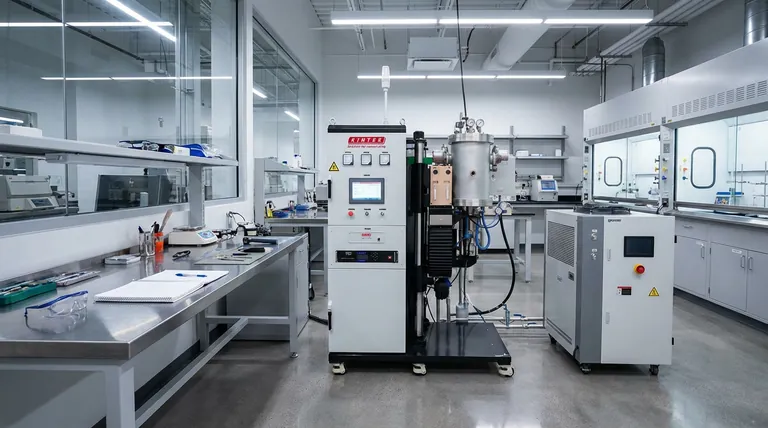
Precision temperature control is the determinant factor in the structural success of PTFE/Fe2O3 composites. A sintering furnace ensures quality by executing a specific thermal profile: heating at a controlled rate of 3 °C/min to reach 380 °C, and subsequently cooling at a slow rate of 1.0 °C/min. This rigorous cycle allows the polytetrafluoroethylene (PTFE) matrix to fully melt and fuse, eliminating internal defects while preventing fractures caused by rapid temperature changes.
The core function of the furnace is not merely reaching a peak temperature, but managing the rate of thermal change. By balancing the densification of particles with a slow cooling phase, the process secures the material's mechanical integrity and ensures the accuracy of future electromagnetic measurements.
The Role of Controlled Heating
Achieving Optimal Fusion
To create a solid composite, the furnace must heat the material at a steady rate of 3 °C/min.
This gradual ramp-up is essential for the PTFE matrix particles. It ensures they melt uniformly and fuse together effectively, creating a cohesive bond with the Fe2O3 (Iron Oxide) components.
Eliminating Internal Porosity
A primary goal of the sintering process is densification.
By adhering to the strict heating profile up to 380 °C, the furnace allows the material to settle and bond. This eliminates internal pores (air gaps) that would otherwise weaken the structure and distort the material's properties.
The Critical Importance of Cooling
Preventing Thermal Stress
The cooling phase is where many structural failures occur.
The furnace must reduce the temperature at a significantly slower rate of 1.0 °C/min. This slow pace is critical to prevent thermal shock, which occurs when the outside of the material cools and contracts faster than the inside.
Avoiding Micro-Cracks
If cooling is uncontrolled, the resulting internal stress leads to the formation of cracks.
By maintaining the 1.0 °C/min rate, the furnace ensures the composite cools uniformly. This maintains the mechanical integrity of the sample, ensuring it is a solid, crack-free block rather than a fractured, brittle component.
Understanding the Trade-offs
Speed vs. Quality
There is often a temptation to accelerate the sintering process to increase throughput.
However, increasing the heating rate above 3 °C/min risks incomplete fusion and remaining porosity. Similarly, accelerating the cooling phase beyond 1.0 °C/min almost guarantees the introduction of thermal stress fractures.
Impact on Data Accuracy
The physical structure directly correlates to performance data.
Any compromise in the thermal profile that leads to pores or cracks will invalidate subsequent testing. Specifically, structural defects introduce anomalies in electromagnetic measurements, rendering the composite useless for precision applications.
Making the Right Choice for Your Goal
To maximize the performance of your PTFE/Fe2O3 composites, you must align your furnace programming with your specific end-goals.
- If your primary focus is Mechanical Durability: Prioritize the cooling rate limit of 1.0 °C/min to strictly prevent the formation of micro-cracks that compromise structural strength.
- If your primary focus is Electromagnetic Accuracy: Ensure the heating phase reaches the full 380 °C at the prescribed rate to guarantee complete pore elimination, as air gaps will distort signal readings.
Ultimately, the structural quality of the composite is defined by the discipline of the thermal cycle.
Summary Table:
| Process Phase | Target Parameter | Control Rate | Primary Structural Benefit |
|---|---|---|---|
| Heating Phase | 380 °C Peak | 3.0 °C/min | Ensures uniform fusion & eliminates porosity |
| Cooling Phase | Room Temp | 1.0 °C/min | Prevents thermal stress & micro-cracking |
| Material Focus | PTFE/Fe2O3 | Precision Control | Maximizes mechanical and electromagnetic integrity |
Elevate Your Materials Research with KINTEK Precision
Achieving the perfect PTFE/Fe2O3 composite requires more than just heat; it requires absolute thermal discipline. KINTEK’s high-precision sintering furnaces provide the exact ramp-up and cooling control necessary to eliminate porosity and prevent structural fractures.
Backed by expert R&D and manufacturing, KINTEK offers Muffle, Tube, Rotary, Vacuum, and CVD systems, all customizable to meet your unique lab requirements. Don’t let thermal stress compromise your data accuracy—partner with the leaders in high-temperature lab technology.
Contact KINTEK Today to Optimize Your Sintering Process
References
- Bello Murtala Alhaji, Abubakar Yakubu. Synthesis and Characterization of Hematite Fe2O3 Nanofiller for Enhanced Dielectric and Microwave-Absorbing Properties in PTFE Composites. DOI: 10.58915/ijneam.v17i1.521
This article is also based on technical information from Kintek Furnace Knowledge Base .
Related Products
- Vacuum Heat Treat Sintering Furnace with Pressure for Vacuum Sintering
- Spark Plasma Sintering SPS Furnace
- Vacuum Heat Treat Sintering Furnace Molybdenum Wire Vacuum Sintering Furnace
- Small Vacuum Heat Treat and Tungsten Wire Sintering Furnace
- Vacuum Dental Porcelain Sintering Furnace for Dental Laboratories
People Also Ask
- What are the benefits of using vacuum heat treating furnaces for metal alloys? Achieve Superior Metal Properties and Performance
- How does vacuum heat treating affect the grain structure of metal alloys? Achieve Precise Microstructure Control
- What is one of the most important uses of vacuum heat treating furnaces in aerospace? Achieve Superior Strength in Aircraft Alloys
- What are the key components of a vacuum sintering furnace? Essential Parts for Precision Material Processing
- What is the purpose of setting a mid-temperature dwell stage? Eliminate Defects in Vacuum Sintering



















