
A Bridgman crystal growth furnace ensures the quality of (Bi2Te3)1-c(Sb2Te)c crystals by strictly enforcing a precise temperature gradient and utilizing an extremely slow mechanical translation speed. By maintaining a cooling rate as low as 2.8 K per hour, the system facilitates directional solidification. This controlled environment minimizes structural chaos, resulting in low defect densities and the formation of quasi-single crystal structures essential for high-performance applications.
Success in the Bridgman method relies on the precise synchronization of thermal gradients and slow translation speeds. This rigorous control forces directional solidification, directly reducing material defects to unlock superior electrical transport properties.
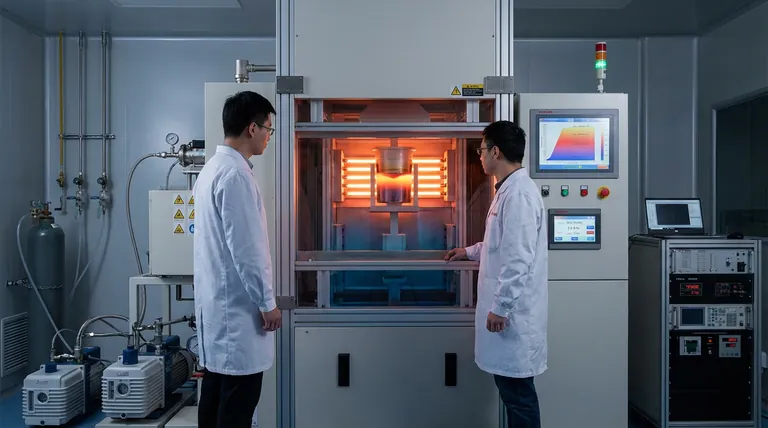
The Mechanics of Quality Control
Establishing the Temperature Gradient
The furnace does not simply heat the material; it maintains a sharp, consistent temperature gradient. This gradient creates a distinct boundary between the molten material and the solidifying crystal.
The Role of Slow Translation
The physical movement of the sample through the furnace is deliberately sluggish. The primary reference highlights a cooling rate of 2.8 K per hour.
Enabling Atomic Arrangement
This slow translation is critical for quality. It provides the atoms in the melt sufficient time to align correctly into a lattice structure as they transition to a solid state.
Impact on Material Structure
Achieving Directional Solidification
The combination of the thermal gradient and slow speed induces directional solidification. Instead of freezing randomly, the crystal grows in a single, uniform direction.
Creating Quasi-Single Structures
This process results in a quasi-single crystal structure. Unlike polycrystalline materials, which consist of many fragmented grains, this structure offers better uniformity.
Minimizing Defect Densities
Rapid cooling causes stress, fractures, and atomic misalignment. The controlled Bridgman environment ensures low defect densities, producing a physically robust and chemically consistent material.
Enhancing Electrical Characteristics
The ultimate goal of this structural perfection is functional performance. The lack of defects ensures the material exhibits superior electrical transport characteristics, which is vital for thermoelectric applications.
Understanding the Trade-offs
The Time-Intensive Nature
The primary constraint of this method is throughput. A rate of 2.8 K per hour means the growth process is exceptionally time-consuming compared to other manufacturing methods.
Sensitivity to Fluctuations
Because the process is so slow, the system must remain stable for long periods. Any fluctuation in the temperature gradient or translation speed during the long growth cycle can introduce defects.
Making the Right Choice for Your Goal
To maximize the quality of (Bi2Te3)1-c(Sb2Te)c crystals, you must prioritize process control over production speed.
- If your primary focus is structural integrity: Ensure your mechanical translation is set to an extremely low speed (near 2.8 K/hr) to minimize defect density.
- If your primary focus is electrical performance: Verify that the temperature gradient is perfectly stable to facilitate the quasi-single crystal growth required for optimal transport.
Precision in the growth phase is the only path to superior material performance.
Summary Table:
| Key Quality Factor | Mechanism | Impact on Crystal |
|---|---|---|
| Thermal Gradient | Sharp temperature boundary | Enables controlled directional solidification |
| Cooling Rate | 2.8 K per hour (Ultra-slow) | Provides sufficient time for perfect atomic alignment |
| Mechanical Speed | Sluggish translation | Minimizes stress and reduces defect densities |
| Material Structure | Quasi-single crystal growth | Enhances electrical transport characteristics |
Elevate Your Crystal Growth Precision with KINTEK
To achieve high-performance thermoelectric materials like (Bi2Te3)1-c(Sb2Te)c, you need a thermal environment that offers uncompromising stability. KINTEK provides expert-engineered high-temperature solutions, including specialized Vacuum, Tube, and CVD systems, designed to meet the rigorous demands of directional solidification and single-crystal growth.
Whether you require precise mechanical translation or custom-calibrated thermal gradients, our R&D and manufacturing teams are ready to build a system tailored to your unique research or production needs.
Ready to minimize defect densities and optimize material performance? Contact KINTEK Today to Consult Our Experts
References
- Hung‐Wei Chen, Hsin‐Jay Wu. Dilute Sb Doping Yields Softer <i>p</i>‐Type Bi<sub>2</sub>Te<sub>3</sub> Thermoelectrics. DOI: 10.1002/aelm.202300793
This article is also based on technical information from Kintek Furnace Knowledge Base .
Related Products
- Vertical Laboratory Quartz Tube Furnace Tubular Furnace
- High Temperature Muffle Oven Furnace for Laboratory Debinding and Pre Sintering
- High Pressure Laboratory Vacuum Tube Furnace
- Laboratory Quartz Tube Furnace RTP Heating Tubular Furnace
- Multi Zone Laboratory Quartz Tube Furnace Tubular Furnace
People Also Ask
- What are the key differences between single-zone and multi-zone vertical tube furnaces? Choose the Right Furnace for Your Lab
- What is a vertical tube furnace and how does it function? Optimize Material Processing with Precision
- How are wafers loaded and unloaded in a vertical tube furnace? Achieve Precision and Purity in Wafer Processing
- How are metal support wires selected for sample suspension? Expert Guide to High-Temp Furnace Materials
- What are the main characteristics of vertical tube furnaces? Optimize Your Lab with Space-Saving, Uniform Heating



















