
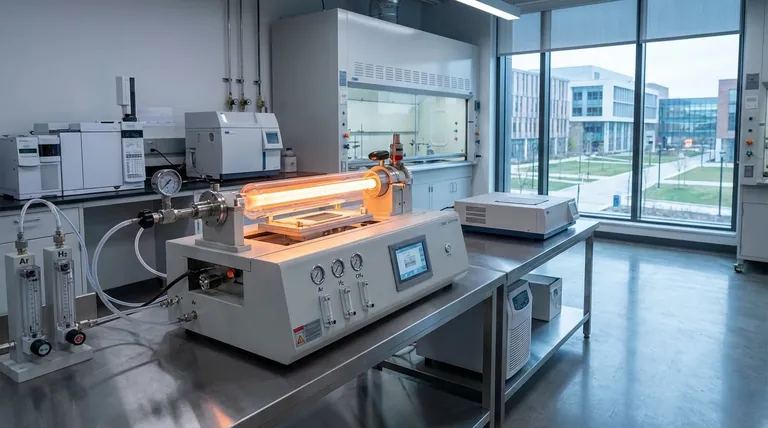
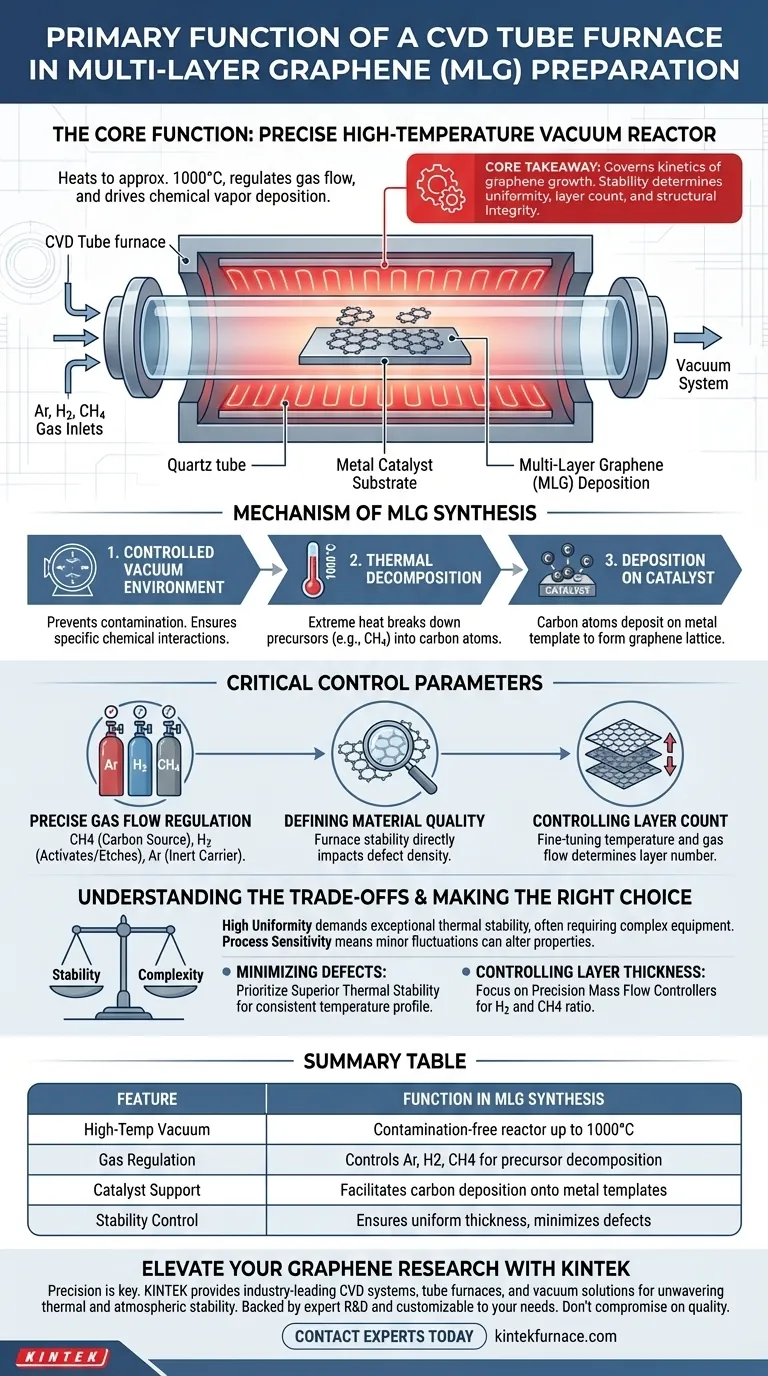
The primary function of a CVD tube furnace in the preparation of Multi-Layer Graphene (MLG) is to provide a precise, high-temperature vacuum environment that drives the chemical vapor deposition process.
It acts as a reactor that heats the system to approximately 1000 °C while regulating the flow of specific gases (Ar, H2, and CH4) to facilitate the decomposition of carbon precursors and their subsequent deposition onto a metal catalyst.
Core Takeaway: The CVD tube furnace is not merely a heating element; it is a precision instrument that governs the kinetics of graphene growth. Its ability to maintain thermal and atmospheric stability is the deciding factor in the uniformity, layer count, and structural integrity of the final MLG material.
The Mechanism of MLG Synthesis
Creating the Reaction Environment
To synthesize MLG, the furnace must establish a controlled vacuum environment.
This isolation prevents contamination and ensures that the chemical interactions occur strictly between the introduced gases and the catalyst substrate.
Thermal Decomposition of Precursors
The furnace operates at high temperatures, typically around 1000 °C.
This extreme heat is required to break down carbon-containing gases, such as methane (CH4). Once decomposed, the carbon atoms are liberated and become available for structural arrangement.
Deposition on Metal Catalysts
The free carbon atoms do not simply float; they deposit onto metal catalyst surfaces placed within the tube.
The catalyst serves as a template, guiding the carbon atoms to arrange themselves into the characteristic hexagonal lattice structure of graphene.
Critical Control Parameters
Precise Gas Flow Regulation
The furnace controls the introduction of specific gas mixtures, including Argon (Ar), Hydrogen (H2), and Methane (CH4).
Methane acts as the carbon source, while Hydrogen often plays a dual role in activating the catalyst and etching away weak carbon bonds to improve quality. Argon serves as an inert carrier gas to maintain pressure and flow dynamics.
Defining Material Quality
The ultimate quality of the MLG depends heavily on the stability of the furnace.
Variations in the internal environment directly impact the defect density, meaning a less stable furnace yields graphene with more structural imperfections.
Controlling Layer Count
The furnace's precision allows researchers to manipulate the layer count of the graphene.
By fine-tuning the temperature and gas flow rates, one can determine whether the resulting material is single-layer graphene or the target Multi-Layer Graphene (MLG).
Understanding the Trade-offs
Stability vs. Complexity
Achieving the high uniformity required for advanced applications (such as ion channels) demands a furnace with exceptional thermal stability.
However, increasing precision often requires more complex and expensive equipment to eliminate thermal gradients along the tube length.
Process Sensitivity
The CVD process is highly sensitive; even minor fluctuations in gas flow or temperature can lead to inconsistent layer thickness.
A lack of precision in the furnace does not just lower quality—it can fundamentally alter the material properties, rendering the MLG unsuitable for its intended application.
Making the Right Choice for Your Goal
To optimize your MLG preparation, you must align your furnace operation with your specific material requirements.
- If your primary focus is minimizing defects: Prioritize a furnace with superior thermal stability to ensure a consistent temperature profile across the catalyst surface.
- If your primary focus is controlling layer thickness: Focus on the precision of the mass flow controllers for H2 and CH4, as the gas ratio heavily influences the deposition rate.
Success in MLG synthesis is less about the maximum temperature reached and more about the unwavering stability of the environment maintained.
Summary Table:
| Feature | Function in MLG Synthesis |
|---|---|
| High-Temp Vacuum | Provides a contamination-free reactor environment up to 1000 °C |
| Gas Regulation | Controls flow of Ar, H2, and CH4 for carbon precursor decomposition |
| Catalyst Support | Facilitates carbon deposition onto metal templates for hexagonal lattice formation |
| Stability Control | Ensures uniform layer thickness and minimizes structural defect density |
Elevate Your Graphene Research with KINTEK
Precision is the deciding factor in the structural integrity of Multi-Layer Graphene. KINTEK provides industry-leading CVD systems, tube furnaces, and vacuum solutions designed to maintain the unwavering thermal and atmospheric stability your research demands.
Backed by expert R&D and precision manufacturing, our lab high-temp furnaces are fully customizable to meet your unique synthesis needs. Don't compromise on material quality—contact our experts today to find the perfect system for your lab.
Visual Guide
References
- Dae Yeop Jeong, Won Il Park. α‐<scp>Al<sub>2</sub>O<sub>3</sub></scp> Networks on <scp>MLG</scp> Membranes for Continuous Lithium Ion Extraction from Artificial Sea Water with Enhanced Selectivity and Durability. DOI: 10.1002/eem2.70145
This article is also based on technical information from Kintek Furnace Knowledge Base .
Related Products
- Custom Made Versatile CVD Tube Furnace Chemical Vapor Deposition CVD Equipment Machine
- Split Chamber CVD Tube Furnace with Vacuum Station CVD Machine
- Multi Heating Zones CVD Tube Furnace Machine for Chemical Vapor Deposition Equipment
- Slide PECVD Tube Furnace with Liquid Gasifier PECVD Machine
- Inclined Rotary Plasma Enhanced Chemical Deposition PECVD Tube Furnace Machine
People Also Ask
- Why are CVD tube furnace sintering systems indispensable for 2D material research and production? Unlock Atomic-Scale Precision
- What is a CVD tube furnace and what is its primary function? Discover Precision Thin-Film Deposition
- How does CVD tube furnace sintering enhance graphene growth? Achieve Superior Crystallinity and High Electron Mobility
- Which industries and research fields benefit from CVD tube furnace sintering systems for 2D materials? Unlock Next-Gen Tech Innovations
- How can integrating CVD tube furnaces with other technologies benefit device fabrication? Unlock Advanced Hybrid Processes



















