
To ensure the formation of a conductive coating and prevent chemical degradation.
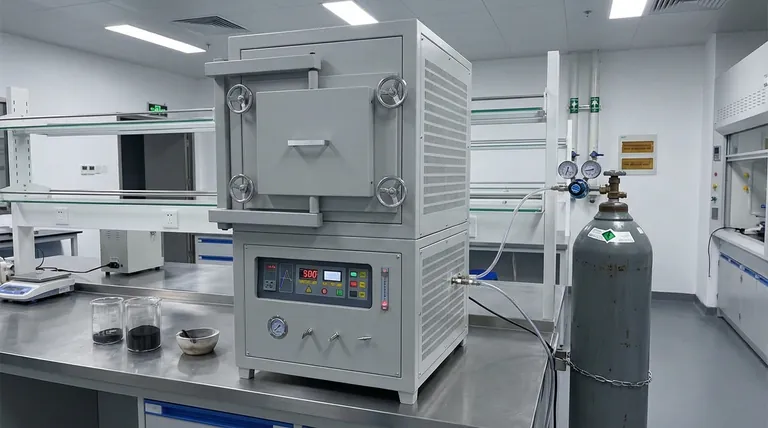
The carbonization process involves heating a precursor mixed with a carbon source (typically glucose) to approximately 500°C. You must use an inert atmosphere furnace because the presence of oxygen would cause the carbon source to combust rather than coat the particles, while simultaneously oxidizing the unstable iron within the compound.
The inert atmosphere acts as a strictly controlled chemical shield; it forces the carbon source to decompose into a conductive layer rather than burning away, while preserving the delicate valence state of the iron.
1. Preventing the Loss of the Carbon Source
The primary goal of this process is to create a carbon-coated material. You are typically introducing a carbon precursor, such as glucose, which covers the sodium iron phosphate particles.
The Combustion Risk
If you attempt this process in a standard air furnace, the oxygen in the air reacts with the glucose at high temperatures. Instead of forming a solid coating, the carbon reacts with oxygen to form carbon dioxide ($CO_2$) and burns off completely.
Promoting Pyrolysis
By utilizing an inert gas like nitrogen, you remove oxygen from the equation. This forces the glucose to undergo pyrolysis—a thermal decomposition in the absence of oxygen. This results in the necessary "reduced" carbon remaining on the surface of the particles.
2. Stabilizing the Iron Chemistry
Beyond the coating itself, the chemical integrity of the sodium iron phosphate (NaFePO4) relies heavily on the stability of the iron atoms within the crystal lattice.
Protecting Divalent Iron
Sodium iron phosphate contains divalent iron ($Fe^{2+}$). This form of iron is chemically active and prone to oxidation. At the elevated temperatures required for carbonization (around 500°C), $Fe^{2+}$ is highly unstable in the presence of air.
Avoiding Impurities
If oxygen penetrates the furnace chamber, the divalent iron will oxidize into trivalent iron ($Fe^{3+}$). This unwanted chemical reaction fundamentally changes the material's structure and performance characteristics. An inert nitrogen environment effectively "locks" the iron in its required divalent state.
3. Creating a Continuous Conductive Network
The ultimate objective of carbon-coating battery materials is to enhance electrical conductivity. Sodium iron phosphate, on its own, often lacks sufficient conductivity for high-performance applications.
The Role of Reduced Carbon
To achieve high performance, you need a continuous, highly conductive reduced carbon coating. "Reduced" carbon refers to carbon that has been processed in an oxygen-starved environment.
Surface Interface
The inert atmosphere ensures that this coating forms uniformly over the particle surfaces. This conductive layer acts as a bridge, allowing electrons to move freely across the surface of the cathode material, which is critical for the battery's final electrochemical performance.
Understanding the Trade-offs
While an inert atmosphere is chemically mandatory, it introduces specific processing constraints that must be managed.
Gas Selection and Cost
You generally have a choice between nitrogen and argon. Nitrogen is typically sufficient for preventing the oxidation of divalent iron and is more cost-effective. Argon provides a heavier, more protective blanket but is significantly more expensive and generally reserved for extremely sensitive metallic sintering or neutral hardening processes.
Thermal Control vs. Atmosphere Purity
Maintaining a pure atmosphere becomes harder as temperature rises. While carbonization occurs around 500°C, related processes like calcination (to crystallize the maricite phase) may require temperatures up to 600°C. As heat increases, the furnace seals are tested more rigorously; any leak that admits oxygen will result in immediate "burn-off" of your carbon layer and degradation of the iron.
Making the Right Choice for Your Goal
To maximize the quality of your NaFePO4 synthesis, consider your specific processing priorities:
- If your primary focus is Electrical Conductivity: Prioritize the purity of your nitrogen stream to ensure the carbon source fully pyrolyzes into a conductive lattice without burning off.
- If your primary focus is Chemical Stability: Monitor furnace seals strictly to prevent oxygen ingress, as even trace amounts can oxidize $Fe^{2+}$ to $Fe^{3+}$ and ruin the crystal structure.
- If your primary focus is Cost Efficiency: Utilize high-purity nitrogen rather than argon, as it is sufficient to prevent the oxidation of sodium iron phosphate components at 500°C.
Control the atmosphere, and you control the material's performance.
Summary Table:
| Process Factor | Influence of Oxygen (Air) | Role of Inert Atmosphere (Nitrogen/Argon) |
|---|---|---|
| Carbon Source | Combusts into $CO_2$; coating is lost | Undergoes pyrolysis to form a conductive layer |
| Iron Valence State | $Fe^{2+}$ oxidizes to $Fe^{3+}$ (Degradation) | Maintains stable $Fe^{2+}$ state in crystal lattice |
| Conductivity | Non-conductive due to lack of carbon | Creates continuous, highly conductive network |
| Material Quality | Structural impurities and performance loss | High-purity, high-performance battery material |
Elevate Your Battery Material Synthesis with KINTEK
Don't let oxygen ingress compromise your research. Backed by expert R&D and precision manufacturing, KINTEK provides industry-leading Muffle, Tube, Rotary, Vacuum, and CVD systems designed to maintain the strict inert environments required for high-performance NaFePO4 production. Our systems are fully customizable to meet your unique temperature and gas flow needs, ensuring every batch achieves optimal conductivity and chemical stability.
Ready to optimize your carbonization process? Contact us today to discuss your specific requirements with our technical experts!
References
- Krishna Dagadkhair, Paresh H. Salame. Electronic Transport Properties of Carbon‐Encapsulated Maricite NaFePO<sub>4</sub> as Cathode Material for Sodium‐Ion Batteries. DOI: 10.1002/adsu.202500188
This article is also based on technical information from Kintek Furnace Knowledge Base .
Related Products
- 1400℃ Controlled Inert Nitrogen Atmosphere Furnace
- 1700℃ Controlled Inert Nitrogen Atmosphere Furnace
- Controlled Inert Nitrogen Hydrogen Atmosphere Furnace
- 1200℃ Controlled Inert Nitrogen Atmosphere Furnace
- Mesh Belt Controlled Atmosphere Furnace Inert Nitrogen Atmosphere Furnace
People Also Ask
- How does oxygen partial pressure control affect ceramic sintering? Master Defect Chemistry
- Why is thorough binder burnout necessary before sintering advanced ceramics? Ensure Peak Density & Zero Defects
- Why is controlled-atmosphere heating required for functional ceramics and sensors? Master Defect Engineering
- How do controlled-atmosphere furnaces support polymer pyrolysis? Master SiC & Si3N4 Ceramic Conversion
- How does real-time dilatometric analysis in a controlled-atmosphere furnace optimize PZT ceramic sintering?


















