
High-temperature processing of Manganese-Cu alloys requires strict environmental and chemical controls due to the extreme volatility of metallic manganese. When subjected to intense heat sources like laser scanning, manganese evaporates rapidly, requiring both a protective inert atmosphere and a deliberate surplus of Mn in the starting material to ensure the final alloy meets design specifications.
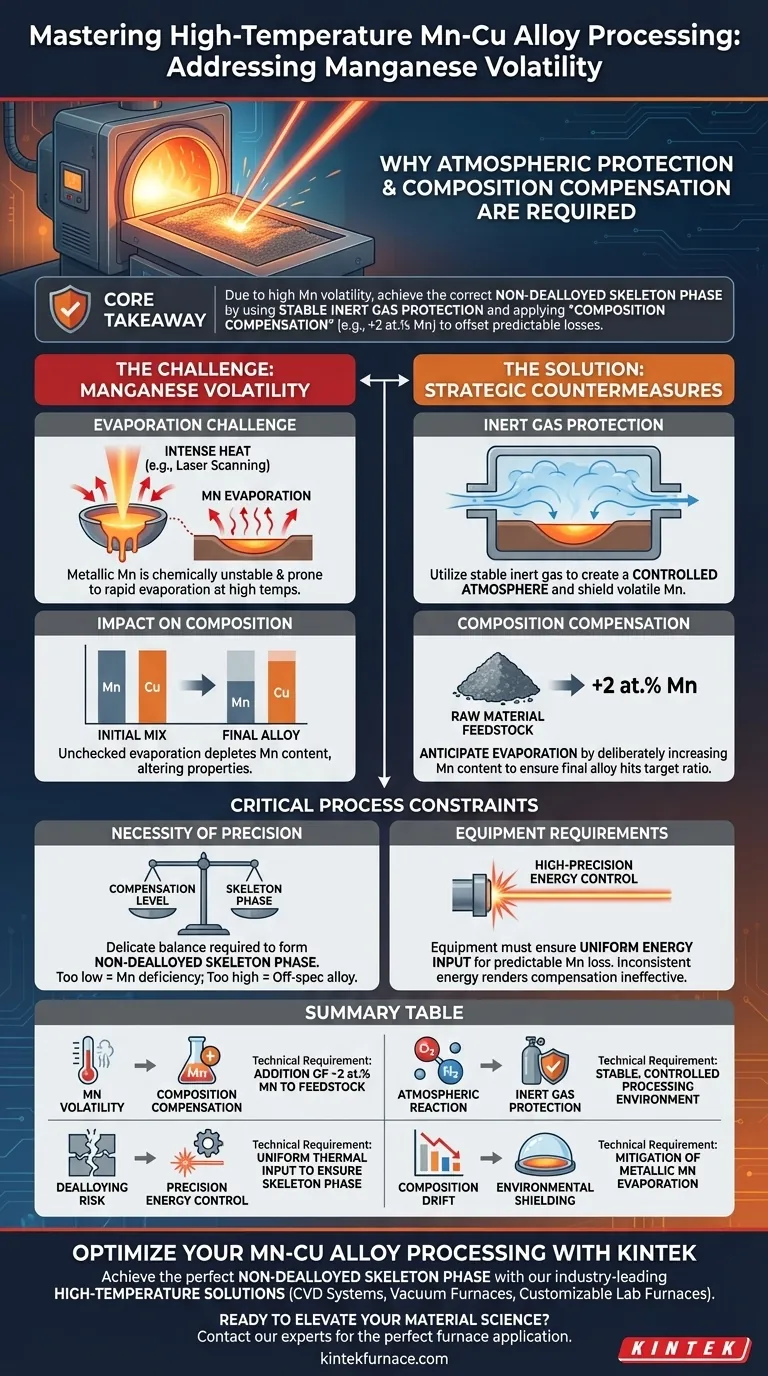
Core Takeaway Because metallic manganese has a high propensity for evaporation during thermal processing, standard feedstock ratios result in a manganese-deficient final product. To achieve the correct non-dealloyed skeleton phase, manufacturers must utilize stable inert gas protection and apply "composition compensation"—typically adding an extra 2 at.% Mn to the initial mix—to offset these predictable losses.
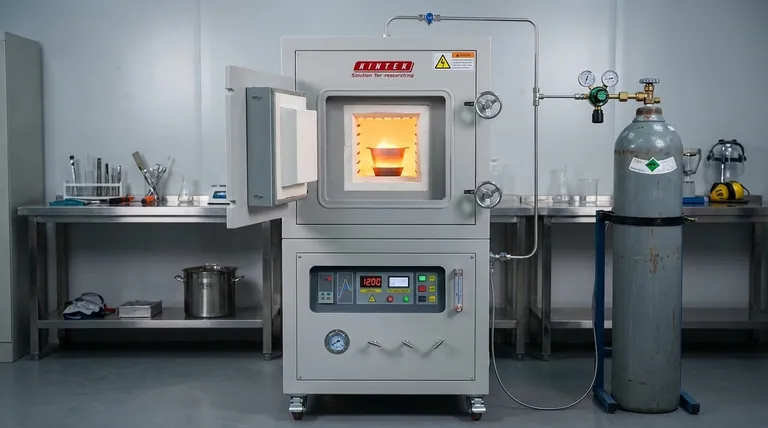
Understanding Manganese Volatility
The Evaporation Challenge
During high-temperature processes such as laser scanning, the thermal energy applied to the material is intense.
Under these conditions, metallic manganese (Mn) is chemically unstable and highly prone to evaporation. This volatility creates an immediate risk of material loss during the melting phase.
The Impact on Composition
If this evaporation is left unchecked, the final chemical composition of the alloy will drift away from the intended design.
This loss is not uniform; it specifically depletes the manganese content relative to the copper, fundamentally altering the alloy's properties and potential performance.
Strategic Countermeasures
Inert Gas Protection
To mitigate environmental instability, the processing equipment must utilize stable inert gas protection.
This creates a controlled atmosphere around the melt pool. It shields the volatile manganese from atmospheric reactions and helps stabilize the immediate processing environment.
Composition Compensation
Process engineers must anticipate the evaporation rather than just trying to prevent it. This is achieved through initial composition compensation.
By deliberately increasing the manganese content in the raw material—typically by 2 at.%—manufacturers can "feed" the evaporation process. This ensures that after the inevitable losses occur, the remaining material settles at the exact intended ratio.
Critical Process Constraints
The Necessity of Precision
This is a delicate balancing act. The goal is to form a specific microstructure known as the non-dealloyed skeleton phase.
If the compensation is too low, the skeleton phase will not form correctly due to Mn deficiency. If the compensation is too high (without corresponding evaporation), the alloy will be off-spec.
Equipment Requirements
Material chemistry alone cannot solve the problem. The manufacturing equipment must be capable of high-precision energy control.
Inconsistent energy input can lead to unpredictable evaporation rates, rendering the fixed composition compensation ineffective. Uniform energy application is required to make the Mn loss predictable and manageable.
Ensuring Process Success
To successfully manufacture Mn-Cu alloys via high-temperature methods, prioritize the following based on your production goals:
- If your primary focus is Chemical Accuracy: Implement a standard composition compensation strategy (e.g., +2 at.% Mn) to neutralize the effects of evaporation.
- If your primary focus is Microstructural Integrity: Ensure your equipment offers high-precision energy control to maintain the stable conditions required for the non-dealloyed skeleton phase.
Precision in both atmospheric control and feedstock chemistry is the only way to guarantee the final alloy matches its design requirements.
Summary Table:
| Process Challenge | Solution | Technical Requirement |
|---|---|---|
| Mn Volatility | Composition Compensation | Addition of ~2 at.% Mn to feedstock |
| Atmospheric Reaction | Inert Gas Protection | Stable, controlled processing environment |
| Dealloying Risk | Precision Energy Control | Uniform thermal input to ensure skeleton phase |
| Composition Drift | Environmental Shielding | Mitigation of metallic manganese evaporation |
Optimize Your Mn-Cu Alloy Processing with KINTEK
Don't let manganese volatility compromise your material integrity. Achieving the perfect non-dealloyed skeleton phase requires the highest levels of thermal precision and atmospheric control.
KINTEK provides industry-leading high-temperature solutions—including CVD systems, vacuum furnaces, and customizable lab furnaces—designed to handle the most volatile materials. Backed by expert R&D and manufacturing, our equipment ensures uniform energy input and stable inert environments tailored to your specific research or production needs.
Ready to elevate your material science? Contact our experts today to find the perfect furnace for your specialized application.
Visual Guide
References
- Haozhang Zhong, Ma Qian. Skeletal High‐Strength Nanoporous Copper and Metamaterials: The Hakka Tulou Design Heritage. DOI: 10.1002/adma.202503701
This article is also based on technical information from Kintek Furnace Knowledge Base .
Related Products
- 1400℃ High Temperature Laboratory Tube Furnace with Alumina Tube
- 2200 ℃ Tungsten Vacuum Heat Treat and Sintering Furnace
- Magnesium Extraction and Purification Condensing Tube Furnace
- 1700℃ High Temperature Laboratory Tube Furnace with Alumina Tube
- Molybdenum Vacuum Heat Treat Furnace
People Also Ask
- How does zone-melting in tube furnaces synthesize bismuth micro-wires? Master Single-Crystal Thermoelectric Growth
- How are high-temp tube furnaces used to measure diffusion coefficients per Fick's law? Master Precision Annealing
- How are high-temperature laboratory tube furnaces applied in long-term vacuum homogenization heat treatments for intermetallic samples?
- How do high-temperature laboratory tube furnaces ensure environmental stability? Precision Thermal Reduction Tips
- How are high-temperature tube furnaces applied in testing ceramic-supported alloy membranes? Insights



















