
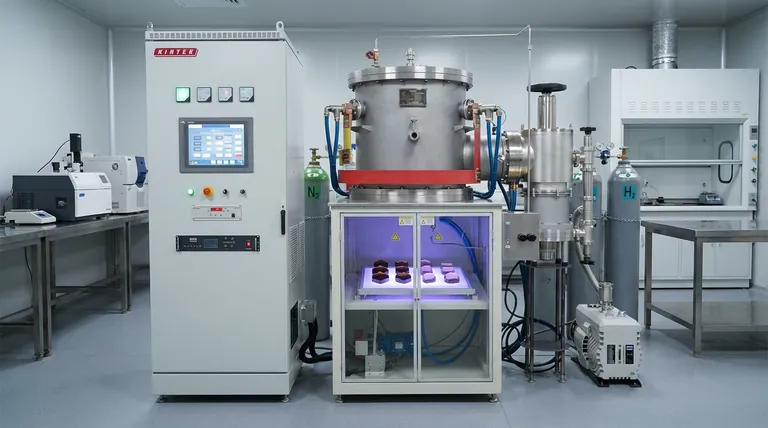
The primary purpose of using a reducing atmosphere annealing furnace for Nd:SrLaGaO4 crystals is to fundamentally alter the crystal's internal structure to eliminate color center defects. By treating the crystal in a specific mixture of nitrogen (N2) and hydrogen (H2), you actively reverse the optical imperfections created during the initial growth phase. This process transforms the material’s appearance from a deep brown to a light violet-brown, signaling a successful reduction in defects.
The annealing process acts as a critical quality control gate, adjusting the internal defect balance to ensure the crystal achieves the optical uniformity required for efficient laser operation.
The Mechanism of Defect Elimination
Targeting Color Centers
During the growth of Nd:SrLaGaO4, the crystal lattice often develops "color centers." These are specific defects that absorb light rather than transmitting or amplifying it.
The annealing furnace provides the thermal environment necessary to mobilize and remove these defects.
The Role of the Reducing Atmosphere
Heat alone is insufficient to correct these specific atomic-level flaws. The presence of a reducing atmosphere, specifically a mix of Nitrogen (N2) and Hydrogen (H2), is chemically necessary.
This gas mixture interacts with the crystal surface and lattice to facilitate the reduction process, effectively "healing" the color centers that degrade performance.
Impact on Optical Performance
Reducing Non-Radiative Losses
For a laser crystal to be effective, it must convert input energy into laser light efficiently.
Untreated crystals suffer from non-radiative losses, where energy is wasted as heat rather than emitted as light. This annealing treatment directly lowers these losses, significantly boosting the crystal's operational efficiency.
Optimizing Optical Uniformity
A laser crystal must have consistent optical properties throughout its entire volume.
The thermal treatment ensures that the internal defect balance is adjusted uniformly. This results in a stable, reliable medium that allows for consistent laser propagation without distortion.
Critical Considerations and Constraints
The Visual Indicator of Quality
One of the most immediate "trade-offs" or indicators in this process is the visual shift. You cannot assume a crystal is ready based on time alone; you must observe the color change.
If the crystal remains deep brown, the annealing was ineffective. A shift to light violet-brown is the mandatory visual confirmation that the optical properties have been optimized.
Process Dependency
This process is highly specific to the chemistry of the defects. Using an oxidizing atmosphere or an inert atmosphere without Hydrogen would likely fail to eliminate the specific color centers found in Nd:SrLaGaO4.
Success depends entirely on the precise control of the N2 and H2 mixture within the furnace.
Ensuring High-Performance Laser Output
To ensure you are getting the most out of your Nd:SrLaGaO4 material, use the following guidelines to align your processing steps with your end goals:
- If your primary focus is Maximum Laser Efficiency: Prioritize the reduction of non-radiative losses by strictly adhering to the N2/H2 atmosphere requirements to eliminate energy-draining defects.
- If your primary focus is Quality Control: Use the transition from deep brown to light violet-brown as your definitive pass/fail metric for the annealing stage.
By rigorously applying this reducing atmosphere treatment, you convert a raw, imperfect solid into a high-performance optical component ready for demanding applications.
Summary Table:
| Feature | Before Annealing | After Reducing Annealing |
|---|---|---|
| Visual Color | Deep Brown | Light Violet-Brown |
| Internal Defects | High Concentration of Color Centers | Minimal / Eliminated |
| Optical Quality | High Non-Radiative Losses | High Efficiency & Uniformity |
| Atmosphere Required | Oxidizing/Inert (Growth Phase) | N2 + H2 Mixture (Reducing) |
| Primary Goal | Material Solidification | Defect Elimination & Tuning |
Unlock Peak Optical Performance with KINTEK
Precision in thermal processing is the difference between an imperfect crystal and a high-performance laser medium. At KINTEK, we understand the critical nature of atmosphere control for specialized applications like Nd:SrLaGaO4 annealing.
Backed by expert R&D and world-class manufacturing, we offer a comprehensive range of Muffle, Tube, Rotary, Vacuum, and CVD systems. Whether you require precise N2/H2 gas mixing or custom high-temperature lab furnaces, our solutions are fully customizable to your unique research and production needs.
Ready to optimize your crystal growth and annealing process?
Contact KINTEK today to discuss your customized furnace solution!
References
- Shanshan Fang, He‐Rui Wen. Growth, Structure, and Spectroscopic Properties of a Disordered Nd:SrLaGaO4 Laser Crystal. DOI: 10.3390/cryst14020174
This article is also based on technical information from Kintek Furnace Knowledge Base .
Related Products
- Controlled Inert Nitrogen Hydrogen Atmosphere Furnace
- Mesh Belt Controlled Atmosphere Furnace Inert Nitrogen Atmosphere Furnace
- 1400℃ Controlled Inert Nitrogen Atmosphere Furnace
- 1200℃ Controlled Inert Nitrogen Atmosphere Furnace
- 1700℃ Controlled Inert Nitrogen Atmosphere Furnace
People Also Ask
- How does hydrogen furnace annealing assist in preparing mechanically alloyed powders for compaction?
- How does atmospheric annealing in a controlled hydrogen furnace affect the cold compaction behavior of metal powders?
- What are the characteristics and uses of hydrogen atmosphere in furnaces? Achieve Superior Surface Purity and Bonding
- What are the characteristics and uses of hydrogen atmospheres in furnaces? Unlock Clean Metal Processing
- What controlled-atmosphere furnace conditions are required for sintering powder metallurgy copper alloy compacts? Ideal Setup












