
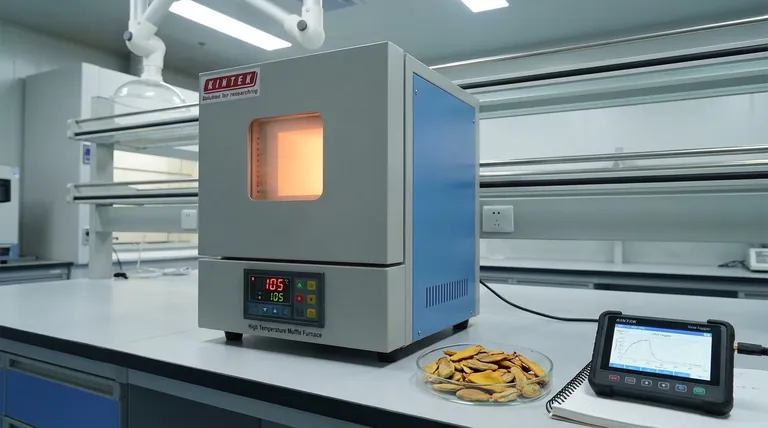
Preheating is a non-negotiable stabilization step that ensures your laboratory furnace reaches a consistent thermal equilibrium before the experiment begins. By running the empty furnace for approximately 30 minutes, you eliminate initial temperature fluctuations and ensure the heating chamber is stable. This guarantees that the mango seeds are exposed to the exact target temperature the moment they are placed inside.
Core Takeaway: Preheating is essential for data integrity, not just equipment operation. It prevents the inclusion of the "ramp-up" phase in your data, ensuring that the kinetic parameters you calculate are based on true, stable isothermal conditions.
Achieving Precise Thermal Conditions
Eliminating Temperature Fluctuations
When a laboratory furnace is first powered on, the internal environment is volatile. The temperature often oscillates significantly as the heating elements cycle on and off to reach the set point.
Preheating for approximately 30 minutes allows these initial spikes and drops to smooth out. This waiting period is critical for transitioning the chamber from a dynamic state to a static, reliable environment.
Establishing Thermal Equilibrium
Achieving the target temperature on the display is not the same as achieving thermal equilibrium throughout the chamber. The walls, the air, and the shelving must all reach a steady state of heat distribution.
If you introduce the mango seeds before this equilibrium is established, the sample may experience uneven heating. This leads to inconsistent drying rates across the seed mass.
Ensuring Data Validity
Immediate Isothermal Exposure
Scientific drying experiments typically aim to model "isothermal" conditions, where the temperature remains constant throughout the process.
By preheating, you ensure the mango seeds are subjected to the target drying conditions immediately upon insertion. This matches the theoretical assumptions used in most mathematical modeling, making your results scientifically valid.
Preserving Kinetic Parameters
The primary goal of many laboratory drying experiments is to extract kinetic parameters, which describe how fast moisture is lost over time.
If the furnace is still ramping up heat while the seeds are inside, the drying rate will be artificially slow at the start. This introduces experimental error, skewing the kinetic data and rendering the resulting calculations inaccurate.
The Broader Context of Biomass Drying
Why Moisture Removal Matters
While preheating ensures accuracy, the drying process itself is essential for quality. Thoroughly removing physical moisture from the feedstock is required to produce high-quality bio-oil.
Impact on Final Product
High water content in the feedstock leads to bio-oil with high acidity and low heating value. Furthermore, drying the seeds efficiently minimizes unnecessary thermal energy consumption during subsequent pyrolysis processes.
Common Pitfalls in Thermal Preparation
The Risk of "False Starts"
A common mistake is loading samples as soon as the thermometer hits the target number. This ignores the thermal lag of the physical equipment components.
Starting too early means the furnace walls may still be absorbing heat intended for the sample. This results in a "drift" in temperature data during the critical early minutes of the experiment.
Balancing Precision and Efficiency
Preheating represents a trade-off: it consumes energy without actively processing material.
However, skipping this step to save energy is a false economy in a laboratory setting. The resulting data will be flawed, potentially requiring the entire experiment to be repeated.
Making the Right Choice for Your Goal
To ensure your mango seed drying experiment yields usable data, apply the following protocols:
- If your primary focus is scientific accuracy: Strictly adhere to the 30-minute preheating window to guarantee the integrity of your extracted kinetic parameters.
- If your primary focus is bio-oil quality: Ensure the preheating phase is fully complete so the moisture removal process is efficient, preventing acidity in the final product.
Precision in the preheating phase is the foundation of a reproducible and scientifically sound experiment.
Summary Table:
| Aspect | Without Preheating | With Preheating (30 mins) |
|---|---|---|
| Temperature Stability | Volatile oscillations & spikes | Stable thermal equilibrium |
| Data Integrity | Includes inaccurate "ramp-up" phase | True isothermal data points |
| Heating Uniformity | Uneven (due to cold chamber walls) | Consistent across all samples |
| Kinetic Accuracy | Skewed moisture loss rates | Precise kinetic parameters |
| Product Quality | Risk of high bio-oil acidity | Efficient, uniform moisture removal |
Elevate Your Laboratory Precision with KINTEK
Don't let thermal fluctuations compromise your research data. Backed by expert R&D and manufacturing, KINTEK offers high-performance Muffle, Tube, Rotary, Vacuum, and CVD systems, along with specialized lab high-temp furnaces. Whether you are drying biomass or conducting complex thermal analysis, our customizable solutions ensure perfect temperature stability every time.
Ready to optimize your thermal processes?
Contact KINTEK today to discuss your unique laboratory needs!
References
- Getachew D. Gebre, J.M. Marchetti. Drying kinetics and mathematical modeling of seeds of two mango varieties at different temperatures and with different pretreatments. DOI: 10.1002/bbb.2611
This article is also based on technical information from Kintek Furnace Knowledge Base .
Related Products
- 1200℃ Muffle Oven Furnace for Laboratory
- Laboratory Muffle Oven Furnace with Bottom Lifting
- Laboratory Vacuum Tilt Rotary Tube Furnace Rotating Tube Furnace
- High Temperature Muffle Oven Furnace for Laboratory Debinding and Pre Sintering
- 1400℃ Muffle Oven Furnace for Laboratory
People Also Ask
- How does a high-temperature laboratory muffle furnace affect material properties? Transform Anodic Oxide Films Fast
- What is the primary function of a high-temperature laboratory muffle furnace in chemical synthesis? Achieve Precision.
- How is a laboratory muffle furnace used in 3D-printed PP-CF cross-linking? Achieve Thermal Stability at 150 °C
- Why is a laboratory high-temperature muffle furnace used for BaTiO3? Achieve Optimal Tetragonal Crystalline Phases
- What is the role of a laboratory high-temperature muffle furnace in iron analysis? Key to Precise Sample Mineralization



















