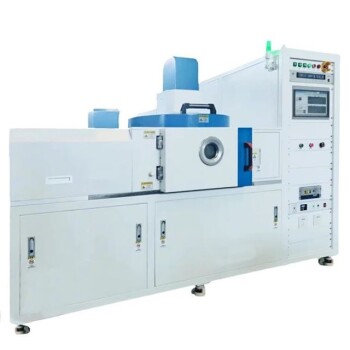
High-energy laser beams and precision control systems are the fundamental drivers of the Powder Bed Fusion (PBF) process for ceramics. The lasers provide the intense thermal energy required to melt or sinter ceramic materials—which inherently possess extremely high melting points—while the control systems meticulously regulate that energy to bond particles without the need for chemical binders.
Ceramics present unique thermal challenges compared to metals or polymers. PBF utilizes focused laser energy to overcome these high melting thresholds, while digital control systems ensure the creation of dense, binder-free structures capable of delivering specific electromagnetic performance.
Overcoming the Thermal Barrier
The High Melting Point Challenge
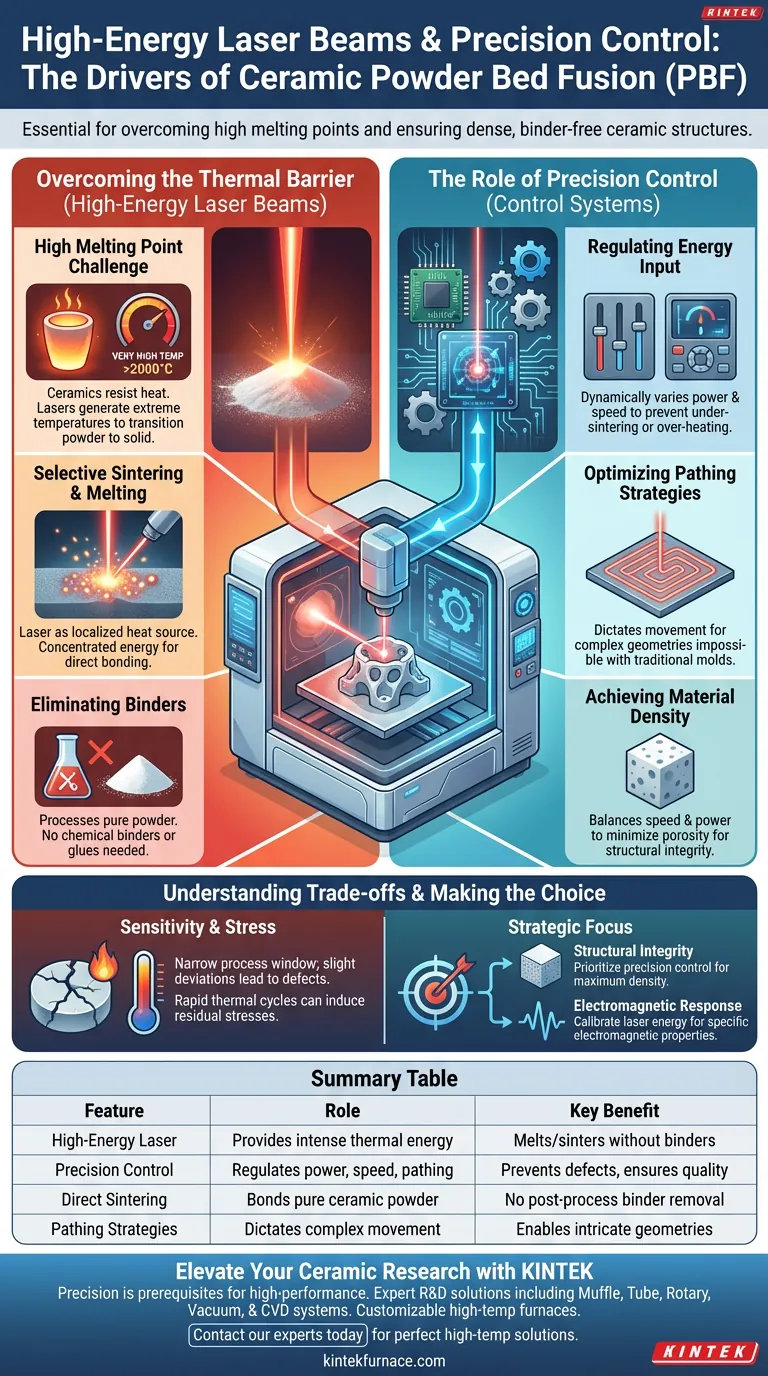
Ceramics are defined by their resistance to heat, possessing melting points far higher than traditional manufacturing materials. High-energy laser beams are necessary to generate the extreme temperatures required to transition ceramic powder from solid particles into a cohesive mass.
Selective Sintering and Melting
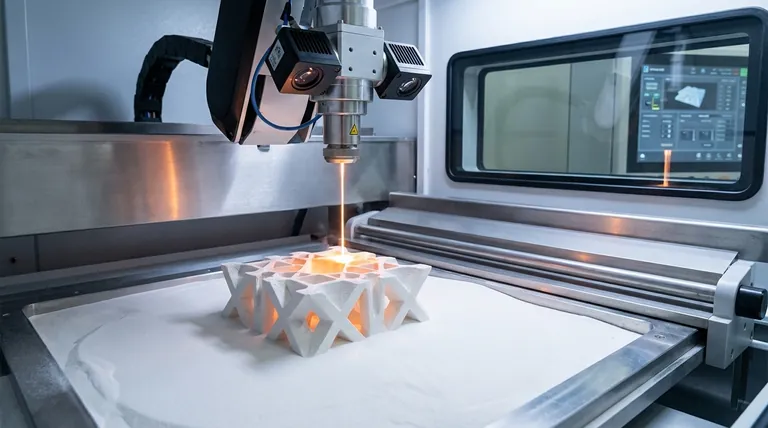
The laser acts as a localized heat source that selectively scans the powder bed. By concentrating high energy into a specific focal point, the system facilitates the direct bonding of ceramic particles.
Eliminating the Need for Binders
A critical advantage of using high-energy lasers is the ability to process pure ceramic powder. Because the laser provides sufficient energy for direct sintering, the process eliminates the need for binders or glues typically used to hold ceramic particles together in other fabrication methods.
The Role of Precision Control
Regulating Energy Input
Raw power is insufficient without management; precision control systems differ the laser's output to match the specific material requirements. These systems dynamically regulate laser power and scanning speed to prevent under-sintering (weak parts) or over-heating (material degradation).
Optimizing Pathing Strategies
The control system dictates the laser’s movement across the powder bed. Precise pathing allows for the fabrication of complex geometries that would be impossible with traditional molds.
Achieving Material Density
The ultimate goal of this control is to create a dense structure. By carefully balancing speed and power, the system minimizes porosity, ensuring the final component has the structural integrity required for functional use.
Understanding the Trade-offs
Sensitivity to Process Parameters
The window for success in ceramic PBF is extremely narrow. Slight deviations in laser power or scan speed can lead to significant defects, such as cracking or delamination, due to the brittle nature of ceramics.
Thermal Stress Management
While high energy is necessary, it introduces steep thermal gradients. The rapid heating and cooling cycles controlled by the system can induce residual stresses within the part, requiring careful calibration to avoid warping.
Making the Right Choice for Your Goal
To maximize the effectiveness of PBF for ceramics, align your process controls with your specific performance targets:
- If your primary focus is Structural Integrity: Prioritize precision control over scanning speed to ensure maximum density and particle bonding.
- If your primary focus is Electromagnetic Response: Calibrate the laser energy to achieve the specific density and microstructure required to tune the material's electromagnetic properties.
Precision in energy delivery is not just a feature; it is the prerequisite for high-performance ceramic fabrication.
Summary Table:
| Feature | Role in Ceramic PBF | Key Benefit |
|---|---|---|
| High-Energy Laser | Provides intense localized thermal energy | Melts/sinters ceramics without chemical binders |
| Precision Control | Regulates power, speed, and scan pathing | Prevents material degradation and structural defects |
| Direct Sintering | Bonds pure ceramic powder directly | Eliminates the need for post-process binder removal |
| Pathing Strategies | Dictates complex laser movement | Enables intricate geometries impossible with molds |
Elevate Your Ceramic Research with KINTEK
Precision in energy delivery is the prerequisite for high-performance ceramic fabrication. Backed by expert R&D and manufacturing, KINTEK offers a wide range of laboratory solutions, including Muffle, Tube, Rotary, Vacuum, and CVD systems. Whether you are developing advanced materials or optimizing PBF parameters, our lab high-temp furnaces are fully customizable to meet your unique thermal processing needs.
Ready to achieve superior material density and structural integrity? Contact our experts today to find the perfect high-temperature solution for your lab!
Visual Guide
References
- Wenqing Wang, Rujie He. Advanced 3D printing accelerates electromagnetic wave absorption from ceramic materials to structures. DOI: 10.1038/s44334-024-00013-w
This article is also based on technical information from Kintek Furnace Knowledge Base .
Related Products
- RF PECVD System Radio Frequency Plasma Enhanced Chemical Vapor Deposition
- 915MHz MPCVD Diamond Machine Microwave Plasma Chemical Vapor Deposition System Reactor
People Also Ask
- What is RF in PECVD? A Critical Control for Plasma Deposition
- What is the role of RF power in PECVD and how does the RF-PECVD process work? Master Thin Film Deposition Control
- What are the applications of plasma enhanced chemical vapor deposition? Key Uses in Electronics, Optics & Materials
- What are the key advantages of PECVD technology? Achieve Low-Temperature, High-Quality Thin Film Deposition
- How are deposition rates and film properties controlled in PECVD? Master Key Parameters for Optimal Thin Films