
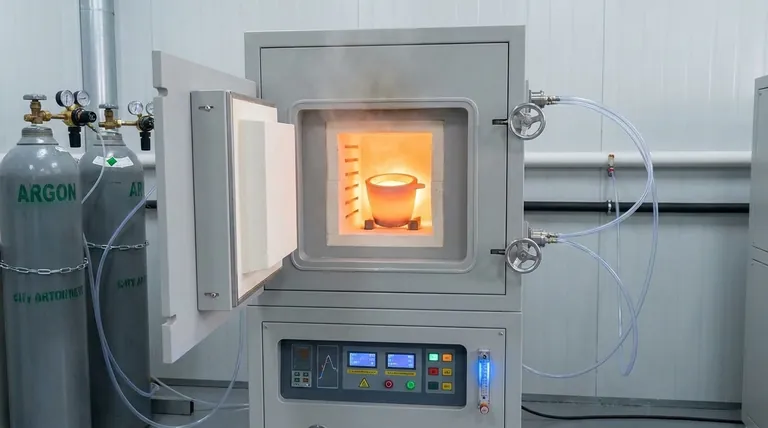
The continuous injection of high-purity argon serves as a critical shield for process integrity. By creating an inert protective atmosphere within the furnace, argon effectively isolates the molten cast iron from the surrounding air. This isolation is essential to prevent the oxidation of the melt at high temperatures and to eliminate the potential for atmospheric nitrogen absorption.
The ultimate goal of this process is scientific isolation. By neutralizing the environment, you ensure that any measured changes in nitrogen content are the result of internal physicochemical reactions within the material, rather than contamination from external gases.
The Mechanics of Protection
Establishing an Inert Barrier
At melting temperatures, cast iron is highly reactive with the surrounding atmosphere. High-purity argon acts as a non-reactive blanket that physically displaces the air inside the furnace. This establishes a controlled environment where the melt is completely isolated from external variables.
Preventing High-Temperature Oxidation
Oxygen is a primary contaminant during the melting process. Without protection, the high temperatures would cause rapid oxidation of the cast iron melt. The continuous argon flow prevents oxygen from contacting the metal, preserving the chemical composition of the melt and preventing the formation of unwanted oxides.
Ensuring Data Integrity
Eliminating Atmospheric Nitrogen
Air contains a significant amount of nitrogen, which can easily dissolve into molten iron. This creates a "noise" floor in metallurgical data. By excluding air, the argon atmosphere guarantees that atmospheric nitrogen does not interfere with the melt's chemistry.
Isolating Internal Reactions
For precise metallurgical studies, it is vital to distinguish between external contamination and internal changes. Because the argon shield prevents external gas absorption, metallurgists can be certain that any observed fluctuations in nitrogen content originate strictly from the material's internal physicochemical reactions.
Understanding the Trade-offs
Cost vs. Accuracy
Using high-purity argon is more expensive than using standard industrial grades or alternative shielding gases. However, this cost is a necessary investment when specific chemical precision—particularly regarding nitrogen content—is required.
Complexity of Continuous Injection
The requirement for "continuous" injection adds a layer of operational complexity. Any interruption in the flow breaks the inert seal, immediately exposing the melt to oxidation and nitrogen uptake. The system relies on absolute consistency to maintain data validity.
Making the Right Choice for Your Goal
To determine if this rigorous setup is required for your specific application, consider your primary objectives:
- If your primary focus is precise chemical analysis: You must use continuous high-purity argon to guarantee that nitrogen readings reflect only internal material changes.
- If your primary focus is melt cleanliness: You should rely on argon injection to prevent the formation of oxides and inclusions caused by atmospheric exposure.
By controlling the atmosphere, you transform the furnace from a chaotic environment into a precise laboratory instrument.
Summary Table:
| Feature | Role of High-Purity Argon | Benefit to Cast Iron Melting |
|---|---|---|
| Atmosphere Control | Displaces air and moisture | Creates a 100% inert protective barrier |
| Oxidation Prevention | Eliminates oxygen contact | Maintains chemical composition and prevents oxides |
| Nitrogen Isolation | Excludes atmospheric nitrogen | Ensures measured nitrogen data reflects internal reactions |
| Data Integrity | Removes external variables | Enables precise scientific analysis and repeatability |
Elevate Your Metallurgical Precision with KINTEK
Don’t let atmospheric contamination compromise your research or production quality. KINTEK provides state-of-the-art laboratory solutions tailored for high-temperature applications. Backed by expert R&D and world-class manufacturing, we offer a wide range of Muffle, Tube, Rotary, Vacuum, and CVD systems—all fully customizable to support continuous gas injection and precise atmosphere control.
Whether you are conducting delicate physicochemical studies or high-volume cast iron melting, our furnaces ensure the chemical integrity of your materials. Contact KINTEK today to discuss your unique needs and see how our advanced heating technology can optimize your results.
Visual Guide

References
- Ricardo Queirós, Attila Diószegi. Assessing Pore Formation due to Nitrogen Partitioning in a Hypoeutectic Cast Iron. DOI: 10.1007/s40962-024-01521-3
This article is also based on technical information from Kintek Furnace Knowledge Base .
Related Products
- High Temperature Muffle Oven Furnace for Laboratory Debinding and Pre Sintering
- 1200℃ Muffle Oven Furnace for Laboratory
- 1700℃ High Temperature Muffle Oven Furnace for Laboratory
- 1800℃ High Temperature Muffle Oven Furnace for Laboratory
- 1700℃ High Temperature Laboratory Tube Furnace with Alumina Tube
People Also Ask
- What thermal phenomena occur during polymer binder burnout in ceramic green bodies? Lab Furnace Guide
- What role does a high-temperature muffle furnace play in STFO synthesis? Achieve Pure Perovskite Results
- Why is controlled heat treatment in a muffle furnace necessary for calcined clay? Achieve Optimal Pozzolanic Activity
- How does a high-temperature muffle furnace facilitate the formation of LaNbxAl1−xO3+δ perovskite structures? Key Roles
- What role does a high-temperature muffle furnace play in the multi-stage synthesis of Li0.5MnFe1.5O4? Key to Pure Spinel



















