
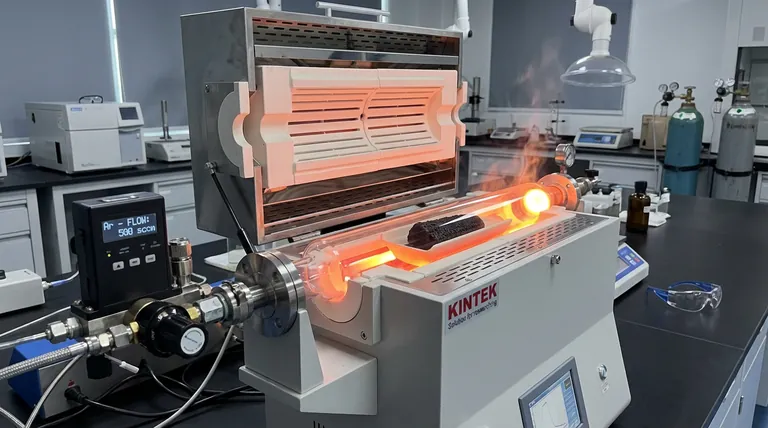
Precise atmosphere control is the fundamental requirement for successfully converting Ni-ZIF-8 into Ni-N-C without destroying the material during high-temperature annealing. By maintaining a high-purity argon (Ar) environment at 1000 °C, the furnace prevents the oxidation of the carbon substrate while facilitating the physical removal of volatile components.
Core Takeaway The thermal conversion process relies on a strictly inert, flowing atmosphere to protect the carbon framework from combustion at high temperatures. Simultaneously, this gas flow acts as a transport mechanism to sweep away zinc vapors, which is the physical driver behind creating a pure, highly porous material structure.
The Critical Role of Inert Gases
Preventing Substrate Oxidation
The primary function of atmosphere control in this context is protection. At the requisite annealing temperature of 1000 °C, carbon-based materials are highly reactive with oxygen.
Without a high-purity inert environment (specifically Argon), the carbon substrate would react with atmospheric oxygen. This would result in the combustion of the sample rather than its conversion, effectively destroying the material before the synthesis is complete.
Ensuring Directional Conversion
The goal of the thermal treatment is a specific chemical transformation, not simple heating. The atmosphere ensures that the organic ligands within the ZIF-8 precursor undergo a "directional conversion."
This controlled environment allows the ligands to restructure into a stable nitrogen-doped carbon (NC) framework. This precise structural evolution is only possible when external chemical reactions (like oxidation) are strictly excluded.
Mechanism for Porosity and Purity
Managing Zinc Vaporization
A key component of the Ni-ZIF-8 precursor is zinc (Zn). During the thermal process, this zinc must be removed to achieve the desired material purity.
As the temperature rises, the zinc vaporizes. If these vapors are not managed, they can re-deposit or remain trapped, compromising the purity of the final Ni-N-C catalyst.
The Function of Flowing Gas
Atmosphere control involves not just the type of gas, but its flow. The flowing inert gas serves as a carrier mechanism.
This flow actively sweeps the generated zinc vapors out of the heating zone. The removal of zinc is what creates vacancies in the material, resulting in a highly porous carrier material. This porosity is essential for the performance of the final catalyst.
Common Pitfalls in Atmosphere Control
The Risk of Stagnant Atmospheres
While the chemical composition of the gas (Argon) is crucial, failing to maintain adequate flow is a critical error.
A stagnant or insufficient flow will fail to evacuate the zinc vapors efficiently. This leads to a final product with low porosity and high impurity levels, negating the benefits of the thermal treatment.
Impurity Leaks
Even minor leaks in the tube furnace can introduce oxygen into the system. Given the 1000 °C operating temperature, even trace amounts of oxygen can degrade the quality of the nitrogen-doped carbon framework.
Making the Right Choice for Your Goal
To ensure the successful synthesis of Ni-N-C, your atmosphere control strategy must align with specific material properties.
- If your primary focus is Structural Integrity: Prioritize the purity of the Argon gas to strictly prevent oxidation and preserve the carbon backbone.
- If your primary focus is Surface Area and Porosity: Focus on the flow rate of the inert gas to maximize the evacuation of zinc vapors and creating pore structures.
Precise atmosphere control turns a destructive high-heat environment into a constructive synthesis tool, balancing chemical protection with physical purification.
Summary Table:
| Feature | Impact on Ni-ZIF-8 Conversion | Result of Poor Control |
|---|---|---|
| Inert Gas (Argon) | Prevents carbon substrate oxidation at 1000 °C | Sample combustion and material loss |
| Gas Flow Rate | Sweeps away zinc vapors to create vacancies | Low porosity and high impurity levels |
| Temperature (1000 °C) | Facilitates organic ligand restructuring | Incomplete chemical transformation |
| System Sealing | Maintains high-purity environment | Trace oxygen degrades nitrogen-doped framework |
Elevate Your Material Synthesis with KINTEK Precision
Achieving the perfect Ni-N-C framework requires more than just heat; it demands absolute control over your environment. Backed by expert R&D and manufacturing, KINTEK offers high-performance Muffle, Tube, Rotary, Vacuum, and CVD systems designed to maintain the rigorous purity and gas flow rates your research requires. Whether you need a standard setup or a customizable solution for unique high-temperature needs, our laboratory furnaces provide the stability necessary for delicate thermal conversions.
Ready to optimize your porous material production? Contact KINTEK today to consult with our specialists and find the ideal system for your lab.
References
- Qiaoting Cheng, Hua Wang. Modification of NiSe2 Nanoparticles by ZIF-8-Derived NC for Boosting H2O2 Production from Electrochemical Oxygen Reduction in Acidic Media. DOI: 10.3390/catal14060364
This article is also based on technical information from Kintek Furnace Knowledge Base .
Related Products
- 1200℃ Controlled Inert Nitrogen Atmosphere Furnace
- 1700℃ Controlled Inert Nitrogen Atmosphere Furnace
- 1400℃ Controlled Inert Nitrogen Atmosphere Furnace
- Mesh Belt Controlled Atmosphere Furnace Inert Nitrogen Atmosphere Furnace
- Controlled Inert Nitrogen Hydrogen Atmosphere Furnace
People Also Ask
- What controlled-atmosphere furnace conditions are required for sintering powder metallurgy copper alloy compacts? Ideal Setup
- Why is uniform atmosphere flow important in a controlled atmosphere furnace? Ensure Consistent Results and Avoid Costly Failures
- What are the operational advantages of using a controlled atmosphere furnace? Boost Quality and Efficiency in Heat Treatment
- What are the operational considerations for a controlled atmosphere furnace? Master Key Factors for Material Processing
- What are the key benefits of precise temperature control in a controlled atmosphere furnace? Unlock Superior Quality and Efficiency



















