
Pre-oxidation treatment is the critical foundational step required to prepare a substrate for the successful deposition of Ti(Nb)-Si-C coatings. This process typically involves heating the substrate in a tube furnace at 800 °C for 10 hours to generate a specific surface chemistry. Without this treatment, the substrate lacks the physical and chemical characteristics necessary for strong adhesion.
The core purpose of pre-oxidation is to generate a thin, uniform Cr₂O₃ oxide film. This film acts as an anchoring interface, transforming a smooth, inert surface into a chemically active one that prevents the coating from peeling or delaminating.
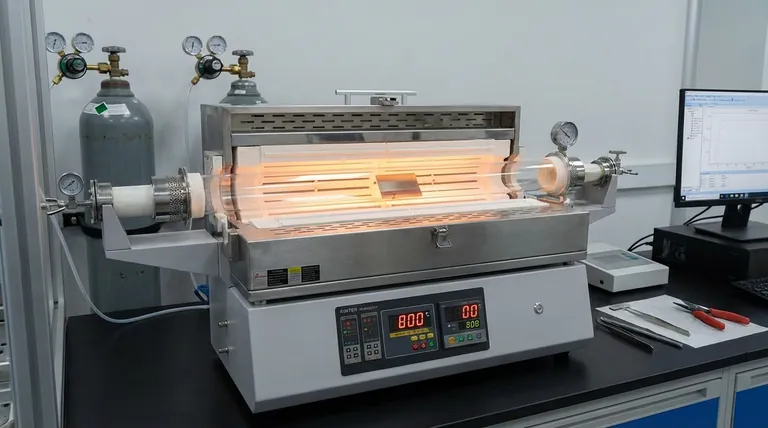
The Mechanism of Surface Modification
Formation of the Oxide Layer
The central goal of the pre-oxidation process is the creation of a Cr₂O₃ (Chromium Oxide) film.
By subjecting the substrate to 800 °C heat for a duration of 10 hours, this specific oxide layer forms uniformly across the material. This layer serves as the bridge between the base material and the subsequent coating.
Increasing Micro-Roughness
A raw substrate often possesses a surface that is too smooth for effective coating application.
The formation of the Cr₂O₃ film alters this physical state by significantly increasing micro-roughness. This added texture increases the surface area available for the coating to grip, acting effectively as "teeth" for the deposited layer.
Enhancing Chemical Affinity
Physical texture alone is often insufficient for advanced ceramic coatings; chemical compatibility is equally important.
The oxide film modifies the surface chemistry to improve chemical affinity. This ensures that the incoming Ti(Nb)-Si-C atoms can form strong chemical bonds with the substrate surface rather than merely sitting on top of it.
Ensuring Coating Integrity
Creating Ideal Nucleation Sites
For a coating to grow uniformly and densely, it requires specific points to start forming, known as nucleation sites.
The combination of increased micro-roughness and chemical affinity provides ideal nucleation sites. These sites allow the Ti(Nb)-Si-C structure to begin depositing in a stable, organized manner immediately upon introduction.
Preventing Delamination
The ultimate measure of a coating's success is its ability to stay attached under stress.
Pre-oxidation significantly enhances bonding strength. By establishing a robust interface, the treatment effectively prevents the catastrophic failures of peeling or delamination that occur on untreated, smooth surfaces.
Understanding Process Dependencies
Parameter Sensitivity
The formation of the specific Cr₂O₃ phase is dependent on precise conditions.
Deviating from the 800 °C temperature or the 10-hour duration may result in an incomplete film or a different oxide structure that does not offer the same adhesive benefits.
The Cost of Preparation
This treatment introduces a significant time investment into the manufacturing cycle.
While 10 hours of heating adds latency to production, it is a non-negotiable trade-off to ensure the mechanical reliability of the final component. Skipping this step to save time introduces a high risk of coating failure.
Ensuring Coating Success
To maximize the performance of your Ti(Nb)-Si-C coatings, consider the following regarding pre-oxidation:
- If your primary focus is mechanical durability: Strictly adhere to the 800 °C / 10-hour cycle to guarantee a uniform Cr₂O₃ layer that maximizes bonding strength.
- If your primary focus is troubleshooting adhesion failure: Verify the presence and uniformity of the pre-oxidation film, as a smooth substrate is likely the root cause of peeling.
A robust coating is impossible without a chemically active, micro-rough interface.
Summary Table:
| Process Parameter | Role in Treatment | Impact on Ti(Nb)-Si-C Coating |
|---|---|---|
| Temperature (800 °C) | Facilitates Cr₂O₃ film formation | Ensures uniform chemical modification |
| Duration (10 Hours) | Allows for consistent layer growth | Maximizes surface micro-roughness for 'grip' |
| Oxide Film (Cr₂O₃) | Acts as a bridge/interface | Prevents peeling and catastrophic delamination |
| Surface Texture | Increases micro-roughness | Provides ideal nucleation sites for deposition |
Elevate Your Coating Precision with KINTEK
Achieving the perfect Cr₂O₃ oxide layer requires the absolute thermal stability and atmospheric control found in KINTEK’s advanced laboratory systems. Backed by expert R&D and manufacturing, KINTEK offers high-performance Muffle, Tube, Rotary, Vacuum, and CVD systems—all fully customizable to meet your unique research or production needs.
Don't let adhesion failure compromise your materials. Whether you are optimizing Ti(Nb)-Si-C deposition or developing new ceramic interfaces, our furnaces provide the 800 °C precision your substrates demand. Contact KINTEK today to discuss your custom furnace solution and ensure the mechanical integrity of your next project.
References
- Xichao Li, Lili Zheng. The Preparation and Properties of Ti(Nb)-Si-C Coating on the Pre-Oxidized Ferritic Stainless Steel for Solid Oxide Fuel Cell Interconnect. DOI: 10.3390/ma17030632
This article is also based on technical information from Kintek Furnace Knowledge Base .
Related Products
- Vacuum Sealed Continuous Working Rotary Tube Furnace Rotating Tube Furnace
- 1400℃ High Temperature Laboratory Tube Furnace with Alumina Tube
- 1700℃ High Temperature Laboratory Tube Furnace with Alumina Tube
- Magnesium Extraction and Purification Condensing Tube Furnace
- High Pressure Laboratory Vacuum Tube Furnace
People Also Ask
- What is the purpose of rotary tube furnaces? Achieve Uniform Heat Treatment for Powders and Granules
- What are the key advantages of using a rotary tube furnace? Achieve Dynamic, Uniform Heating for Powders
- How does the amount of material processed vary between batch and continuous rotary tube furnaces? Scale Your Production Efficiently
- What are the advantages of rotary tube furnaces in fuel compatibility? Boost Efficiency and Cut Costs
- What is the temperature range of some rotary tube furnaces? Achieve Uniform Heating Up to 1200°C



















