
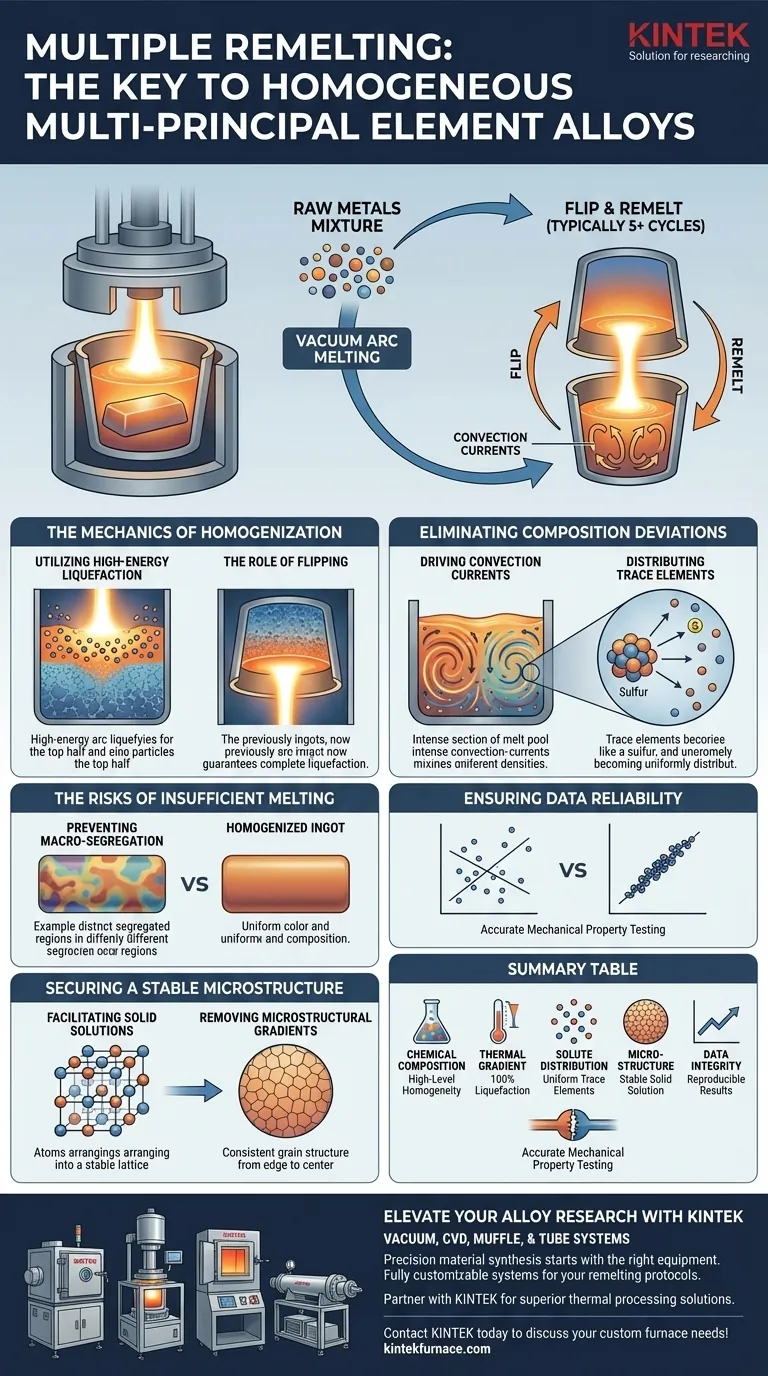
Multiple remelting is a non-negotiable requirement in vacuum arc melting to transform a mixture of raw metals into a consistent, high-quality alloy. By flipping the sample and remelting it typically at least five times, you ensure that every distinct metal particle is fully liquefied and that the chemical composition becomes uniform throughout the entire ingot.
In the production of multi-principal element alloys, a single melt is almost never sufficient to create a stable material. The repetitive process of flipping and remelting utilizes melt pool convection to eliminate composition gradients, ensuring the final alloy is chemically homogeneous and structurally sound.
The Mechanics of Homogenization
Utilizing High-Energy Liquefaction
The primary goal of the vacuum arc is to deliver high energy to liquefy metal particles. However, because the bottom of the sample sits on a cooled hearth, it often remains cooler than the top.
The Role of Flipping
Flipping the ingot physically inverts the thermal gradient. This ensures that material previously at the bottom is exposed directly to the high-energy arc in the next cycle. This guarantees that all metal particles are completely liquefied, preventing unmelted raw materials from contaminating the final structure.
Eliminating Compositional Deviations
Driving Convection Currents
Chemical uniformity does not happen instantly. Each melting cycle generates convection currents within the melt pool, which acts as a stirring mechanism. Repeatedly triggering these currents is necessary to thoroughly mix elements with different densities and melting points.
Distributing Trace Elements
This mixing is particularly critical for trace elements, such as 0.2 at% sulfur or other minor solutes. Without multiple remelting cycles, these elements tend to cluster. The process creates a uniform distribution of solutes, preventing localized concentrations that could weaken the material.
The Risks of Insufficient Melting
Preventing Macro-Segregation
If the number of melting cycles is insufficient, the alloy is prone to macro-segregation. This occurs when chemical components separate into distinct regions rather than forming a cohesive whole.
Ensuring Data Reliability
Segregation is a major liability for research and development. If an ingot suffers from macro-segregation, subsequent mechanical property testing will yield inaccurate or scattershot results. Homogenization is essential to ensure that your test data actually represents the intrinsic properties of the alloy, rather than a casting defect.
Securing a Stable Microstructure
Facilitating Solid Solutions
Multi-principal element alloys rely on complex interactions between atoms to form specific phases. The repeated thermal cycling helps facilitate the formation of stable solid solution structures.
Removing Microstructural Gradients
By eliminating chemical gradients, you inevitably eliminate microstructural gradients. This results in a material where the grain structure and phase distribution are consistent from the edge of the ingot to the center.
Ensuring Process Integrity
If your primary focus is Material Stability:
Run at least five remelting cycles to ensure the formation of a stable solid solution structure free of unmelted particles.
If your primary focus is Data Accuracy:
Prioritize thorough homogenization to eliminate macro-segregation, ensuring that your mechanical testing yields reproducible and valid results.
The integrity of your final alloy is directly proportional to the rigor of your remelting process; it is the bridge between a simple mixture of metals and a sophisticated engineering material.
Summary Table:
| Aspect | Effect of Multiple Remelting | Benefit for Alloys |
|---|---|---|
| Chemical Composition | Eliminates composition gradients via convection | Achieves high-level chemical homogeneity |
| Thermal Gradient | Flipping inverts the thermal profile | Ensures 100% liquefaction of all raw materials |
| Solute Distribution | Prevents clustering of trace elements | Uniform distribution of minor solutes |
| Microstructure | Removes phase and grain gradients | Creates a stable, consistent solid solution structure |
| Data Integrity | Eliminates macro-segregation | Ensures reproducible and accurate mechanical testing |
Elevate Your Alloy Research with KINTEK
Precision in material synthesis starts with the right equipment. KINTEK provides industry-leading high-temperature lab furnaces, including Vacuum, CVD, Muffle, and Tube systems, designed to handle the rigorous demands of multi-principal element alloy production.
Backed by expert R&D and precision manufacturing, our systems are fully customizable to support your specific remelting protocols and homogenization requirements. Don't let macro-segregation compromise your research data—partner with KINTEK for superior thermal processing solutions.
Contact KINTEK today to discuss your custom furnace needs!
Visual Guide
References
- Shimaa El‐Hadad, M. M. Rashad. Magnetic Properties of Al25Co(25-x)CrxFe25-yNi25Ndy Compositionally Complex Alloys. DOI: 10.1007/s11661-025-07818-0
This article is also based on technical information from Kintek Furnace Knowledge Base .
Related Products
- Vacuum Induction Melting Furnace
- Vacuum Heat Treat Sintering and Brazing Furnace
- Small Vacuum Heat Treat and Tungsten Wire Sintering Furnace
- Vacuum Heat Treat Sintering Furnace Molybdenum Wire Vacuum Sintering Furnace
- Vacuum Heat Treat Sintering Furnace with Pressure for Vacuum Sintering
People Also Ask
- What are the core functions of the High Vacuum Induction Melting (VIM) furnace? Optimize DD5 Superalloy Purification
- What are the advantages of using a VIM furnace to control residual oxygen pressure? Achieve Superior Metal Uniformity
- What is the role of VIM and directional solidification in aero-engine blade substrates? Engineering Extreme Durability
- What are the technical advantages of using a Vacuum Induction Melting furnace in the development of advanced packaging steel?
- Why is a Vacuum Induction Melting furnace (VIM) used for Cu-Zn-Al-Sn alloys? Achieve Precision Composition Control



















