
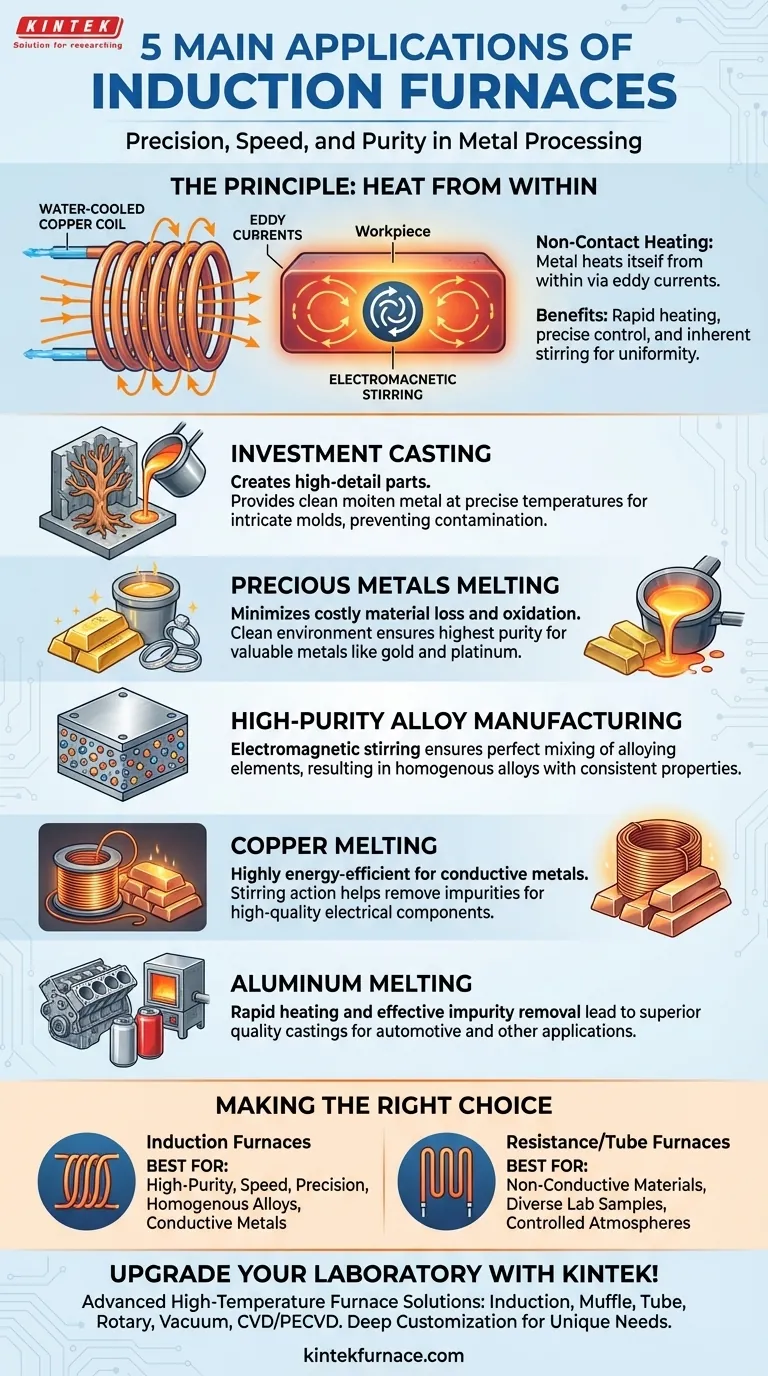
While there are many uses, the five principal applications of induction furnaces are investment casting, melting precious metals, melting copper, manufacturing high-purity alloys, and melting aluminum. These applications all leverage the unique ability of induction technology to provide rapid, clean, and highly controlled heat directly within the metal itself.
The core value of an induction furnace is not just heat, but precision. It excels in applications where metal purity, alloy consistency, and minimizing material loss are more critical than simply melting bulk material at the lowest possible cost.
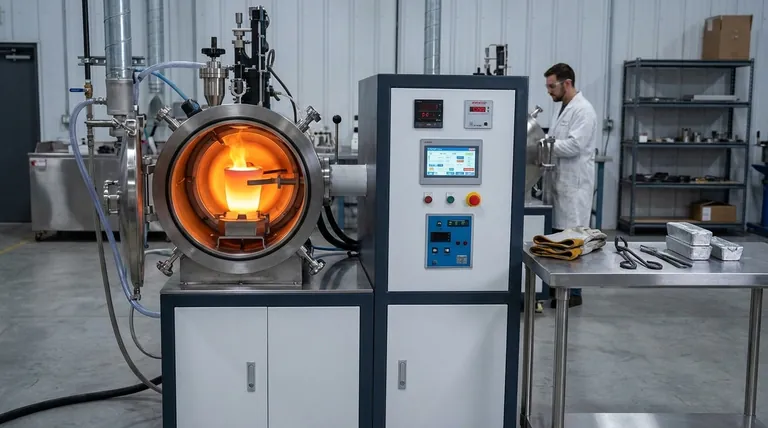
The Principle: Why Induction Excels at Melting
At the heart of an induction furnace is a powerful, non-contact heating method. Understanding this principle is key to seeing why it's chosen for specific, high-value tasks.
How It Works: Heat from Within
An induction furnace uses a water-cooled copper coil to generate a strong, alternating electromagnetic field. When a conductive material, like metal, is placed inside this field, it causes electric currents—known as eddy currents—to flow within the metal.
The metal's natural resistance to these currents generates intense, rapid heat. This means the material heats itself from the inside out, without any external flame or heating element making contact.
The Inherent Benefits
This method provides several key advantages. It offers extremely fast startup and melting times, precise temperature control, and a high degree of safety since there is no open flame.
Crucially, the electromagnetic field also creates a natural stirring action in the molten metal. This electromagnetic stirring is vital for producing completely uniform and homogenous alloys.
A Closer Look at the Primary Applications
The unique benefits of induction heating make it the ideal choice for several demanding industrial processes.
1. Investment Casting
Investment casting creates complex, high-detail parts. This process requires a very clean source of molten metal that can be poured quickly and at a precise temperature to perfectly fill the intricate mold.
Induction melting provides this by preventing contamination from combustion by-products and ensuring the metal is at the exact right fluidity.
2. Precious Metals Melting
When working with gold, silver, and platinum-group metals, even a tiny percentage of material loss is extremely costly. Contamination can also dramatically reduce the value of the final product.
Induction furnaces are the standard here because the non-contact heating process minimizes oxidation and material loss. The clean melting environment ensures the highest possible purity is maintained.
3. High-Purity Alloy Manufacturing
Creating specialized alloys for aerospace, medical, or other high-performance sectors requires exact chemical compositions.
The electromagnetic stirring inherent to induction furnaces ensures that all alloying elements are perfectly mixed. This results in a completely homogenous melt and a final product with consistent, reliable properties throughout.
4. Copper and Aluminum Melting
While other methods can melt copper and aluminum, induction is preferred for its efficiency and quality. The process is highly energy-efficient for these conductive metals.
The stirring action also helps remove dissolved gases and impurities, leading to higher-quality castings for everything from electrical components to automotive parts.
Understanding the Trade-offs
No single technology is perfect for every task. An induction furnace is a specialized tool, and its advantages must be weighed against its limitations.
When to Choose Induction
Induction is the superior choice when your priority is purity, speed, and precision. It is unmatched for melting high-value metals, creating complex alloys, or when you need to prevent contamination from fuel or electrodes.
Its efficiency with conductive materials also makes it a strong contender for dedicated copper and aluminum foundries.
When Other Furnaces Are Better
Induction furnaces are less effective for non-conductive materials like ceramics. For these applications, a resistance or tube furnace that uses external heating elements is necessary.
Furthermore, for smaller, lab-scale heat treatment of diverse sample types or processes requiring a tightly controlled gas atmosphere, a tube furnace often provides more versatility than a dedicated induction melting system.
Making the Right Choice for Your Application
Selecting the right heating technology comes down to your primary goal.
- If your primary focus is high-purity melting or valuable metals: Choose an induction furnace for its clean, non-contact heating that minimizes contamination and material loss.
- If your primary focus is creating specialized, homogenous alloys: The inherent electromagnetic stirring of an induction furnace makes it the best tool for ensuring a perfectly mixed final product.
- If your primary focus is processing non-conductive materials or diverse lab samples: A resistance or tube furnace will offer greater versatility and the ability to heat materials that don't respond to induction.
Ultimately, understanding the core principle of how a furnace generates heat is the key to matching the right tool to your specific technical goal.
Summary Table:
| Application | Key Benefit |
|---|---|
| Investment Casting | Clean, precise melting for complex molds |
| Precious Metals Melting | Minimizes oxidation and material loss |
| High-Purity Alloy Manufacturing | Ensures homogenous and consistent alloys |
| Copper Melting | Energy-efficient with high-quality output |
| Aluminum Melting | Rapid heating and impurity removal |
Upgrade your laboratory with KINTEK's advanced high-temperature furnace solutions! Leveraging exceptional R&D and in-house manufacturing, we provide diverse labs with induction furnaces, Muffle, Tube, Rotary Furnaces, Vacuum & Atmosphere Furnaces, and CVD/PECVD Systems. Our strong deep customization capability ensures we precisely meet your unique experimental needs for high-purity melting and alloy production. Contact us today to discuss how our solutions can enhance your efficiency and results!
Visual Guide
Related Products
- 600T Vacuum Induction Hot Press Vacuum Heat Treat and Sintering Furnace
- Vacuum Induction Melting Furnace
- 1200℃ Controlled Inert Nitrogen Atmosphere Furnace
- 1700℃ Controlled Inert Nitrogen Atmosphere Furnace
- Vacuum Heat Treat Sintering Furnace with Pressure for Vacuum Sintering
People Also Ask
- Why use Vacuum Hot Press (VHP) for ZnS Ceramics? Achieve Superior IR Transparency and Mechanical Strength
- How does a vacuum hot press sintering furnace mitigate copper sintering swelling? Solve Fe-Cu Expansion Issues
- What are the benefits of using a vacuum hot press sintering furnace for the preparation of SiCw/2024 aluminum matrix composites? Achieve High-Performance Aerospace Materials
- What is the core function of a vacuum hot press sintering furnace in the preparation of high-density RuTi alloys? Achieve Maximum Density and Purity
- How does the vacuum environment in a vacuum hot press sintering furnace protect chromium-containing ceramics? Find out.



















