
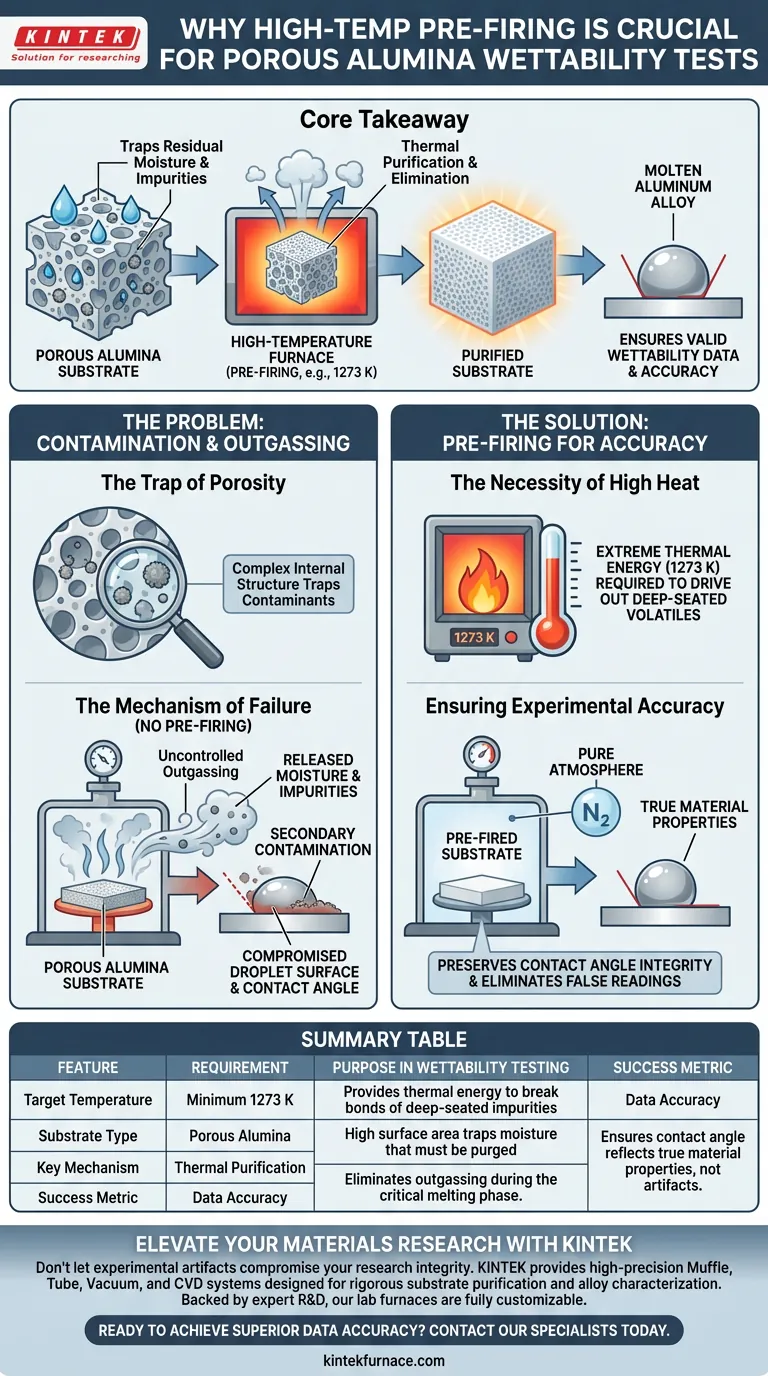
The use of a high-temperature furnace to pre-fire porous alumina substrates is a mandatory purification step required to ensure the validity of wettability data. This thermal treatment, often conducted at temperatures such as 1273 K, is the only effective method to completely eradicate residual moisture and latent impurities trapped within the ceramic's porous structure. Without this preliminary purge, these contaminants would be released during the experiment, compromising the chemical environment and the integrity of the aluminum alloy droplet.
Core Takeaway The primary function of pre-firing is to prevent outgassing during the testing phase. By eliminating moisture and impurities beforehand, you avoid secondary contamination of the experimental atmosphere and the droplet surface, ensuring that your wettability measurements reflect the true properties of the materials rather than experimental artifacts.
The Physics of Contamination in Porous Ceramics
The Trap of Porosity
Porous alumina substrates naturally possess a high surface area and a complex internal structure. While beneficial for certain applications, this structure acts as a trap for environmental contaminants.
Residual Moisture and Impurities
The most common contaminants are residual moisture absorbed from the air and volatile impurities left over from manufacturing or handling. These substances are often lodged deep within the pores, making them impossible to remove through simple surface cleaning or low-temperature drying.
The Necessity of High Heat
To fully drive out these trapped volatiles, extreme thermal energy is required. A high-temperature furnace setting, specifically around 1273 K, provides the energy necessary to break the bonds holding these impurities and force them out of the substrate completely.
The Mechanism of Failure: Outgassing
Uncontrolled Release
If a substrate is not pre-fired, the high temperatures required to melt the aluminum alloy during the actual test will inadvertently trigger the purification process. The trapped moisture and impurities will vaporize and expand, exiting the pores in a phenomenon known as outgassing.
Secondary Contamination
This released gas does not simply disappear; it enters the immediate experimental environment. This results in secondary contamination of the testing atmosphere, which is often a carefully controlled vacuum or inert gas environment.
Compromising the Droplet Surface
Most critically, the outgassed vapors interact directly with the molten aluminum droplet. This interaction alters the surface chemistry of the droplet, leading to oxidation or other reactions that fundamentally change how the liquid interacts with the solid substrate.
Ensuring Experimental Accuracy
Preserving Contact Angle Integrity
Wettability is characterized by measuring the contact angle of the droplet on the substrate. This measurement is highly sensitive to surface tension and chemical homogeneity.
Eliminating False Readings
Any contamination of the droplet surface introduces variables that distort the contact angle. By pre-firing the substrate, you ensure that the observed wetting behavior is intrinsic to the alloy and the alumina, guaranteeing the accuracy of the measurement results.
Common Pitfalls to Avoid
Insufficient Temperature
Pre-firing at temperatures significantly lower than 1273 K may fail to remove all deep-seated impurities. Partial removal can be deceptive, as outgassing may still occur once the experimental temperature rises, ruining the data during the critical melting phase.
Ignoring the Timeline
Pre-firing should be viewed as an immediate precursor to testing. Allowing a pre-fired porous substrate to sit exposed to ambient air for extended periods allows it to re-absorb moisture, negating the benefits of the furnace treatment.
Making the Right Choice for Your Experiment
To ensure your wettability characterization yields publishable, reliable data, adhere to the following protocols:
- If your primary focus is Data Accuracy: Ensure your furnace protocol reaches at least 1273 K to guarantee the total elimination of deep-seated moisture.
- If your primary focus is Atmosphere Control: Recognize that substrate outgassing is a leading cause of vacuum degradation; pre-firing is the primary defense against this.
Ultimately, high-temperature pre-firing is not merely a cleaning step; it is a fundamental control ensuring that your results measure the material, not the moisture.
Summary Table:
| Feature | Requirement | Purpose in Wettability Testing |
|---|---|---|
| Target Temperature | Minimum 1273 K | Provides thermal energy to break bonds of deep-seated impurities |
| Substrate Type | Porous Alumina | High surface area traps moisture that must be purged |
| Key Mechanism | Thermal Purification | Eliminates outgassing during the critical melting phase |
| Success Metric | Data Accuracy | Ensures contact angle reflects true material properties, not artifacts |
Elevate Your Materials Research with KINTEK
Don't let experimental artifacts compromise your research integrity. KINTEK provides high-precision Muffle, Tube, Vacuum, and CVD systems designed to meet the rigorous thermal demands of substrate purification and alloy characterization. Backed by expert R&D and manufacturing, our lab high-temp furnaces are fully customizable to your specific heating profiles.
Ready to achieve superior data accuracy?
Contact our specialists today to find your custom furnace solution.
Visual Guide
References
- Chukwudalu Uchenna Uba, Jonathan Raush. Quantification of Wettability and Surface Tension of Liquid Aluminum 7075 Alloy on Various Substrates. DOI: 10.3390/jmmp9050165
This article is also based on technical information from Kintek Furnace Knowledge Base .
Related Products
- 1400℃ High Temperature Laboratory Tube Furnace with Alumina Tube
- 1700℃ High Temperature Laboratory Tube Furnace with Alumina Tube
- High Temperature Muffle Oven Furnace for Laboratory Debinding and Pre Sintering
- 1200℃ Muffle Oven Furnace for Laboratory
- 2200 ℃ Tungsten Vacuum Heat Treat and Sintering Furnace
People Also Ask
- How does zone-melting in tube furnaces synthesize bismuth micro-wires? Master Single-Crystal Thermoelectric Growth
- How are high-temperature laboratory tube furnaces applied in long-term vacuum homogenization heat treatments for intermetallic samples?
- How do high-temperature laboratory tube furnaces ensure environmental stability? Precision Thermal Reduction Tips
- How are high-temp tube furnaces used to measure diffusion coefficients per Fick's law? Master Precision Annealing
- How are high-temperature tube furnaces applied in testing ceramic-supported alloy membranes? Insights



















