
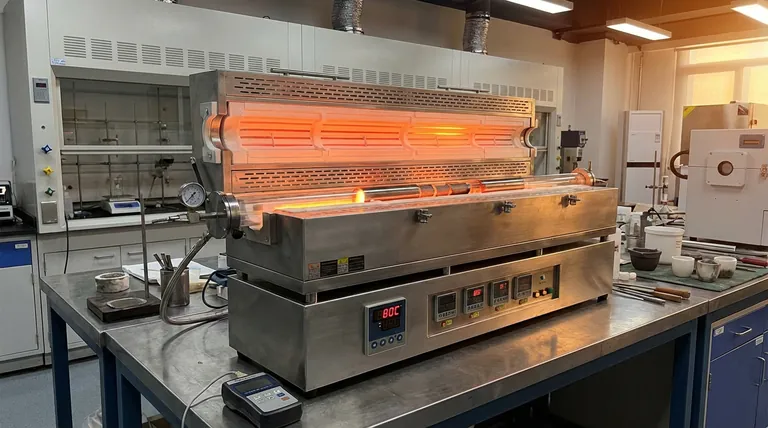
Using a periodic resistance furnace significantly enhances processing performance by executing precise spheroidizing annealing. This equipment maintains High Vanadium High Speed Steel at a constant 880°C for an extended duration, followed by a controlled slow cooling phase. This specific thermal cycle fundamentally alters the material's microstructure to reduce hardness and drastically improve workability.
By providing a stable thermal environment, the furnace transforms irregular carbides into spherical structures. This process serves two critical functions: it lowers the steel's hardness to facilitate cutting and homogenizes the structure to ensure success during future quenching operations.
The Mechanism of Improvement
Achieving Spheroidization
The primary goal of using this furnace is to drive spheroidizing annealing. High Vanadium High Speed Steel contains hard carbides that can be abrasive and difficult to process.
By holding the steel at 880°C, the furnace creates the thermodynamic conditions necessary to reshape these carbides. They transition from irregular or plate-like shapes into small, spherical globules.
Reduction of Material Hardness
This morphological change in carbides has a direct impact on mechanical properties. The spherical shape minimizes internal stress concentrations and reduces the overall hardness of the steel.
This softening effect is the key to improving processing performance. Without it, the high vanadium content would make the steel too brittle and hard for standard machining operations.
The Role of Thermal Stability
Precision at 880°C
The periodic resistance furnace is selected for its ability to provide a stable thermal environment.
Unlike combustion furnaces which may have temperature fluctuations, a resistance furnace utilizes a precise temperature control system. This ensures the steel remains exactly at the target temperature of 880°C, which is critical for thorough internal structural transformation.
Controlled Slow Cooling
The "periodic" nature of the furnace allows for batch processing where the cooling rate can be strictly managed.
After the holding period, the furnace facilitates a slow cooling process. This gradual reduction in temperature prevents the reformation of hard structures, locking in the benefits of the annealing phase.
Operational Trade-offs
Process Duration vs. Throughput
While this method produces superior material properties, it is time-intensive. The requirement for extended holding periods and slow cooling means that production throughput is lower compared to rapid heat treatment methods.
Atmosphere Management
While the resistance furnace excels at temperature control, the atmosphere must be considered. As noted in similar industrial box furnace applications, heating in an oxidation (air) atmosphere requires careful management to prevent excessive scaling on the steel surface.
Making the Right Choice for Your Project
The periodic resistance furnace is an essential tool when material quality outweighs production speed.
- If your primary focus is Machinability: Prioritize the slow cooling phase to maximize the spheroidization of carbides, ensuring the material is soft enough for cutting tools.
- If your primary focus is Quench Preparation: Ensure the holding time at 880°C is sufficient for the specific thickness of your steel to guarantee a uniform internal structure before hardening.
The periodic resistance furnace converts a difficult-to-work material into a stable, process-ready manufacturing resource.
Summary Table:
| Feature | Process Detail | Impact on Material Performance |
|---|---|---|
| Annealing Temp | Constant 880°C | Thermodynamic carbide reshaping |
| Thermal Cycle | Spheroidizing Annealing | Transforms carbides into spherical globules |
| Cooling Method | Controlled Slow Cooling | Prevents reformation of hard structures |
| Hardness Control | Material Softening | Facilitates easier cutting and machining |
| Microstructure | Homogenization | Ensures consistency for future quenching |
Elevate Your Material Processing with KINTEK Precision
Don't let high-vanadium alloys compromise your tool life or production efficiency. KINTEK’s advanced laboratory and industrial furnaces are engineered to deliver the precise thermal stability and controlled cooling rates essential for perfect spheroidizing annealing.
Backed by expert R&D and manufacturing, KINTEK offers a comprehensive range of Muffle, Tube, Rotary, Vacuum, and CVD systems. Whether you need standard periodic resistance furnaces or fully customizable high-temperature solutions, our equipment ensures your High Speed Steel achieves the exact hardness and microstructure required for superior performance.
Ready to optimize your heat treatment workflow? Contact KINTEK today to discuss your unique furnace requirements with our technical experts.
References
- Yujie Wang, Haochun Xia. Investigation on microstructure, mechanical properties, and tribological behaviors of spray-formed high-vanadium high-speed steel after heat treatment. DOI: 10.1007/s44251-024-00061-6
This article is also based on technical information from Kintek Furnace Knowledge Base .
Related Products
- 1200℃ Controlled Inert Nitrogen Atmosphere Furnace
- Mesh Belt Controlled Atmosphere Furnace Inert Nitrogen Atmosphere Furnace
- 1700℃ Controlled Inert Nitrogen Atmosphere Furnace
- Vertical Laboratory Quartz Tube Furnace Tubular Furnace
- Multi Heating Zones CVD Tube Furnace Machine for Chemical Vapor Deposition Equipment
People Also Ask
- What controlled-atmosphere furnace conditions are required for sintering powder metallurgy copper alloy compacts? Ideal Setup
- How does a controlled atmosphere furnace prevent oxidation and decarburization? Master Precision Heat Treatment
- How does a vacuum or controlled atmosphere furnace facilitate sessile-drop experiments? Optimize Alloy Wetting Analysis
- Why is a controlled atmosphere furnace required for 316L debinding? Ensure Structural Integrity & Zero Cracks
- How do surface oxide layers on ceramic powders like silicon nitride affect sintering? Master Atmosphere Control
















