
High-temperature furnace treatment is the critical post-processing step that transforms a printed zirconia part from a fragile mixture into a functional dental implant. Because Stereolithography (SLA) prints with a mix of ceramic powder and organic binder, the furnace is required to burn off the binder and fuse the ceramic particles into a dense, durable solid.
SLA printing creates a "green body" composed of ceramic powder held together by an organic matrix. Furnace treatment is the essential bridge between printing and application, utilizing extreme heat to remove this matrix and densify the material for maximum hardness and fracture toughness.
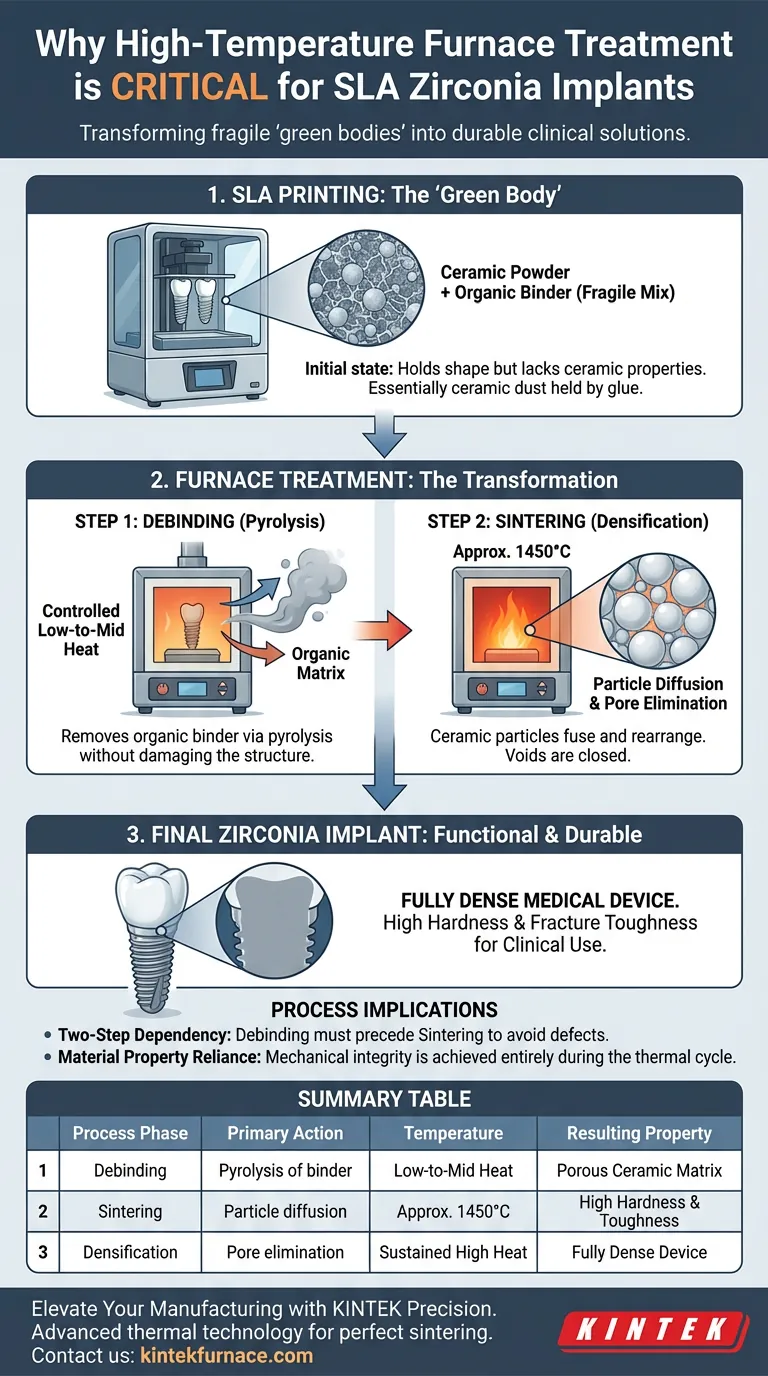
From Green Body to Solid Ceramic
The SLA printing process does not produce a finished ceramic directly. Instead, it creates a precursor shape known as a green body. The furnace treatment is necessary to convert this precursor into a usable medical device through two distinct physical changes.
The Initial State: The Green Body
Zirconia components produced via SLA are initially composite structures. They contain a significant amount of organic binder mixed with ceramic powder.
At this stage, the part holds its shape but lacks the physical properties of ceramic. It is essentially ceramic dust held together by glue.
Step 1: Debinding (Pyrolysis)
The first necessity of the furnace is debinding. This process uses controlled heating to trigger pyrolysis.
The goal is to completely remove the organic matrix without damaging the delicate structure of the implant. The binder must be burned away cleanly to leave only the ceramic material behind.
Step 2: High-Temperature Sintering
Once the binder is removed, the furnace temperature is raised significantly, typically to around 1450°C.
At this temperature, the ceramic particles undergo diffusion and rearrangement. This causes the particles to fuse together at an atomic level.
Eliminating Porosity
The primary goal of sintering is the elimination of pores. As the particles rearrange, the voids left by the binder are closed.
This results in a fully dense dental ceramic. This density is directly responsible for the implant's high hardness and ideal fracture toughness.
Understanding the Process Implications
While SLA offers design freedom, the necessity of furnace treatment introduces specific process constraints that must be managed to ensure quality.
The Two-Step Dependency
You cannot skip or combine these steps haphazardly. The removal of the organic matrix (debinding) must occur before the particles fuse (sintering).
Failing to separate these stages properly would trap organic material inside the hardening ceramic, leading to defects.
Material Property Reliance
The mechanical integrity of the implant is not determined by the printer, but by the thermal cycle.
The high hardness and fracture toughness required for dental applications are achieved entirely during the sintering phase at 1450°C.
Making the Right Choice for Your Goal
The furnace treatment is not merely a finishing step; it is the phase where the component becomes a ceramic. Your approach to this stage dictates the success of the manufacturing process.
- If your primary focus is mechanical reliability: Ensure your thermal profile reaches the full 1450°C sintering temperature to guarantee particle diffusion and the elimination of microscopic pores.
- If your primary focus is process integrity: Prioritize a controlled debinding phase to fully evacuate the organic matrix before high heat is applied.
The furnace transforms a printed shape into a clinical solution, creating the density and toughness required for human use.
Summary Table:
| Process Phase | Primary Action | Temperature Requirement | Resulting Property |
|---|---|---|---|
| Debinding | Pyrolysis of organic binders | Controlled Low-to-Mid Heat | Porous Ceramic Matrix |
| Sintering | Particle diffusion and fusion | Approx. 1450°C | High Hardness & Toughness |
| Densification | Pore elimination | Sustained High Heat | Fully Dense Medical Device |
Elevate Your Ceramic Manufacturing with KINTEK Precision
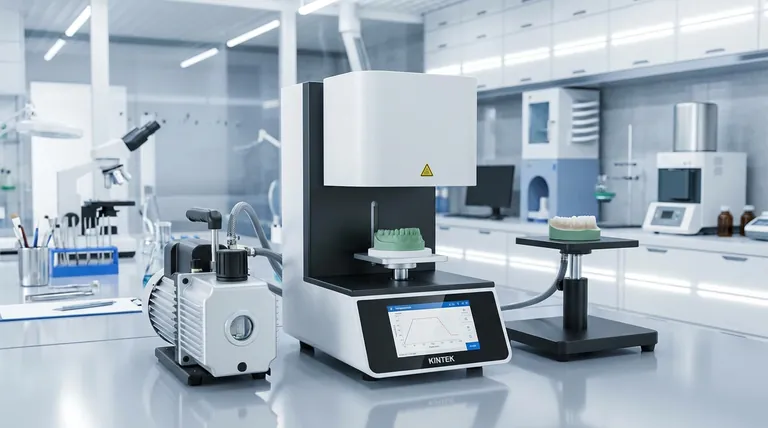
Transform your SLA-printed 'green bodies' into high-performance clinical solutions with KINTEK’s advanced thermal technology. Backed by expert R&D and world-class manufacturing, we provide high-temperature Muffle, Vacuum, and Tube furnaces specifically designed to handle the delicate debinding and high-heat sintering cycles required for zirconia dental implants.
Whether you need a standard setup or a customizable system tailored to your unique research or production needs, KINTEK ensures uniform heating and precise control to guarantee the fracture toughness and density your customers demand.
Ready to optimize your sintering workflow? Contact us today to find your perfect furnace solution!
Visual Guide
References
- The Role of Additive Manufacturing in Dental Implant Production—A Narrative Literature Review. DOI: 10.3390/sci7030109
This article is also based on technical information from Kintek Furnace Knowledge Base .
Related Products
- 1400℃ High Temperature Laboratory Tube Furnace with Alumina Tube
- 1800℃ High Temperature Muffle Oven Furnace for Laboratory
- 1700℃ High Temperature Laboratory Tube Furnace with Alumina Tube
- 1700℃ High Temperature Muffle Oven Furnace for Laboratory
- 1700℃ Controlled Inert Nitrogen Atmosphere Furnace
People Also Ask
- How does zone-melting in tube furnaces synthesize bismuth micro-wires? Master Single-Crystal Thermoelectric Growth
- How are high-temp tube furnaces used to measure diffusion coefficients per Fick's law? Master Precision Annealing
- How are high-temperature laboratory tube furnaces applied in long-term vacuum homogenization heat treatments for intermetallic samples?
- How do high-temperature laboratory tube furnaces ensure environmental stability? Precision Thermal Reduction Tips
- How are high-temperature tube furnaces applied in testing ceramic-supported alloy membranes? Insights



















