
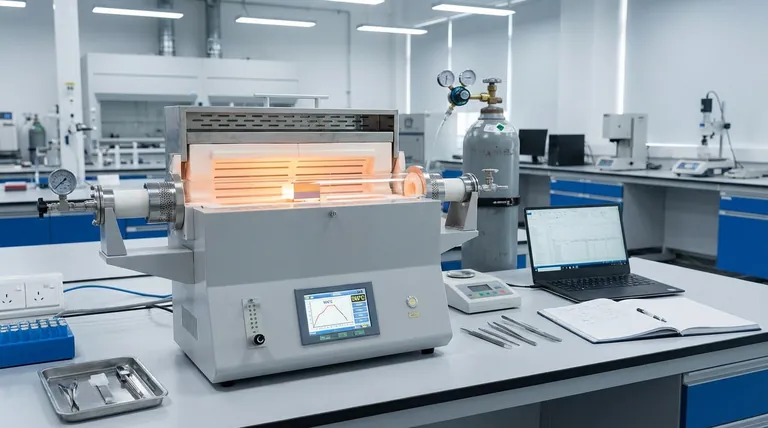
High-temperature annealing is the critical foundation for successful thin film fabrication. Specifically, annealing LaAlO3 (LAO) substrates at 960°C in a tube furnace is performed to thoroughly clean the surface and drastically increase its hydrophilicity. This preparation ensures that the subsequent TiO2 precursor solution wets the surface completely, allowing for strong adhesion and uniform molecular distribution.
Core Takeaway The success of a TiO2 thin film depends heavily on the interface created before deposition begins. Annealing the substrate at 960°C modifies its surface energy to ensure the precursor spreads evenly, acting as a template that forces the TiO2 to grow along the desired (001) crystal plane.
Optimizing the Substrate-Film Interface
Improving Surface Hydrophilicity
The primary mechanical function of this high-temperature treatment is to alter the surface energy of the LAO substrate.
By exposing the substrate to 960°C, you significantly increase its hydrophilicity. This ensures that when the liquid precursor is applied, it spreads out into a uniform layer rather than beading up due to surface tension.
Enhancing Wetting and Adhesion
A hydrophilic surface is a prerequisite for proper adhesion.
Without this thermal conditioning, the precursor solution may settle unevenly, leading to gaps or weak points in the film. The annealing process guarantees better physical contact between the solution and the substrate, laying the groundwork for a robust film-substrate bond.
Controlling Crystal Growth and Architecture
Facilitating Directional Growth
The ultimate goal of using single-crystal substrates like LAO is to dictate the orientation of the film growing on top of it.
The 960°C anneal prepares the substrate lattice to act as an ideal guide. This specific preparation promotes the directional growth of the TiO2 film along the (001) crystal plane, which is often critical for the material's final electronic or optical properties.
Ensuring Molecular Uniformity
Uniformity at the macroscopic level starts with distribution at the molecular level.
Because the surface is clean and highly wettable, the TiO2 molecular chains can distribute themselves evenly across the substrate. This prevents local aggregation or clumping that would otherwise ruin the homogeneity of the final thin film.
Understanding the Trade-offs
The Risk of Thermal Shock
While high heat is necessary, the application of that heat must be precise.
Rapid temperature changes can lead to film cracking or substrate damage. As noted in supplementary processes, multi-stage programmed temperature control—such as slow ramps—is often required to prevent structural failure while releasing dissociation energy.
Precision vs. Throughput
Achieving a pristine surface through high-temperature annealing is time-consuming and energy-intensive.
However, skipping or shortening this step to save time typically results in poor crystallinity and internal defects. The trade-off is a longer process time in exchange for maximized photoelectric conversion efficiency and reduced internal defects in the final device.
Making the Right Choice for Your Goal
- If your primary focus is Film Uniformity: Ensure your furnace reaches 960°C to maximize hydrophilicity, guaranteeing the precursor solution spreads without beading.
- If your primary focus is Crystal Orientation: Prioritize this annealing step to prepare the surface template, specifically to induce growth along the (001) plane.
- If your primary focus is Defect Reduction: Combine substrate annealing with controlled, multi-stage heating during the crystallization phase to minimize internal stress and cracking.
High-quality thin film deposition is impossible without first engineering the surface that supports it.
Summary Table:
| Feature | Impact of 960°C Annealing |
|---|---|
| Surface Energy | Significantly increases hydrophilicity to prevent precursor beading |
| Adhesion | Ensures strong physical contact and uniform molecular distribution |
| Crystal Growth | Acts as a template for directional growth along the (001) plane |
| Film Quality | Maximizes photoelectric efficiency and reduces internal defects |
Precision Heat Treatment for Superior Thin Films
High-quality thin film deposition starts with the perfect substrate surface. KINTEK provides the high-precision thermal solutions required to achieve the critical 960°C environment for LAO annealing. Backed by expert R&D and manufacturing, we offer high-performance Tube, Muffle, Vacuum, and CVD systems—all fully customizable to meet your specific research or production needs.
Ensure perfect (001) crystal orientation and flawless molecular uniformity in your next project. Contact KINTEK today to discuss your custom furnace solution!
References
- Tianyao Zhang, Yuan Lin. Highly Sensitive Wearable Sensor Based on (001)‐Orientated TiO<sub>2</sub> for Real‐Time Electrochemical Detection of Dopamine, Tyrosine, and Paracetamol. DOI: 10.1002/smll.202312238
This article is also based on technical information from Kintek Furnace Knowledge Base .
Related Products
- 1700℃ High Temperature Laboratory Tube Furnace with Alumina Tube
- 1400℃ High Temperature Laboratory Tube Furnace with Alumina Tube
- 1200℃ Split Tube Furnace Laboratory Quartz Tube Furnace with Quartz Tube
- 1700℃ Controlled Inert Nitrogen Atmosphere Furnace
- Vertical Laboratory Quartz Tube Furnace Tubular Furnace
People Also Ask
- How are high-temp tube furnaces used to measure diffusion coefficients per Fick's law? Master Precision Annealing
- How are high-temperature laboratory tube furnaces applied in long-term vacuum homogenization heat treatments for intermetallic samples?
- How do high-temperature laboratory tube furnaces ensure environmental stability? Precision Thermal Reduction Tips
- How are high-temperature tube furnaces applied in testing ceramic-supported alloy membranes? Insights
- In what scenarios are laboratory high-temperature tube furnaces or muffle furnaces utilized? Study MgTiO3-CaTiO3 Ceramics



















